
Articles liés à Demography and Degeneration: Eugenics and the Declining...
Demography and Degeneration: Eugenics and the Declining Birthrate in Twentieth-Century Britain - Couverture rigide
Synopsis
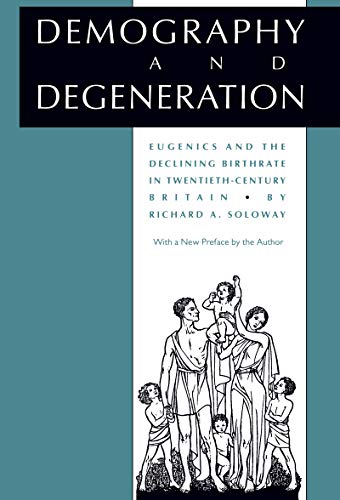
Richard Soloway offers a compelling and authoritative study of the relationship of the eugenics movement to the dramatic decline in the birthrate and family size in twentieth-century Britain. Working in a tradition of hereditarian determinism which held fast to the premise that ""like tends to beget like,"" eugenicists developed and promoted a theory of biosocial engineering through selective reproduction. Soloway shows that the appeal of eugenics to the middle and upper classes of British society was closely linked to recurring concerns about the relentless drop in fertility and the rapid spread of birth control practices from the 1870s to World War II.
Demography and Degeneration considers how differing scientific and pseudoscientific theories of biological inheritance became popularized and enmeshed in the prolonged, often contentious national debate about ""race suicide"" and ""the dwindling family."" Demographic statistics demonstrated that birthrates were declining among the better-educated, most successful classes while they remained high for the poorest, least-educated portion of the population. For many people steeped in the ideas of social Darwinism, eugenicist theories made this decline all the more alarming: they feared that falling birthrates among the ""better"" classes signfied a racial decline and degeneration that might prevent Britain from successfully negotiating the myriad competive challenges facing the nation in the twentieth century.
Although the organized eugenics movement remained small and elitist throughout most of its history, this study demonstrates how pervasive eugenic assumptions were in the middle and upper reaches of British society, at least until World War II. It also traces the important role of eugenics in the emergence of the modern family planning movement and the formulation of population policies in the interwar years.
Les informations fournies dans la section « Synopsis » peuvent faire référence à une autre édition de ce titre.
À propos de l'auteur
Richard A. Soloway is Eugen Merzbacher Professor of History at the University of North Carolina at Chapel Hill. His books include Birth Control and the Population Question in England, 1877-1930.
Les informations fournies dans la section « A propos du livre » peuvent faire référence à une autre édition de ce titre.
Résultats de recherche pour Demography and Degeneration: Eugenics and the Declining...

Image d'archives
Demography and Degeneration : Eugenics and the Declining Birthrate in Twentieth-Century Britain
Edité par
University of North Carolina Press, 1990
ISBN 10 : 0807818658
ISBN 13 : 9780807818657
Ancien ou d'occasion
Couverture rigide
Vendeur : Better World Books Ltd, Dunfermline, Royaume-Uni
Évaluation du vendeur 5 sur 5 étoiles

Etat : Good. Former library copy. Pages intact with minimal writing/highlighting. The binding may be loose and creased. Dust jackets/supplements are not included. Includes library markings. Stock photo provided. Product includes identifying sticker. Better World Books: Buy Books. Do Good. N° de réf. du vendeur GRP36388598
Acheter D'occasion
EUR 5,70
Expédition à EUR 5,93
Expédition depuis Royaume-Uni vers Etats-Unis
Expédition depuis Royaume-Uni vers Etats-Unis
Quantité disponible : 1 disponible(s)
Image fournie par le vendeur
Demography and Degeneration: Eugenics and the Declining Birthrate in Twentieth-Century Britain
Edité par
The University of North Carolina Press, 1990
ISBN 10 : 0807818658
ISBN 13 : 9780807818657
Ancien ou d'occasion
Couverture rigide
Vendeur : WeBuyBooks, Rossendale, LANCS, Royaume-Uni
Évaluation du vendeur 5 sur 5 étoiles
hardcover. Etat : Very Good. Most items will be dispatched the same or the next working day. A copy that has been read, but is in excellent condition. Pages are intact and not marred by notes or highlighting. The spine remains undamaged. N° de réf. du vendeur rev2296607475
Acheter D'occasion
EUR 3,34
Expédition à EUR 10,74
Expédition depuis Royaume-Uni vers Etats-Unis
Expédition depuis Royaume-Uni vers Etats-Unis
Quantité disponible : 1 disponible(s)
Image d'archives
Demography and Degeneration: Eugenics and the Declining Birthrate in Twentieth-Century Britain
Edité par
Univ of North Carolina Pr, 1990
ISBN 10 : 0807818658
ISBN 13 : 9780807818657
Ancien ou d'occasion
Couverture rigide
Vendeur : HPB-Red, Dallas, TX, Etats-Unis
Évaluation du vendeur 5 sur 5 étoiles
hardcover. Etat : Good. Connecting readers with great books since 1972! Used textbooks may not include companion materials such as access codes, etc. May have some wear or writing/highlighting. We ship orders daily and Customer Service is our top priority! N° de réf. du vendeur S_474537555
Acheter D'occasion
EUR 11,29
Expédition à EUR 3,34
Expédition nationale : Etats-Unis
Expédition nationale : Etats-Unis
Quantité disponible : 1 disponible(s)
Image d'archives
Demography and Degeneration : Eugenics and the Declining Birthrate in Twentieth-Century Britain
Edité par
University of North Carolina Press, 1990
ISBN 10 : 0807818658
ISBN 13 : 9780807818657
Ancien ou d'occasion
Couverture rigide
Vendeur : Better World Books, Mishawaka, IN, Etats-Unis
Évaluation du vendeur 5 sur 5 étoiles
Etat : Good. Former library copy. Pages intact with minimal writing/highlighting. The binding may be loose and creased. Dust jackets/supplements are not included. Includes library markings. Stock photo provided. Product includes identifying sticker. Better World Books: Buy Books. Do Good. N° de réf. du vendeur GRP36388598
Acheter D'occasion
EUR 15,38
Livraison gratuite
Expédition nationale : Etats-Unis
Expédition nationale : Etats-Unis
Quantité disponible : 1 disponible(s)
Image fournie par le vendeur
Demography and Degeneration : Eugenics and the Declining Birthrate in Twentieth-Century Britain
Edité par
University of North Carolina Press, 1990
ISBN 10 : 0807818658
ISBN 13 : 9780807818657
Ancien ou d'occasion
Couverture rigide
Edition originale
Vendeur : Southampton Books, Sag Harbor, NY, Etats-Unis
Évaluation du vendeur 5 sur 5 étoiles
Hardcover. Etat : Like New. First Edition. First Edition, First Printing. Published by University of North Carolina Press, 1990. Octavo. Hardcover. Book is like new. Dust jacket is like new.100% positive feedback. 30 day money back guarantee. NEXT DAY SHIPPING! Excellent customer service. Please email with any questions. All books packed carefully and ship with free delivery confirmation/tracking. All books come with free bookmarks. Ships from Sag Harbor, New York. N° de réf. du vendeur 455796
Acheter D'occasion
EUR 22,91
Expédition à EUR 4,44
Expédition nationale : Etats-Unis
Expédition nationale : Etats-Unis
Quantité disponible : 1 disponible(s)
Image d'archives
Demography and Degeneration: Eugenics and the Declining Birthrate in Twentieth-Century Britain
Edité par
Univ of North Carolina Pr, 1990
ISBN 10 : 0807818658
ISBN 13 : 9780807818657
Ancien ou d'occasion
Couverture rigide
Vendeur : Amazing Books Pittsburgh, Pittsburgh, PA, Etats-Unis
Évaluation du vendeur 5 sur 5 étoiles
hardcover. Etat : Very Good. 2nd ed. Clean sturdy and unmarked with mild shelf wear EP. N° de réf. du vendeur Sq42657
Acheter D'occasion
EUR 24,16
Expédition à EUR 3,55
Expédition nationale : Etats-Unis
Expédition nationale : Etats-Unis
Quantité disponible : 1 disponible(s)
Image fournie par le vendeur
Demography and Degeneration: Eugenics and the Declining Birthrate in Twentieth-Century Britain
Edité par
The University of North Carolina Press, 1990
ISBN 10 : 0807818658
ISBN 13 : 9780807818657
Ancien ou d'occasion
Couverture rigide
Edition originale
Vendeur : Court Street Books LLC, Florence, AL, Etats-Unis
Évaluation du vendeur 5 sur 5 étoiles
Hardcover. Etat : Near Fine. Etat de la jaquette : Fine. 1st Edition. Book is like new save for mild foxing of top edge of pageblock. Jacket is like new. N° de réf. du vendeur 019014
Acheter D'occasion
EUR 27,49
Expédition à EUR 4,45
Expédition nationale : Etats-Unis
Expédition nationale : Etats-Unis
Quantité disponible : 1 disponible(s)
Image fournie par le vendeur
Demography and Degeneration: Eugenics and the Declining Birthrate in Twentieth-Century Britain
Edité par
Univ of North Carolina Pr, 1990
ISBN 10 : 0807818658
ISBN 13 : 9780807818657
Ancien ou d'occasion
Couverture rigide
Vendeur : Emily Green Books, North Shields, Royaume-Uni
Évaluation du vendeur 5 sur 5 étoiles
Hardcover. Etat : Fine. Etat de la jaquette : Fine. 2nd Edition. Photos included in listing. About the book Richard Soloway offers a compelling and authoritative study of the relationship of the eugenics movement to the dramatic decline in the birthrate and family size in twentieth-century Britain. Working in a tradition of hereditarian determinism which held fast to the premise that ""like tends to beget like,"" eugenicists developed and promoted a theory of biosocial engineering through selective reproduction. Soloway shows that the appeal of eugenics to the middle and upper classes of British society was closely linked to recurring concerns about the relentless drop in fertility and the rapid spread of birth control practices from the 1870s to World War II. Demography and Degeneration considers how differing scientific and pseudoscientific theories of biological inheritance became popularized and enmeshed in the prolonged, often contentious national debate about ""race suicide"" and ""the dwindling family."" Demographic statistics demonstrated that birthrates were declining among the better-educated, most successful classes while they remained high for the poorest, least-educated portion of the population. For many people steeped in the ideas of social Darwinism, eugenicist theories made this decline all the more alarming: they feared that falling birthrates among the ""better"" classes signfied a racial decline and degeneration that might prevent Britain from successfully negotiating the myriad competive challenges facing the nation in the twentieth century. Although the organized eugenics movement remained small and elitist throughout most of its history, this study demonstrates how pervasive eugenic assumptions were in the middle and upper reaches of British society, at least until World War II. It also traces the important role of eugenics in the emergence of the modern family planning movement and the formulation of population policies in the interwar years. N° de réf. du vendeur 2301
Acheter D'occasion
EUR 9,77
Expédition à EUR 23,72
Expédition depuis Royaume-Uni vers Etats-Unis
Expédition depuis Royaume-Uni vers Etats-Unis
Quantité disponible : 1 disponible(s)
Image d'archives
Demography and Degeneration. Eugenics and the Declining Birthrate in Twentieth-Century Britain. CLOTHBOUND. FIRST EDITION.
Edité par
Chapel Hill & London: University of North Carolina Press, 1995., 1995
ISBN 10 : 0807818658
ISBN 13 : 9780807818657
Ancien ou d'occasion
Couverture rigide
Edition originale
Vendeur : Scientia Books, ABAA ILAB, Arlington, MA, Etats-Unis
Évaluation du vendeur 4 sur 5 étoiles

Hardcover. Etat : Near Fine. Dust Jacket Included. 1st Edition. xix, 443 pp. Original cloth. Near Fine, in dust jacket. First Edition. ISBN 0807818658. N° de réf. du vendeur 17594
Acheter D'occasion
EUR 27,49
Expédition à EUR 7,12
Expédition nationale : Etats-Unis
Expédition nationale : Etats-Unis
Quantité disponible : 1 disponible(s)
Image d'archives
Demography and Degeneration: Eugenics and the Declining Birthrate in Twentieth Century Britain
Edité par
University of North Carolina Press, Chapel Hill, 1990
ISBN 10 : 0807818658
ISBN 13 : 9780807818657
Neuf
Couverture rigide
Edition originale
Vendeur : Dan Pope Books, West Hartford, CT, Etats-Unis
Évaluation du vendeur 5 sur 5 étoiles
Hardcover. Etat : New. Etat de la jaquette : New. 1st Edition. Brand new, still in original shrink-wrap! A study of the relationship of the eugenics movement to the dramatic decline in the birthrate and family size in 20th century Britain, shows how the popular theories of biosocial engineering led to a rapid drop in birthrates from the 1870s to WW II. 443 pages. SALE. N° de réf. du vendeur 4911
Acheter neuf
EUR 32,08
Expédition à EUR 4
Expédition nationale : Etats-Unis
Expédition nationale : Etats-Unis
Quantité disponible : 1 disponible(s)