
Articles liés à Aspects of Orality and Formularity in Gregorian Chant
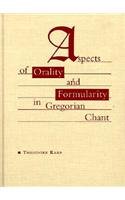
Synopsis
A study of medieval monophonic music. The text focuses on its movement away from the concept of chants as products and towards the idea of chants as processes. The essays are loosely connected through their bearing on one or more of three themes: the role of orality in the transmission of chants circa 700-1400; varying degrees of stability or instability in the transmission of chant; and the role of the formula in the construction of chant.
Les informations fournies dans la section « Synopsis » peuvent faire référence à une autre édition de ce titre.
Résultats de recherche pour Aspects of Orality and Formularity in Gregorian Chant

Image fournie par le vendeur
Aspects of Orality and Formularity in Gregorian Chant
Edité par
Northwestern University Press, Evanston, Illinois, 1998
ISBN 10 : 0810112388
ISBN 13 : 9780810112384
Ancien ou d'occasion
Couverture rigide
Edition originale
Vendeur : Round Table Books, LLC, Gurnee, IL, Etats-Unis
Évaluation du vendeur 5 sur 5 étoiles

Hard Cover. Etat : New No dust jacket as issued. Stated First Edition. First Printing. Publisher's full beige cloth red and reverse-red lettering on spine and cover. NB: "Aspects of Orality and Formularity in Gregorian Chant" is a milestone publication in the study of medieval monophonic music. In its movement away from the concept of chants as products and toward the idea of chants as processes, it will markedly change accepted ways of thinking about this musical form. The essays are loosely connected through their bearing on one or more of three themes: the role of orality in the transmission of chant circa 700-1400; varying degrees of stability or instability in the transmission of chant; and the role of the formula in the construction of chant. Throughout, Karp uses 202 musical examples. The first essay evaluates forms of evidence that may shed light on the nature of orality that led to the surviving notational records of Gregorian chant and assembles evidence that supports the conclusion that fidelity of transmission represented an important goal of the Franks. The second essay treats formulas that cross the boundaries of individual liturgical genres and modes. The third essay defines the varying kinds of musical formulas in chant and proposes a chronological ordering of the genre of second-mode tracts. The fourth essay treats the transmission of a stable melody and explores the ways in which one basic melody may be adapted to texts of widely differing structures and lengths. The fifth essay deals with a group of unstable melodies that furnished difficulties in modal classification. The sixth essay explores the problems faced by scribes seeking to represent in diastematic notation melodies employing tones not normally admitted into the medieval gamut. The seventh essay takes up the role of the formula in introits, a neumatic genre intended forchoral performance. The two final essays look at second-mode tracts and at the interrelationship between Roman and Gregorian chant. Theodore Cyrus Karp (1926 â" 2015) was an American musicologist. His principal area of study was Secular music, mainly mediaeval monophony, especially the music of the trouvà res. He was a major contributor in this area to the Grove Dictionary of Music and Musicians. Prof. Karp received his PhD from New York University in 1960. In 1963 he was taken on as a faculty member by the University of California, Davis and in 1971 became a music professor. He moved to Northwestern University in 1973, where he was dean of the department until 1988 and a professor until his retirement in 1996. Besides trouvà re monophony, Karp wrote articles on the polyphony of the schools of Saint Martial, Santiago de Compostela, and Notre Dame. He proposed new methods for the transcription of polyphony from the manuscripts. In more recent research Prof. Karp studied the application of computers to his field. This is a brand new copy, still in its original shrink-wrap, in perfect pristine condition. NEW. 4to 11" - 13" tall. 484 pages. N° de réf. du vendeur 30710
Acheter D'occasion
EUR 91,96
Expédition à EUR 5,80
Expédition nationale : Etats-Unis
Expédition nationale : Etats-Unis
Quantité disponible : 2 disponible(s)