
Articles liés à Conversations in Sicily
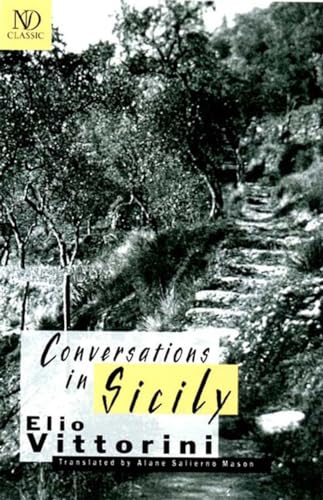
Synopsis
It stands as a modern classic not only for its powerful thematic resonance as one of the great novels of Italian anti-fascism but also as a trailblazer for its style, which blends literary modernism with the pre-modern fable in a prose of lyric beauty. Comparing Vittorini's work to Picasso's, Italo Calvino described Conversations as "the book-Guernica."
The novel begins at a time in the narrator's life when nothing seems to matter; whether he is reading newspaper posters blaring of wartime massacres, lying in bed with his wife or girlfriend, or flipping through the pages of a dictionary it is all the same to him--until he embarks on a journey back to Sicily, the home he has not seen in some fifteen years. In traveling through the Sicilian countryside and in variously hilarious and tragic conversations with its people--his indomitable mother in particular--he reconnects with his roots and rediscovers some basic human values.
In the introduction Hemingway wrote for the American debut of Conversations (published as In Sicily by New Directions in 1949) he remarked: "I care very much about Vittorini's ability to bring rain with him when he comes, if the earth is dry and that is what you need." More recently, American critic Donald Heiney wrote that in this one book, Vittorini "like Rabelais and Cervantes...adds a new artistic dimension to the history of literature."
Les informations fournies dans la section « Synopsis » peuvent faire référence à une autre édition de ce titre.
À propos de l'auteur
ERNEST HEMINGWAY was born in 1899 in Oak Park, Illinois. He worked as a reporter for the Kansas City Star for six months before volunteering in 1918 for the American Red Cross ambulance service in Italy during World War I. Wounded by an Austrian trench mortar, he spent months in the hospital in Milan recovering from his injuries. After a brief return to the United States, he moved to Paris in December 1921 and quickly made a name for himself in expatriate literary circles there. His first major novel, The Sun Also Rises (1926), established him as a mainstream writer and was followed by the bestselling A Farewell to Arms (1929). Married four times and the father of three children, he was a celebrity known for his masculine ethos and interest in blood sports such as hunting, boxing, and bullfighting. He made frequent deep sea fishing excursions aboard his cabin cruiser Pilar from his home in Key West, Florida, where he had settled in 1928. He later made his home in Cuba in the village of San Francisco de Paula, outside Havana. He worked as a war correspondent during the Spanish Civil War and World War II, and his novel For Whom The Bell Tolls (1940) solidified his reputation as one of the most important writers of the twentieth century. His novella The Old Man and the Sea (1952) won the Pulitzer Prize, and in 1954 he was awarded the Nobel Prize in Literature. Unable to remain in post-revolutionary Cuba, Hemingway spent his final years in Ketchum, Idaho. Following unsuccessful treatment at the Mayo Clinic for physical and mental health problems, he died from suicide at his home in Ketchum in 1961.
Les informations fournies dans la section « A propos du livre » peuvent faire référence à une autre édition de ce titre.
Résultats de recherche pour Conversations in Sicily

Image d'archives
Conversations in Sicily
Edité par
New Directions, 2000
ISBN 10 : 0811214559
ISBN 13 : 9780811214551
Ancien ou d'occasion
Paperback
Vendeur : HPB Inc., Dallas, TX, Etats-Unis
Évaluation du vendeur 5 sur 5 étoiles

Paperback. Etat : Very Good. Connecting readers with great books since 1972! Used books may not include companion materials, and may have some shelf wear or limited writing. We ship orders daily and Customer Service is our top priority! N° de réf. du vendeur S_482017386
Acheter D'occasion
EUR 5,37
Expédition à EUR 3,34
Expédition nationale : Etats-Unis
Expédition nationale : Etats-Unis
Quantité disponible : 1 disponible(s)
Image fournie par le vendeur
Conversations in Sicily
Edité par
New Directions, 2000
ISBN 10 : 0811214559
ISBN 13 : 9780811214551
Ancien ou d'occasion
Couverture souple
Vendeur : Cycle Books LA, South el monte, CA, Etats-Unis
Évaluation du vendeur 5 sur 5 étoiles
Etat : very_good. N° de réf. du vendeur AMTV.0811214559.VG
Acheter D'occasion
EUR 6,27
Expédition à EUR 2,67
Expédition nationale : Etats-Unis
Expédition nationale : Etats-Unis
Quantité disponible : 1 disponible(s)
Image d'archives
Conversations in Sicily
Edité par
New Directions Publishing Corporation, 2000
ISBN 10 : 0811214559
ISBN 13 : 9780811214551
Ancien ou d'occasion
Paperback
Vendeur : ThriftBooks-Atlanta, AUSTELL, GA, Etats-Unis
Évaluation du vendeur 5 sur 5 étoiles
Paperback. Etat : Good. No Jacket. Pages can have notes/highlighting. Spine may show signs of wear. ~ ThriftBooks: Read More, Spend Less. N° de réf. du vendeur G0811214559I3N00
Acheter D'occasion
EUR 9,02
Livraison gratuite
Expédition nationale : Etats-Unis
Expédition nationale : Etats-Unis
Quantité disponible : 1 disponible(s)
Image d'archives
Conversations in Sicily
Edité par
New Directions Publishing Corporation, 2000
ISBN 10 : 0811214559
ISBN 13 : 9780811214551
Ancien ou d'occasion
Paperback
Vendeur : ThriftBooks-Dallas, Dallas, TX, Etats-Unis
Évaluation du vendeur 5 sur 5 étoiles
Paperback. Etat : Very Good. No Jacket. Former library book; May have limited writing in cover pages. Pages are unmarked. ~ ThriftBooks: Read More, Spend Less. N° de réf. du vendeur G0811214559I4N10
Acheter D'occasion
EUR 9,02
Livraison gratuite
Expédition nationale : Etats-Unis
Expédition nationale : Etats-Unis
Quantité disponible : 1 disponible(s)
Image d'archives
Conversations in Sicily
Edité par
New Directions, 2000
ISBN 10 : 0811214559
ISBN 13 : 9780811214551
Ancien ou d'occasion
Paperback
Vendeur : HPB-Diamond, Dallas, TX, Etats-Unis
Évaluation du vendeur 5 sur 5 étoiles
Paperback. Etat : Very Good. Connecting readers with great books since 1972! Used books may not include companion materials, and may have some shelf wear or limited writing. We ship orders daily and Customer Service is our top priority! N° de réf. du vendeur S_482160073
Acheter D'occasion
EUR 5,87
Expédition à EUR 3,34
Expédition nationale : Etats-Unis
Expédition nationale : Etats-Unis
Quantité disponible : 1 disponible(s)
Image fournie par le vendeur
Conversations in Sicily
Edité par
New Directions, 2000
ISBN 10 : 0811214559
ISBN 13 : 9780811214551
Ancien ou d'occasion
Couverture souple
Vendeur : GreatBookPrices, Columbia, MD, Etats-Unis
Évaluation du vendeur 5 sur 5 étoiles
Etat : good. May show signs of wear, highlighting, writing, and previous use. This item may be a former library book with typical markings. No guarantee on products that contain supplements Your satisfaction is 100% guaranteed. Twenty-five year bookseller with shipments to over fifty million happy customers. N° de réf. du vendeur 1548626-5
Acheter D'occasion
EUR 8,16
Expédition à EUR 2,35
Expédition nationale : Etats-Unis
Expédition nationale : Etats-Unis
Quantité disponible : 4 disponible(s)
Image d'archives
Conversations in Sicily
Edité par
New Directions Publishing Corporation, 2000
ISBN 10 : 0811214559
ISBN 13 : 9780811214551
Ancien ou d'occasion
Couverture souple
Vendeur : Better World Books, Mishawaka, IN, Etats-Unis
Évaluation du vendeur 5 sur 5 étoiles
Etat : Good. Pages intact with minimal writing/highlighting. The binding may be loose and creased. Dust jackets/supplements are not included. Stock photo provided. Product includes identifying sticker. Better World Books: Buy Books. Do Good. N° de réf. du vendeur 7489292-6
Acheter D'occasion
EUR 10,59
Livraison gratuite
Expédition nationale : Etats-Unis
Expédition nationale : Etats-Unis
Quantité disponible : 1 disponible(s)
Image d'archives
Conversations in Sicily
Edité par
New Directions Publishing Corporation, 2000
ISBN 10 : 0811214559
ISBN 13 : 9780811214551
Ancien ou d'occasion
Couverture souple
Vendeur : Better World Books, Mishawaka, IN, Etats-Unis
Évaluation du vendeur 5 sur 5 étoiles
Etat : Very Good. Pages intact with possible writing/highlighting. Binding strong with minor wear. Dust jackets/supplements may not be included. Stock photo provided. Product includes identifying sticker. Better World Books: Buy Books. Do Good. N° de réf. du vendeur 8810216-6
Acheter D'occasion
EUR 10,59
Livraison gratuite
Expédition nationale : Etats-Unis
Expédition nationale : Etats-Unis
Quantité disponible : 1 disponible(s)
Image d'archives
Conversations in Sicily
Edité par
New Directions Publishing Corporation, 2000
ISBN 10 : 0811214559
ISBN 13 : 9780811214551
Ancien ou d'occasion
Paperback
Vendeur : World of Books (was SecondSale), Montgomery, IL, Etats-Unis
Évaluation du vendeur 5 sur 5 étoiles
Paperback. Etat : Good. Conversations in Sicily holds a special place in the annals of literature. N° de réf. du vendeur 00102108357
Acheter D'occasion
EUR 10,76
Livraison gratuite
Expédition nationale : Etats-Unis
Expédition nationale : Etats-Unis
Quantité disponible : 1 disponible(s)
Image d'archives
Conversations in Sicily
Edité par
New Directions Publishing Corporation, 2000
ISBN 10 : 0811214559
ISBN 13 : 9780811214551
Ancien ou d'occasion
Paperback
Vendeur : World of Books Inc, Montgomery, IL, Etats-Unis
Évaluation du vendeur 4 sur 5 étoiles

Paperback. Etat : Good. Conversations in Sicily holds a special place in the annals of literature. N° de réf. du vendeur CIN0811214559G
Acheter D'occasion
EUR 12,60
Livraison gratuite
Expédition nationale : Etats-Unis
Expédition nationale : Etats-Unis
Quantité disponible : 1 disponible(s)