
Articles liés à Kitchen Culture in America: Popular Representations...
Synopsis
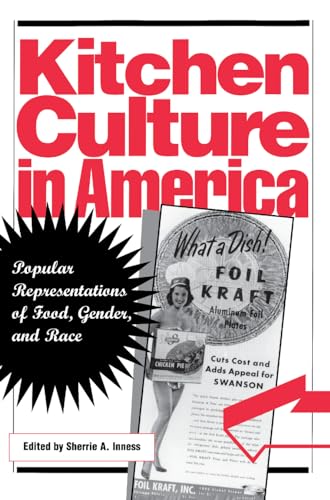
At supermarkets across the nation, customers waiting in line--mostly female--flip through magazines displayed at the checkout stand. What we find on those magazine racks are countless images of food and, in particular, women: moms preparing lunch for the team, college roommates baking together, working women whipping up a meal in under an hour, dieters happy to find a lowfat ice cream that tastes great. In everything from billboards and product packaging to cooking shows, movies, and even sex guides, food has a presence that conveys powerful gender-coded messages that shape our society.
Kitchen Culture in America is a collection of essays that examine how women's roles have been shaped by the principles and practice of consuming and preparing food. Exploring popular representations of food and gender in American society from 1895 to 1970, these essays argue that kitchen culture accomplishes more than just passing down cooking skills and well-loved recipes from generation to generation. Kitchen culture instructs women about how to behave like "correctly" gendered beings. One chapter reveals how juvenile cookbooks, a popular genre for over a century, have taught boys and girls not only the basics of cooking, but also the fine distinctions between their expected roles as grown men and women. Several essays illuminate the ways in which food manufacturers have used gender imagery to define women first and foremost as consumers. Other essays, informed by current debates in the field of material culture, investigate how certain commodities like candy, which in the early twentieth century was advertised primarily as a feminine pleasure, have been culturally constructed. The book also takes a look at the complex relationships among food, gender, class, and race or ethnicity-as represented, for example, in the popular Southern black Mammy figure. In all of the essays, Kitchen Culture in America seeks to show how food serves as a marker of identity in American society.Les informations fournies dans la section « Synopsis » peuvent faire référence à une autre édition de ce titre.
À propos de l'auteur
Sherrie A. Inness is Distinguished Laura C. Harris Chair of Women's Studies at Denison University. She is the author of Tough Girls: Women Warriors and Wonder Women in Popular Culture, also published by the University of Pennsylvania Press; The Lesbian Menace: Ideology, Identity, and the Representation of Lesbian Life; and Intimate Communities: Representation and Social Transformation in Women's College Fiction, 1895-1910.
Les informations fournies dans la section « A propos du livre » peuvent faire référence à une autre édition de ce titre.
Résultats de recherche pour Kitchen Culture in America: Popular Representations...

Image d'archives
Kitchen Culture in America: Popular Representations of Food, Gender, and Race
Edité par
University of Pennsylvania Press, 2000
ISBN 10 : 0812217357
ISBN 13 : 9780812217353
Ancien ou d'occasion
Paperback
Vendeur : World of Books (was SecondSale), Montgomery, IL, Etats-Unis
Évaluation du vendeur 5 sur 5 étoiles

Paperback. Etat : Good. How advertising and product packaging have kept women in the kitchen. N° de réf. du vendeur 00097383858
Acheter D'occasion
EUR 7,35
Livraison gratuite
Expédition nationale : Etats-Unis
Expédition nationale : Etats-Unis
Quantité disponible : 1 disponible(s)
Image d'archives
Kitchen Culture in America : Popular Representations of Food, Gender, and Race
Edité par
University of Pennsylvania Press, 2000
ISBN 10 : 0812217357
ISBN 13 : 9780812217353
Ancien ou d'occasion
Couverture souple
Vendeur : Better World Books, Mishawaka, IN, Etats-Unis
Évaluation du vendeur 5 sur 5 étoiles
Etat : Good. Pages intact with minimal writing/highlighting. The binding may be loose and creased. Dust jackets/supplements are not included. Stock photo provided. Product includes identifying sticker. Better World Books: Buy Books. Do Good. N° de réf. du vendeur 14664064-6
Acheter D'occasion
EUR 7,36
Livraison gratuite
Expédition nationale : Etats-Unis
Expédition nationale : Etats-Unis
Quantité disponible : 1 disponible(s)
Image d'archives
Kitchen Culture in America : Popular Representations of Food, Gender, and Race
Edité par
University of Pennsylvania Press, 2000
ISBN 10 : 0812217357
ISBN 13 : 9780812217353
Ancien ou d'occasion
Couverture souple
Vendeur : Better World Books, Mishawaka, IN, Etats-Unis
Évaluation du vendeur 5 sur 5 étoiles
Etat : Good. Former library copy. Pages intact with minimal writing/highlighting. The binding may be loose and creased. Dust jackets/supplements are not included. Includes library markings. Stock photo provided. Product includes identifying sticker. Better World Books: Buy Books. Do Good. N° de réf. du vendeur 42717648-75
Acheter D'occasion
EUR 7,36
Livraison gratuite
Expédition nationale : Etats-Unis
Expédition nationale : Etats-Unis
Quantité disponible : 1 disponible(s)
Image d'archives
Kitchen Culture in America: Popular Representations of Food, Gender, and Race
Edité par
University of Pennsylvania Press, 2000
ISBN 10 : 0812217357
ISBN 13 : 9780812217353
Ancien ou d'occasion
Paperback
Vendeur : ThriftBooks-Dallas, Dallas, TX, Etats-Unis
Évaluation du vendeur 5 sur 5 étoiles
Paperback. Etat : As New. No Jacket. Pages are clean and are not marred by notes or folds of any kind. ~ ThriftBooks: Read More, Spend Less. N° de réf. du vendeur G0812217357I2N00
Acheter D'occasion
EUR 9,12
Livraison gratuite
Expédition nationale : Etats-Unis
Expédition nationale : Etats-Unis
Quantité disponible : 1 disponible(s)
Image d'archives
Kitchen Culture in America: Popular Representations of Food, Gender, and Race
Edité par
University of Pennsylvania Press, 2000
ISBN 10 : 0812217357
ISBN 13 : 9780812217353
Ancien ou d'occasion
Paperback
Vendeur : World of Books Inc, Montgomery, IL, Etats-Unis
Évaluation du vendeur 4 sur 5 étoiles

Paperback. Etat : Good. How advertising and product packaging have kept women in the kitchen. N° de réf. du vendeur CIN0812217357G
Acheter D'occasion
EUR 9,18
Livraison gratuite
Expédition nationale : Etats-Unis
Expédition nationale : Etats-Unis
Quantité disponible : 1 disponible(s)
Image d'archives
Kitchen Culture in America: Popular Representations of Food, Gender, and Race
Edité par
University of Pennsylvania Press, 2000
ISBN 10 : 0812217357
ISBN 13 : 9780812217353
Ancien ou d'occasion
Paperback
Vendeur : Half Price Books Inc., Dallas, TX, Etats-Unis
Évaluation du vendeur 5 sur 5 étoiles
Paperback. Etat : Very Good. Connecting readers with great books since 1972! Used books may not include companion materials, and may have some shelf wear or limited writing. We ship orders daily and Customer Service is our top priority! N° de réf. du vendeur S_434699149
Acheter D'occasion
EUR 6,64
Expédition à EUR 3,33
Expédition nationale : Etats-Unis
Expédition nationale : Etats-Unis
Quantité disponible : 1 disponible(s)
Image d'archives
Kitchen Culture in America: Popular Representations of Food, Gender, and Race
Edité par
University of Pennsylvania Press, 2000
ISBN 10 : 0812217357
ISBN 13 : 9780812217353
Ancien ou d'occasion
Paperback
Vendeur : HPB-Diamond, Dallas, TX, Etats-Unis
Évaluation du vendeur 5 sur 5 étoiles
Paperback. Etat : Very Good. Connecting readers with great books since 1972! Used books may not include companion materials, and may have some shelf wear or limited writing. We ship orders daily and Customer Service is our top priority! N° de réf. du vendeur S_482863759
Acheter D'occasion
EUR 7,31
Expédition à EUR 3,33
Expédition nationale : Etats-Unis
Expédition nationale : Etats-Unis
Quantité disponible : 1 disponible(s)
Image d'archives
Kitchen Culture in America: Popular Representations of Food, Gender, and Race
Edité par
University of Pennsylvania Press, 2000
ISBN 10 : 0812217357
ISBN 13 : 9780812217353
Ancien ou d'occasion
paperback
Vendeur : Magers and Quinn Booksellers, Minneapolis, MN, Etats-Unis
Évaluation du vendeur 5 sur 5 étoiles
paperback. Etat : Very Good. May have light to moderate shelf wear and/or a remainder mark. Complete. Clean pages. N° de réf. du vendeur 1132395
Acheter D'occasion
EUR 8,23
Expédition à EUR 3,55
Expédition nationale : Etats-Unis
Expédition nationale : Etats-Unis
Quantité disponible : 1 disponible(s)
Image d'archives
Kitchen Culture in America: Popular Representations of Food, Gender, and Race
Edité par
University of Pennsylvania Press, 2000
ISBN 10 : 0812217357
ISBN 13 : 9780812217353
Ancien ou d'occasion
Soft cover
Vendeur : The Extreme History Project, Bozeman, MT, Etats-Unis
Évaluation du vendeur 4 sur 5 étoiles
Soft cover. Etat : Very Good. Item in VERY GOOD condition. Soft Cover. No notations or highlighting. Signs of shelf wear. N° de réf. du vendeur ABE-1754172335122
Acheter D'occasion
EUR 18,31
Expédition à EUR 4,44
Expédition nationale : Etats-Unis
Expédition nationale : Etats-Unis
Quantité disponible : 1 disponible(s)
Image fournie par le vendeur
Kitchen Culture in America: Popular Representations of Food, Gender, and Race
Edité par
University of Pennsylvania Press, Philadelphia, 2001
ISBN 10 : 0812217357
ISBN 13 : 9780812217353
Ancien ou d'occasion
Couverture souple
Vendeur : Browsing Is Arousing, Middlebury, VT, Etats-Unis
Évaluation du vendeur 4 sur 5 étoiles
Etat : Very Good. Softcover, 286 pages. Kitchen Culture in America is a collection of essays that examine how women's roles have been shaped by the principles and practice of consuming and preparing food. Exploring popular representations of food and gender in American society from 1895 to 1970, these essays argue that kitchen culture accomplishes more than just passing down cooking skills and well-loved recipes from generation to generation. Kitchen culture instructs women about how to behave like "correctly" gendered beings. One chapter reveals how juvenile cookbooks, a popular genre for over a century, have taught boys and girls not only the basics of cooking, but also the fine distinctions between their expected roles as grown men and women. Several essays illuminate the ways in which food manufacturers have used gender imagery to define women first and foremost as consumers. Other essays, informed by current debates in the field of material culture, investigate how certain commodities like candy, which in the early twentieth century was advertised primarily as a feminine pleasure, have been culturally constructed. The book also takes a look at the complex relationships among food, gender, class, and race or ethnicity-as represented, for example, in the popular Southern black Mammy figure. In all of the essays, Kitchen Culture in America seeks to show how food serves as a marker of identity in American society. Clean, bright copy. Record # 471963. N° de réf. du vendeur 471963
Acheter D'occasion
EUR 18,31
Expédition à EUR 6,22
Expédition nationale : Etats-Unis
Expédition nationale : Etats-Unis
Quantité disponible : 1 disponible(s)