
Articles liés à Cutting Along the Color Line: Black Barbers and Barber...
Synopsis
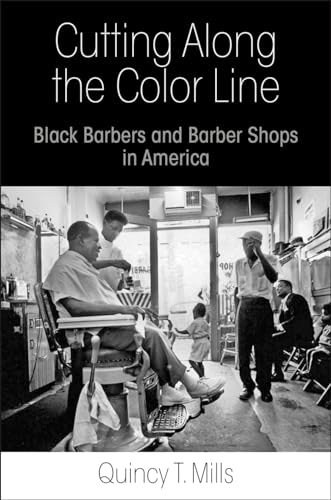
Today, black-owned barber shops play a central role in African American public life. The intimacy of commercial grooming encourages both confidentiality and camaraderie, which make the barber shop an important gathering place for African American men to talk freely. But for many years preceding and even after the Civil War, black barbers endured a measure of social stigma for perpetuating inequality: though the profession offered economic mobility to black entrepreneurs, black barbers were obliged by custom to serve an exclusively white clientele. Quincy T. Mills traces the lineage from these nineteenth-century barbers to the bustling enterprises of today, demonstrating that the livelihood offered by the service economy was crucial to the development of a black commercial sphere and the barber shop as a democratic social space.
Cutting Along the Color Line chronicles the cultural history of black barber shops as businesses and civic institutions. Through several generations of barbers, Mills examines the transition from slavery to freedom in the nineteenth century, the early twentieth-century expansion of black consumerism, and the challenges of professionalization, licensing laws, and competition from white barbers. He finds that the profession played a significant though complicated role in twentieth-century racial politics: while the services of shaving and grooming were instrumental in the creation of socially acceptable black masculinity, barbering permitted the financial independence to maintain public spaces that fostered civil rights politics. This sweeping, engaging history of an iconic cultural establishment shows that black entrepreneurship was intimately linked to the struggle for equality.
Les informations fournies dans la section « Synopsis » peuvent faire référence à une autre édition de ce titre.
À propos de l'auteur
Quincy T. Mills is Associate Professor of History at Vassar College.
Les informations fournies dans la section « A propos du livre » peuvent faire référence à une autre édition de ce titre.
Résultats de recherche pour Cutting Along the Color Line: Black Barbers and Barber...

Image d'archives
Cutting Along the Color Line: Black Barbers and Barber Shops in America
Edité par
University of Pennsylvania Press, 2016
ISBN 10 : 0812223799
ISBN 13 : 9780812223798
Ancien ou d'occasion
Paperback
Vendeur : Midtown Scholar Bookstore, Harrisburg, PA, Etats-Unis
Évaluation du vendeur 5 sur 5 étoiles

Paperback. Etat : Good. Good - Bumped and creased book with tears to the extremities, but not affecting the text block, may have remainder mark or previous owner's name - GOOD Standard-sized. N° de réf. du vendeur M0812223799Z3
Acheter D'occasion
EUR 5,18
Expédition à EUR 5,35
Expédition nationale : Etats-Unis
Expédition nationale : Etats-Unis
Quantité disponible : 2 disponible(s)
Image d'archives
Cutting Along the Color Line: Black Barbers and Barber Shops in America
Edité par
University of Pennsylvania Press, 2016
ISBN 10 : 0812223799
ISBN 13 : 9780812223798
Ancien ou d'occasion
paperback
Vendeur : Textbooks_Source, Columbia, MO, Etats-Unis
Évaluation du vendeur 5 sur 5 étoiles
paperback. Etat : Good. Reprint. Ships in a BOX from Central Missouri! May not include working access code. Will not include dust jacket. Has used sticker(s) and some writing or highlighting. UPS shipping for most packages, (Priority Mail for AK/HI/APO/PO Boxes). N° de réf. du vendeur 002352384U
Acheter D'occasion
EUR 12,16
Expédition à EUR 3,56
Expédition nationale : Etats-Unis
Expédition nationale : Etats-Unis
Quantité disponible : 6 disponible(s)
Image fournie par le vendeur
Cutting Along the Color Line : Black Barbers and Barber Shops in America
Edité par
University of Pennsylvania Press, 2016
ISBN 10 : 0812223799
ISBN 13 : 9780812223798
Ancien ou d'occasion
Couverture souple
Vendeur : GreatBookPrices, Columbia, MD, Etats-Unis
Évaluation du vendeur 5 sur 5 étoiles
Etat : good. May show signs of wear, highlighting, writing, and previous use. This item may be a former library book with typical markings. No guarantee on products that contain supplements Your satisfaction is 100% guaranteed. Twenty-five year bookseller with shipments to over fifty million happy customers. N° de réf. du vendeur 26523437-5
Acheter D'occasion
EUR 13,39
Expédition à EUR 2,35
Expédition nationale : Etats-Unis
Expédition nationale : Etats-Unis
Quantité disponible : 5 disponible(s)
Image fournie par le vendeur
Cutting Along the Color Line : Black Barbers and Barber Shops in America
Edité par
University of Pennsylvania Press, 2016
ISBN 10 : 0812223799
ISBN 13 : 9780812223798
Ancien ou d'occasion
Couverture souple
Vendeur : GreatBookPrices, Columbia, MD, Etats-Unis
Évaluation du vendeur 5 sur 5 étoiles
Etat : As New. Unread book in perfect condition. N° de réf. du vendeur 26523437
Acheter D'occasion
EUR 30,61
Expédition à EUR 2,35
Expédition nationale : Etats-Unis
Expédition nationale : Etats-Unis
Quantité disponible : 10 disponible(s)
Image fournie par le vendeur
Cutting Along the Color Line : Black Barbers and Barber Shops in America
Edité par
University of Pennsylvania Press, 2016
ISBN 10 : 0812223799
ISBN 13 : 9780812223798
Neuf
Couverture souple
Vendeur : GreatBookPrices, Columbia, MD, Etats-Unis
Évaluation du vendeur 5 sur 5 étoiles
Etat : New. N° de réf. du vendeur 26523437-n
Acheter neuf
EUR 31,56
Expédition à EUR 2,35
Expédition nationale : Etats-Unis
Expédition nationale : Etats-Unis
Quantité disponible : 10 disponible(s)
Image fournie par le vendeur
Cutting Along the Color Line: Black Barbers and Barber Shops in America (Paperback or Softback)
Edité par
University of Pennsylvania Press 12/28/2016, 2016
ISBN 10 : 0812223799
ISBN 13 : 9780812223798
Neuf
Paperback or Softback
Vendeur : BargainBookStores, Grand Rapids, MI, Etats-Unis
Évaluation du vendeur 5 sur 5 étoiles
Paperback or Softback. Etat : New. Cutting Along the Color Line: Black Barbers and Barber Shops in America. Book. N° de réf. du vendeur BBS-9780812223798
Acheter neuf
EUR 33,99
Livraison gratuite
Expédition nationale : Etats-Unis
Expédition nationale : Etats-Unis
Quantité disponible : 5 disponible(s)
Image fournie par le vendeur
Cutting Along the Color Line
Edité par
University of Pennsylvania Press, US, 2016
ISBN 10 : 0812223799
ISBN 13 : 9780812223798
Neuf
Paperback
Vendeur : Rarewaves.com USA, London, LONDO, Royaume-Uni
Évaluation du vendeur 5 sur 5 étoiles
Paperback. Etat : New. Today, black-owned barber shops play a central role in African American public life. The intimacy of commercial grooming encourages both confidentiality and camaraderie, which make the barber shop an important gathering place for African American men to talk freely. But for many years preceding and even after the Civil War, black barbers endured a measure of social stigma for perpetuating inequality: though the profession offered economic mobility to black entrepreneurs, black barbers were obliged by custom to serve an exclusively white clientele. Quincy T. Mills traces the lineage from these nineteenth-century barbers to the bustling enterprises of today, demonstrating that the livelihood offered by the service economy was crucial to the development of a black commercial sphere and the barber shop as a democratic social space. Cutting Along the Color Line chronicles the cultural history of black barber shops as businesses and civic institutions. Through several generations of barbers, Mills examines the transition from slavery to freedom in the nineteenth century, the early twentieth-century expansion of black consumerism, and the challenges of professionalization, licensing laws, and competition from white barbers. He finds that the profession played a significant though complicated role in twentieth-century racial politics: while the services of shaving and grooming were instrumental in the creation of socially acceptable black masculinity, barbering permitted the financial independence to maintain public spaces that fostered civil rights politics. This sweeping, engaging history of an iconic cultural establishment shows that black entrepreneurship was intimately linked to the struggle for equality. N° de réf. du vendeur LU-9780812223798
Acheter neuf
EUR 34,26
Livraison gratuite
Expédition depuis Royaume-Uni vers Etats-Unis
Expédition depuis Royaume-Uni vers Etats-Unis
Quantité disponible : 5 disponible(s)
Image d'archives
Cutting Along the Color Line
Edité par
University of Pennsylvania Press, 2016
ISBN 10 : 0812223799
ISBN 13 : 9780812223798
Neuf
PAP
Vendeur : PBShop.store UK, Fairford, GLOS, Royaume-Uni
Évaluation du vendeur 5 sur 5 étoiles
PAP. Etat : New. New Book. Shipped from UK. Established seller since 2000. N° de réf. du vendeur FW-9780812223798
Acheter neuf
EUR 29,79
Expédition à EUR 6
Expédition depuis Royaume-Uni vers Etats-Unis
Expédition depuis Royaume-Uni vers Etats-Unis
Quantité disponible : 9 disponible(s)
Image fournie par le vendeur
Cutting Along the Color Line
Edité par
University of Pennsylvania Press, US, 2016
ISBN 10 : 0812223799
ISBN 13 : 9780812223798
Neuf
Paperback
Vendeur : Rarewaves USA, HEBRON, KY, Etats-Unis
Évaluation du vendeur 5 sur 5 étoiles
Paperback. Etat : New. Today, black-owned barber shops play a central role in African American public life. The intimacy of commercial grooming encourages both confidentiality and camaraderie, which make the barber shop an important gathering place for African American men to talk freely. But for many years preceding and even after the Civil War, black barbers endured a measure of social stigma for perpetuating inequality: though the profession offered economic mobility to black entrepreneurs, black barbers were obliged by custom to serve an exclusively white clientele. Quincy T. Mills traces the lineage from these nineteenth-century barbers to the bustling enterprises of today, demonstrating that the livelihood offered by the service economy was crucial to the development of a black commercial sphere and the barber shop as a democratic social space. Cutting Along the Color Line chronicles the cultural history of black barber shops as businesses and civic institutions. Through several generations of barbers, Mills examines the transition from slavery to freedom in the nineteenth century, the early twentieth-century expansion of black consumerism, and the challenges of professionalization, licensing laws, and competition from white barbers. He finds that the profession played a significant though complicated role in twentieth-century racial politics: while the services of shaving and grooming were instrumental in the creation of socially acceptable black masculinity, barbering permitted the financial independence to maintain public spaces that fostered civil rights politics. This sweeping, engaging history of an iconic cultural establishment shows that black entrepreneurship was intimately linked to the struggle for equality. N° de réf. du vendeur LU-9780812223798
Acheter neuf
EUR 35,99
Livraison gratuite
Expédition nationale : Etats-Unis
Expédition nationale : Etats-Unis
Quantité disponible : Plus de 20 disponibles
Image d'archives
Cutting Along the Color Line - Black Barbers and Barber Shops in America (eng)
Edité par
University of Pennsylvania Press, 2016
ISBN 10 : 0812223799
ISBN 13 : 9780812223798
Neuf
Couverture souple
Vendeur : Brook Bookstore On Demand, Napoli, NA, Italie
Évaluation du vendeur 5 sur 5 étoiles
Etat : new. N° de réf. du vendeur 3f614aabf9b33aab51495d854f206af7
Acheter neuf
EUR 31,59
Expédition à EUR 5,50
Expédition depuis Italie vers Etats-Unis
Expédition depuis Italie vers Etats-Unis
Quantité disponible : 9 disponible(s)