
Articles liés à Getting Out: Historical Perspectives on Leaving Iraq
Synopsis
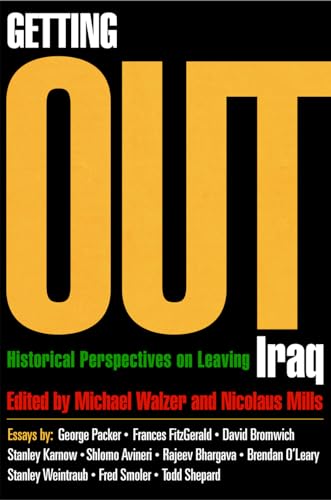
Eventually every conqueror, every imperial power, every occupying army gets out. Why do they decide to leave? And how do political and military leaders manage withdrawal? Do they take with them those who might be at risk if left behind? What are the immediate consequences of departure? For Michael Walzer and Nicolaus Mills, now is the time to ask those questions about exiting--and to worry specifically about the difficulties certain to arise as we leave--Iraq.
Getting Out approaches these issues in two sections. The first, entitled "Lessons Learned," examines seven historical cases of how and how not to withdraw: Britain's departure from the American colonies and from India, the French withdrawal from Algeria, Israel's unilateral withdrawal from Gaza, and the U.S. decision to leave (or not leave) the Philippines, Korea, and Vietnam. These cases offer a comparative perspective and an opportunity to learn from the history of political and military retreats.
The second section, "Exiting Iraq," begins with an introduction to just how the United States got into Iraq and continues with an examination of how the U.S. might leave from a diversity of voices, ranging from those who believe that the Iraq war has produced no real good to those who hope for a decent ending. In addition to essays by volume editors Walzer and Mills, Getting Out features contributions by Shlomo Avineri, Rajeev Bhargava, David Bromwich, Frances FitzGerald, Stanley Karnow, Brendan O'Leary, George Packer, Todd Shepard, Fred Smoler, and Stanley Weintraub.
Les informations fournies dans la section « Synopsis » peuvent faire référence à une autre édition de ce titre.
À propos de l'auteur
Michael Walzer is Professor Emeritus in the School of Social Science at the Institute for Advanced Study in Princeton and editor of Dissent. He is the author of many books, including Just and Unjust Wars and, most recently, Thinking Politically: Essays in Political Theory. Nicolaus Mills is Professor of Literature and American Studies at Sarah Lawrence College. A long-time contributor to Dissent magazine, his most recent book is Winning the Peace: The Marshall Plan and America's Coming of Age as a Superpower.
Les informations fournies dans la section « A propos du livre » peuvent faire référence à une autre édition de ce titre.
Résultats de recherche pour Getting Out: Historical Perspectives on Leaving Iraq

Image d'archives
Getting Out: Historical Perspectives on Leaving Iraq
Edité par
University of Pennsylvania Press, 2009
ISBN 10 : 0812242165
ISBN 13 : 9780812242164
Neuf
Couverture rigide
Vendeur : Gulf Coast Books, Cypress, TX, Etats-Unis
Évaluation du vendeur 5 sur 5 étoiles

hardcover. Etat : New. N° de réf. du vendeur 0812242165-11-27762922
Acheter neuf
EUR 8,09
Livraison gratuite
Expédition nationale : Etats-Unis
Expédition nationale : Etats-Unis
Quantité disponible : 1 disponible(s)
Image d'archives
Getting Out: Historical Perspectives on Leaving Iraq
Edité par
University of Pennsylvania Press (edition ), 2009
ISBN 10 : 0812242165
ISBN 13 : 9780812242164
Ancien ou d'occasion
Couverture rigide
Vendeur : BooksRun, Philadelphia, PA, Etats-Unis
Évaluation du vendeur 5 sur 5 étoiles
Hardcover. Etat : Fair. With dust jacket. The item might be beaten up but readable. May contain markings or highlighting, as well as stains, bent corners, or any other major defect, but the text is not obscured in any way. N° de réf. du vendeur 0812242165-7-1-29
Acheter D'occasion
EUR 8,41
Livraison gratuite
Expédition nationale : Etats-Unis
Expédition nationale : Etats-Unis
Quantité disponible : 1 disponible(s)
Image d'archives
Getting Out: Historical Perspectives on Leaving Iraq
Edité par
University of Pennsylvania Press, 2009
ISBN 10 : 0812242165
ISBN 13 : 9780812242164
Ancien ou d'occasion
Couverture rigide
Vendeur : Midtown Scholar Bookstore, Harrisburg, PA, Etats-Unis
Évaluation du vendeur 5 sur 5 étoiles
Hardcover. Etat : Good. Good - Bumped and creased book with tears to the extremities, but not affecting the text block, may have remainder mark or previous owner's name - GOOD Standard-sized. N° de réf. du vendeur M0812242165Z3
Acheter D'occasion
EUR 6,10
Expédition à EUR 5,27
Expédition nationale : Etats-Unis
Expédition nationale : Etats-Unis
Quantité disponible : 8 disponible(s)
Image d'archives
Getting Out
Edité par
University of Pennsylvania Press, 2009
ISBN 10 : 0812242165
ISBN 13 : 9780812242164
Neuf
Couverture rigide
Vendeur : Majestic Books, Hounslow, Royaume-Uni
Évaluation du vendeur 4 sur 5 étoiles

Etat : New. Print on Demand pp. 168. N° de réf. du vendeur 7938749
Acheter neuf
EUR 34,36
Expédition à EUR 7,56
Expédition depuis Royaume-Uni vers Etats-Unis
Expédition depuis Royaume-Uni vers Etats-Unis
Quantité disponible : Plus de 20 disponibles
Image fournie par le vendeur
Getting Out : Historical Perspectives on Leaving Iraq
Edité par
University of Pennsylvania Press, 2009
ISBN 10 : 0812242165
ISBN 13 : 9780812242164
Neuf
Couverture rigide
Vendeur : GreatBookPrices, Columbia, MD, Etats-Unis
Évaluation du vendeur 5 sur 5 étoiles
Etat : New. N° de réf. du vendeur 6308016-n
Acheter neuf
EUR 39,76
Expédition à EUR 2,32
Expédition nationale : Etats-Unis
Expédition nationale : Etats-Unis
Quantité disponible : 1 disponible(s)
Image d'archives
Getting Out
Edité par
University of Pennsylvania Press, 2009
ISBN 10 : 0812242165
ISBN 13 : 9780812242164
Neuf
Couverture rigide
Vendeur : Books Puddle, Woodside, NY, Etats-Unis
Évaluation du vendeur 4 sur 5 étoiles
Etat : New. Print on Demand pp. 168. N° de réf. du vendeur 26957794
Acheter neuf
EUR 40,78
Expédition à EUR 3,51
Expédition nationale : Etats-Unis
Expédition nationale : Etats-Unis
Quantité disponible : Plus de 20 disponibles
Image d'archives
Getting Out
Edité par
University of Pennsylvania Press, 2009
ISBN 10 : 0812242165
ISBN 13 : 9780812242164
Neuf
Couverture rigide
Vendeur : Biblios, Frankfurt am main, HESSE, Allemagne
Évaluation du vendeur 4 sur 5 étoiles
Etat : New. PRINT ON DEMAND pp. 168. N° de réf. du vendeur 18957800
Acheter neuf
EUR 34,73
Expédition à EUR 9,95
Expédition depuis Allemagne vers Etats-Unis
Expédition depuis Allemagne vers Etats-Unis
Quantité disponible : Plus de 20 disponibles
Image fournie par le vendeur
Getting Out
Edité par
University of Pennsylvania Press, US, 2009
ISBN 10 : 0812242165
ISBN 13 : 9780812242164
Neuf
Couverture rigide
Vendeur : Rarewaves USA, HEBRON, KY, Etats-Unis
Évaluation du vendeur 5 sur 5 étoiles
Hardback. Etat : New. Eventually every conqueror, every imperial power, every occupying army gets out. Why do they decide to leave? And how do political and military leaders manage withdrawal? Do they take with them those who might be at risk if left behind? What are the immediate consequences of departure? For Michael Walzer and Nicolaus Mills, now is the time to ask those questions about exiting-and to worry specifically about the difficulties certain to arise as we leave-Iraq. Getting Out approaches these issues in two sections. The first, entitled "Lessons Learned," examines seven historical cases of how and how not to withdraw: Britain's departure from the American colonies and from India, the French withdrawal from Algeria, Israel's unilateral withdrawal from Gaza, and the U.S. decision to leave (or not leave) the Philippines, Korea, and Vietnam. These cases offer a comparative perspective and an opportunity to learn from the history of political and military retreats. The second section, "Exiting Iraq," begins with an introduction to just how the United States got into Iraq and continues with an examination of how the U.S. might leave from a diversity of voices, ranging from those who believe that the Iraq war has produced no real good to those who hope for a decent ending. In addition to essays by volume editors Walzer and Mills, Getting Out features contributions by Shlomo Avineri, Rajeev Bhargava, David Bromwich, Frances FitzGerald, Stanley Karnow, Brendan O'Leary, George Packer, Todd Shepard, Fred Smoler, and Stanley Weintraub. N° de réf. du vendeur LU-9780812242164
Acheter neuf
EUR 45,70
Livraison gratuite
Expédition nationale : Etats-Unis
Expédition nationale : Etats-Unis
Quantité disponible : Plus de 20 disponibles
Image d'archives
Getting Out
Edité par
University of Pennsylvania Press, 2009
ISBN 10 : 0812242165
ISBN 13 : 9780812242164
Neuf
Couverture rigide
Vendeur : PBShop.store UK, Fairford, GLOS, Royaume-Uni
Évaluation du vendeur 5 sur 5 étoiles
HRD. Etat : New. New Book. Shipped from UK. Established seller since 2000. N° de réf. du vendeur FW-9780812242164
Acheter neuf
EUR 42,34
Expédition à EUR 4,84
Expédition depuis Royaume-Uni vers Etats-Unis
Expédition depuis Royaume-Uni vers Etats-Unis
Quantité disponible : 1 disponible(s)
Image fournie par le vendeur
Getting Out : Historical Perspectives on Leaving Iraq
Edité par
University of Pennsylvania Press, 2009
ISBN 10 : 0812242165
ISBN 13 : 9780812242164
Ancien ou d'occasion
Couverture rigide
Vendeur : GreatBookPrices, Columbia, MD, Etats-Unis
Évaluation du vendeur 5 sur 5 étoiles
Etat : As New. Unread book in perfect condition. N° de réf. du vendeur 6308016
Acheter D'occasion
EUR 46,24
Expédition à EUR 2,32
Expédition nationale : Etats-Unis
Expédition nationale : Etats-Unis
Quantité disponible : 1 disponible(s)