
Articles liés à Displacing Democracy: Economic Segregation in America
Displacing Democracy: Economic Segregation in America - Couverture rigide
Livre 8 sur 21: American Governance: Politics, Policy, and Public Law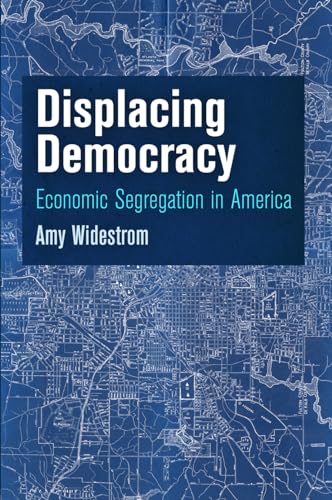
Synopsis
In recent decades, economically disadvantaged Americans have become more residentially segregated from other communities: they are increasingly likely to live in high-poverty neighborhoods that are spatially isolated with few civic resources. Low-income citizens are also less likely to be politically engaged, a trend that is most glaring in terms of voter turnout. Examining neighborhoods in Atlanta, Kansas City, Milwaukee, and Rochester, Amy Widestrom challenges the assumption that the "class gap" in political participation is largely the result of individual choices and dispositions. Displacing Democracy demonstrates that neighborhoods segregated along economic lines create conditions that encourage high levels of political activity, including political and civic mobilization and voting, among wealthier citizens while discouraging and impeding the poor from similar forms of civic engagement.
Drawing on quantitative research, case studies, and interviews, Widestrom shows that neighborhood-level resources and characteristics affect political engagement in distinct ways that are not sufficiently appreciated in the current understanding of American politics and political behavior. In addition to the roles played by individual traits and assets, increasing economic segregation in the United States denies low-income citizens the civic and social resources vital for political mobilization and participation. People living in poverty lack the time, money, and skills for active civic engagement, and this is compounded by the fact that residential segregation creates a barren civic environment incapable of supporting a vibrant civic community. Over time, this creates a balance of political power that is dramatically skewed not only toward individuals with greater incomes but toward entire neighborhoods with more economic resources.
Les informations fournies dans la section « Synopsis » peuvent faire référence à une autre édition de ce titre.
À propos de l'auteur
Amy Widestrom teaches political science at Arcadia University. She was chosen in 2016 for a Clarence Stone Scholar Award by the Urban and Local Politics Section of the American Political Science Association.
Les informations fournies dans la section « A propos du livre » peuvent faire référence à une autre édition de ce titre.
Résultats de recherche pour Displacing Democracy: Economic Segregation in America

Image d'archives
Displacing Democracy: Economic Segregation in America (American Governance: Politics, Policy, and Public Law)
Edité par
University of Pennsylvania Press, 2015
ISBN 10 : 0812246594
ISBN 13 : 9780812246599
Ancien ou d'occasion
Couverture rigide
Vendeur : Midtown Scholar Bookstore, Harrisburg, PA, Etats-Unis
Évaluation du vendeur 5 sur 5 étoiles

Hardcover. Etat : Very Good. With very good dust jacket. Very Good hardcover with light shelfwear - NICE! Standard-sized. N° de réf. du vendeur mon0000235610
Acheter D'occasion
EUR 12,59
Expédition à EUR 5,17
Expédition nationale : Etats-Unis
Expédition nationale : Etats-Unis
Quantité disponible : 1 disponible(s)
Image d'archives
Displacing Democracy
Edité par
MT - University of Pennsylvania Press, 2015
ISBN 10 : 0812246594
ISBN 13 : 9780812246599
Neuf
Couverture rigide
Vendeur : PBShop.store UK, Fairford, GLOS, Royaume-Uni
Évaluation du vendeur 5 sur 5 étoiles
HRD. Etat : New. New Book. Shipped from UK. Established seller since 2000. N° de réf. du vendeur FW-9780812246599
Acheter neuf
EUR 87,25
Expédition à EUR 5,85
Expédition depuis Royaume-Uni vers Etats-Unis
Expédition depuis Royaume-Uni vers Etats-Unis
Quantité disponible : 1 disponible(s)
Image fournie par le vendeur
Displacing Democracy : Economic Segregation in America
Edité par
University of Pennsylvania Press, 2015
ISBN 10 : 0812246594
ISBN 13 : 9780812246599
Ancien ou d'occasion
Couverture rigide
Vendeur : GreatBookPrices, Columbia, MD, Etats-Unis
Évaluation du vendeur 5 sur 5 étoiles
Etat : As New. Unread book in perfect condition. N° de réf. du vendeur 21599569
Acheter D'occasion
EUR 91,09
Expédition à EUR 2,28
Expédition nationale : Etats-Unis
Expédition nationale : Etats-Unis
Quantité disponible : 1 disponible(s)
Image fournie par le vendeur
Displacing Democracy : Economic Segregation in America
Edité par
University of Pennsylvania Press, 2015
ISBN 10 : 0812246594
ISBN 13 : 9780812246599
Neuf
Couverture rigide
Vendeur : GreatBookPrices, Columbia, MD, Etats-Unis
Évaluation du vendeur 5 sur 5 étoiles
Etat : New. N° de réf. du vendeur 21599569-n
Acheter neuf
EUR 93,54
Expédition à EUR 2,28
Expédition nationale : Etats-Unis
Expédition nationale : Etats-Unis
Quantité disponible : 1 disponible(s)
Image d'archives
Displacing Democracy: Economic Segregation in America (American Governance: Politics, Policy, and Public Law)
Edité par
University of Pennsylvania Press, 2015
ISBN 10 : 0812246594
ISBN 13 : 9780812246599
Ancien ou d'occasion
Couverture rigide
Edition originale
Vendeur : The Good Books Store, Chicago, IL, Etats-Unis
Évaluation du vendeur 2 sur 5 étoiles

Hardcover. Etat : Fine. Etat de la jaquette : Fine. 1st Edition. 1st printing, fine, like new. N° de réf. du vendeur 2138206853
Acheter D'occasion
EUR 93,24
Expédition à EUR 4,31
Expédition nationale : Etats-Unis
Expédition nationale : Etats-Unis
Quantité disponible : 1 disponible(s)
Image d'archives
Displacing Democracy: Economic Segregation in America (American Governance: Politics, Policy, and Public Law)
Edité par
University of Pennsylvania Press, 2015
ISBN 10 : 0812246594
ISBN 13 : 9780812246599
Neuf
Couverture rigide
Vendeur : Ria Christie Collections, Uxbridge, Royaume-Uni
Évaluation du vendeur 5 sur 5 étoiles
Etat : New. In English. N° de réf. du vendeur ria9780812246599_new
Acheter neuf
EUR 84,40
Expédition à EUR 13,17
Expédition depuis Royaume-Uni vers Etats-Unis
Expédition depuis Royaume-Uni vers Etats-Unis
Quantité disponible : 1 disponible(s)
Image fournie par le vendeur
Displacing Democracy : Economic Segregation in America
Edité par
University of Pennsylvania Press, 2015
ISBN 10 : 0812246594
ISBN 13 : 9780812246599
Neuf
Couverture rigide
Vendeur : GreatBookPricesUK, Woodford Green, Royaume-Uni
Évaluation du vendeur 5 sur 5 étoiles
Etat : New. N° de réf. du vendeur 21599569-n
Acheter neuf
EUR 84,39
Expédition à EUR 17,49
Expédition depuis Royaume-Uni vers Etats-Unis
Expédition depuis Royaume-Uni vers Etats-Unis
Quantité disponible : 1 disponible(s)
Image d'archives
Displacing Democracy: Economic Segregation in America (American Governance: Politics, Policy, and Public Law)
Edité par
University of Pennsylvania Press, 2014
ISBN 10 : 0812246594
ISBN 13 : 9780812246599
Neuf
Couverture rigide
Vendeur : Kennys Bookshop and Art Galleries Ltd., Galway, GY, Irlande
Évaluation du vendeur 5 sur 5 étoiles
Etat : New. 2014. Hardcover. . . . . . N° de réf. du vendeur V9780812246599
Acheter neuf
EUR 96,21
Expédition à EUR 9,50
Expédition depuis Irlande vers Etats-Unis
Expédition depuis Irlande vers Etats-Unis
Quantité disponible : 1 disponible(s)
Image d'archives
Displacing Democracy: Economic Segregation in America
Edité par
University of Pennsylvania Press, 2015
ISBN 10 : 0812246594
ISBN 13 : 9780812246599
Neuf
Couverture rigide
Vendeur : THE SAINT BOOKSTORE, Southport, Royaume-Uni
Évaluation du vendeur 5 sur 5 étoiles
Hardback. Etat : New. New copy - Usually dispatched within 4 working days. N° de réf. du vendeur B9780812246599
Acheter neuf
EUR 87,23
Expédition à EUR 19,70
Expédition depuis Royaume-Uni vers Etats-Unis
Expédition depuis Royaume-Uni vers Etats-Unis
Quantité disponible : 1 disponible(s)
Image fournie par le vendeur
Displacing Democracy : Economic Segregation in America
Edité par
University of Pennsylvania Press, 2015
ISBN 10 : 0812246594
ISBN 13 : 9780812246599
Ancien ou d'occasion
Couverture rigide
Vendeur : GreatBookPricesUK, Woodford Green, Royaume-Uni
Évaluation du vendeur 5 sur 5 étoiles
Etat : As New. Unread book in perfect condition. N° de réf. du vendeur 21599569
Acheter D'occasion
EUR 92,49
Expédition à EUR 17,49
Expédition depuis Royaume-Uni vers Etats-Unis
Expédition depuis Royaume-Uni vers Etats-Unis
Quantité disponible : 1 disponible(s)