
Articles liés à 7 Things Your Teenager Won't Tell You: And How...
Synopsis
REVISED AND UPDATED 2011 EDITION
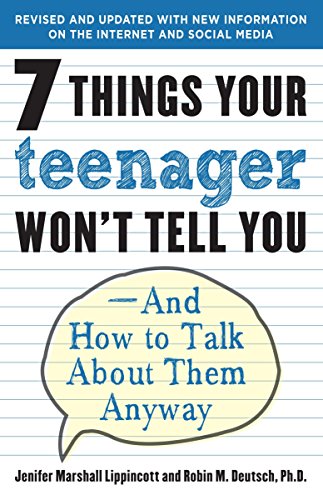
The essence of adolescence hasn't changed since this book was first published in 2005. Their brains haven't skipped a growth spurt; their search for identity hasn't been called off or even detoured; they haven't forgotten how to speak with the ease of attitude. And yet, fingers fly across keys to a host of new adolescent domains--from texting to iTunes, from chats to anything-on-demand. This update traverses new adolescent territory, both charted and uncharted, to bring parents up-to-speed on what to expect and how to deal.
Every teenager keeps secrets, and if you're like most parents, you worry about what your kids don't tell you--especially when they prefer text messages and social networking sites to face-to-face conversation. Now this popular guide has been revised and updated to address the challenges parents face with a wired and Web-savvy generation. Jenifer Lippincott and Robin Deutsch offer a deceptively simple plan for talking to your kids that's based on a simple set of rules: Teens need to stay safe, show respect, and keep in touch--online, and in real life.
Les informations fournies dans la section « Synopsis » peuvent faire référence à une autre édition de ce titre.
À propos de l'auteur
Jenifer Marshall Lippincott has worked with adolescents for more than two decades as a teacher, dean, and learning consultant. She holds a master’s degree in human development from Harvard University. She lives in Washington, D.C., with her husband and two adolescents.
Robin M. Deutsch, PhD., is the director of the Center of Excellence for Children, Families, and the Law at the Massachusetts School of Professional Psychology, a consultant in the department of psychiatry at Massachusetts General Hospital, and an associate clinical professor at Harvard Medical School. In her psychology practice, she sees children, adolescents, and parents. She successfully survived the adolescence of a son and a daughter.
Extrait. © Reproduit sur autorisation. Tous droits réservés.
The Rules of Play
Is it possible to achieve lasting peace during our children’s adolescence under the guidance of only three commandments: Stay safe; show respect; keep in touch? While these three simple rules may not guarantee a smooth ride through adolescence, they can ease some of the stresses that tend to ambush our teens—and us—as we all struggle toward (their) adulthood.
Our Own Adolescence—A Look Back
Though we’ve all searched, few of us have found a reliable way to hold a conversation with our adolescents that consistently evades conflict, or at least contention. Why is it so easy to forget that we’re the grown-ups? Too often, the moment we detect static in the communication lines with our adolescents, we tend to rush to the defensive, either for protection or to rack up another parenting victory.
Us: Don’t you speak to me in that tone of voice! Keep it up and you can forget your plans for the weekend.
Meant as harmless pinpricks aimed at our adolescents’ psyches, these types of ultimatums tend to choke off most conversations, leaving tempers smoldering.
Them: You can’t do that! You know I already have plans. Why do you always have to spoil everything?
This kind of conversational tack rarely heads in a positive direction.
Frazzled by these types of savaged conversations, we wonder why we are not entitled to wear the same cloak of respect as that of our parents. While theirs fit squarely upon shoulders that flaunted an air of unassailable power, that same cloak hangs awkwardly on us, out of style and ill fitting. Lest we forget, our parents ruled in a different kingdom, and many of us, as their subjects, were not always the loyal followers that they believed us to be.
Why aren’t we able to engender the same obsequiousness in our adolescents as many of us conveyed to our parents? As products of a different era, we came of age in a time when the fruits of our parents’ labors bought us, their offspring, the ultimate luxury—free time. Unleashed from the burden of contributing to family survival, we never questioned the leisurely pace with which we were allowed to saunter through our pre-adult years, urged to learn and explore to our heart’s content, rewarded for any glory that showcased our parents’ successes (however modest by today’s standards).
Our parents, whether participants or direct descendants of a victorious postwar generation, led the charge to create a better one, decorated with opportunity, cushioned by heightened levels of comfort. Conceived in glory, we, as the lucky benefactors, were liberated from societal debts or struggle for anything but our own causes. And so we became the early adapters, the birthright members of a whole new era of adolescence. With a mandate to go forth and excel, we were fearless in our pursuit of our parents’ promises.
Wanting for little, we searched for more and in doing so created loftier goals and even higher aspirations than a comfortable home, a car or two in the driveway, and the promise of a good education. Time and opportunity allowed us to both experiment and question. Through experimentation, we proved that boundaries confined only the meek. Better jobs, more money, higher pinnacles of success were all achievable. Through questioning, we discovered that nothing was sacrosanct, not our parents’ authority, not the government, not even the law. Regardless of the degree of difficulty of our personal journeys through adolescence, we proved it to be a profitable investment for our parents, thereby entrenching it as a necessary and essential gateway to adulthood.
Why the history lesson? Perhaps to shed new light on why our adolescents think, act, and speak differently than we did. Perhaps because to change the future requires a fresh look at the past.
Today’s Adolescent—What’s Changed?
Raised from birth on a nutritious diet of activities, lessons, and above all encouragement, our teenagers seem to thrive as we escort them from one expectation to the next. Whether in school, on sports teams, via music lessons, or through countless other releases from tolls of responsibility except to excel, we strive, because we can, to eradicate any hindrances that could divert their focus from our intended outcomes. By heaping on copious praise for any effort or positive intention, rather than for jobs actually well done—by encouraging and engaging them to “use their words,” to discuss, negotiate, and query, rather than practice and demonstrate—we may have entrenched our adolescents even further in an accountability abyss where their sole purpose is to do us proud. By removing a sense of usefulness at a time when they are struggling the hardest to define themselves, have we inadvertently cut off one of their natural sources of self-worth? What does it say about us that frequent articles in major newspapers cite incidents of parents employing “aggressive,” “devious,” even “fraudulent” tactics, all in the name of getting their kids into desired schools ranging from preschool to college? Desired by whom? we might ask. Where are the data connecting higher grades to achievement or even contentment in life? What does it say about our adolescents when a recent study on the ethics of American youth finds that despite significant increases over the past ten years in lying, stealing, and cheating, 76 percent believe that they are “better than most people” they know when it comes to doing the right thing? Perhaps we have done a better job of inflating their egos than bolstering their consciences.
What do you want from me? we often hear them plead. We want you to succeed, we implore. We want you to do your best, to feel good about yourself. We want them to have had a happy childhood, we rationalize.
So we pledge anew to do whatever we can to enable their success. Too often, though, in our eagerness to pass on a legacy of parental generosity, we overlook the critical proteins of sacrifice and responsibility.
Them: Mom, c’mon, I’m late for school. I’ll clean up my room when I get home.
Us: That’s what you said yesterday. You know our agreement is that you at least make your bed—before school. You also know that it’s one of your responsibilities as a family member.
Them: I know, I know. But do you want me to be late for school? I just didn’t have time this morning. Cut me a break, why don’t you?
And so the dilemma goes:
No, we don’t want them to be late for school (or miss out on any fun or opportunity that presents itself, especially if it could reflect badly on them or, worse, on us).
Yes, we are frustrated because this isn’t the first or the fifth time or even the twenty-fifth time they’ve neglected a responsibility.
Yes, we are annoyed that they don’t seem to understand that, in the grand scheme of things, straightening one’s room is a very small task, and one of the few that’s asked of them, but . . . (see next bullet).
Though this may not be a skirmish worth escalating into a full-on battle, any mutually agreed-upon responsibility should be accounted for. (As a matter of fact, a survey of 639 adolescents regarding their practices related to a host of adolescent issues, such as drinking, smoking marijuana, sex, eating, school performance, and more, found that one of the common denominators among the 12.5 percent who were “too good to be true” was a requirement that they keep their rooms clean. Other common denominators were frequent family dinners, intact family units, no phones in rooms, and some type of community service.)
How do we deal with the plight of the long-term investment versus the short-term gain when it comes to raising our teenagers? What rules do we put in place that acknowledge the same loopholes we discovered, indeed created, in our parents’ parenting, yet allow our adolescents to discover the benefit to their own self-image of even the smallest contribution?
The good news is that it is never too late to change our parenting practices. The better news is that it’s simpler than we think.
Les informations fournies dans la section « A propos du livre » peuvent faire référence à une autre édition de ce titre.
Résultats de recherche pour 7 Things Your Teenager Won't Tell You: And How...

Image d'archives
7 Things Your Teenager Wont Te
Edité par
Random House Publishing Group, 2011
ISBN 10 : 0812969596
ISBN 13 : 9780812969597
Ancien ou d'occasion
Couverture souple
Vendeur : World of Books (was SecondSale), Montgomery, IL, Etats-Unis
Évaluation du vendeur 5 sur 5 étoiles

Etat : Very Good. Item in very good condition! Textbooks may not include supplemental items i.e. CDs, access codes etc. N° de réf. du vendeur 00102885466
Acheter D'occasion
EUR 4,23
Livraison gratuite
Expédition nationale : Etats-Unis
Expédition nationale : Etats-Unis
Quantité disponible : 1 disponible(s)
Image d'archives
7 Things Your Teenager Wont Te
Edité par
Random House Publishing Group, 2011
ISBN 10 : 0812969596
ISBN 13 : 9780812969597
Ancien ou d'occasion
Couverture souple
Vendeur : World of Books (was SecondSale), Montgomery, IL, Etats-Unis
Évaluation du vendeur 5 sur 5 étoiles
Etat : Acceptable. Item in acceptable condition! Textbooks may not include supplemental items i.e. CDs, access codes etc. N° de réf. du vendeur 00105083755
Acheter D'occasion
EUR 4,23
Livraison gratuite
Expédition nationale : Etats-Unis
Expédition nationale : Etats-Unis
Quantité disponible : 1 disponible(s)
Image d'archives
7 Things Your Teenager Won't Tell You: And How to Talk About Them Anyway
Edité par
Random House Publishing Group (edition ), 2011
ISBN 10 : 0812969596
ISBN 13 : 9780812969597
Ancien ou d'occasion
Paperback
Vendeur : BooksRun, Philadelphia, PA, Etats-Unis
Évaluation du vendeur 5 sur 5 étoiles
Paperback. Etat : Fair. The item might be beaten up but readable. May contain markings or highlighting, as well as stains, bent corners, or any other major defect, but the text is not obscured in any way. N° de réf. du vendeur 0812969596-7-1
Acheter D'occasion
EUR 4,24
Livraison gratuite
Expédition nationale : Etats-Unis
Expédition nationale : Etats-Unis
Quantité disponible : 1 disponible(s)
Image d'archives
7 Things Your Teenager Won't Tell You: And How to Talk About Them Anyway
Edité par
Random House Publishing Group, 2011
ISBN 10 : 0812969596
ISBN 13 : 9780812969597
Ancien ou d'occasion
Couverture souple
Vendeur : More Than Words, Waltham, MA, Etats-Unis
Évaluation du vendeur 5 sur 5 étoiles
Etat : Good. A sound copy with only light wear. Overall a solid copy at a great price! N° de réf. du vendeur WAL-V-5c-01332
Acheter D'occasion
EUR 1,17
Expédition à EUR 3,55
Expédition nationale : Etats-Unis
Expédition nationale : Etats-Unis
Quantité disponible : 1 disponible(s)
Image d'archives
7 Things Your Teenager Won't Tell You: And How to Talk About Them Anyway
Edité par
Random House Publishing Group, 2011
ISBN 10 : 0812969596
ISBN 13 : 9780812969597
Ancien ou d'occasion
paperback
Vendeur : The Maryland Book Bank, Baltimore, MD, Etats-Unis
Évaluation du vendeur 5 sur 5 étoiles
paperback. Etat : Good. Corners are slightly bent. Used - Good. N° de réf. du vendeur 1-A-2-2019
Acheter D'occasion
EUR 1,70
Expédition à EUR 4,17
Expédition nationale : Etats-Unis
Expédition nationale : Etats-Unis
Quantité disponible : 1 disponible(s)
Image d'archives
7 Things Your Teenager Won't Tell You: And How to Talk About Them Anyway
Edité par
Random House USA Inc, 2005
ISBN 10 : 0812969596
ISBN 13 : 9780812969597
Ancien ou d'occasion
Paperback
Vendeur : World of Books Inc, Montgomery, IL, Etats-Unis
Évaluation du vendeur 4 sur 5 étoiles

Paperback. Etat : Very Good. REVISED AND UPDATED 2011 EDITION The essence of adolescence hasn't changed since this book was first published in 2005. Their brains haven't skipped a growth spurt; their search for identity hasn't been called off or even detoured; they haven't forgotten how to speak with the ease of attitude. And yet, fingers fly across keys to a host of new adolescent domains--from texting to iTunes, from chats to anything-on-demand. This update traverses new adolescent territory, both charted and uncharted, to bring parents up-to-speed on what to expect and how to deal. Every teenager keeps secrets, and if you're like most parents, you worry about what your kids don't tell you--especially when they prefer text messages and social networking sites to face-to-face conversation. Now this popular guide has been revised and updated to address the challenges parents face with a wired and Web-savvy generation. Jenifer Lippincott and Robin Deutsch offer a deceptively simple plan for talking to your kids that's based on a simple set of rules: Teens need to stay safe, show respect, and keep in touch--online, and in real life. N° de réf. du vendeur CIN0812969596VG
Acheter D'occasion
EUR 6,06
Livraison gratuite
Expédition nationale : Etats-Unis
Expédition nationale : Etats-Unis
Quantité disponible : 1 disponible(s)
Image d'archives
7 Things Your Teenager Won't Tell You: And How to Talk About Them Anyway
Edité par
Random House Publishing Group, 2011
ISBN 10 : 0812969596
ISBN 13 : 9780812969597
Ancien ou d'occasion
Paperback
Vendeur : ThriftBooks-Atlanta, AUSTELL, GA, Etats-Unis
Évaluation du vendeur 5 sur 5 étoiles
Paperback. Etat : Good. No Jacket. Pages can have notes/highlighting. Spine may show signs of wear. ~ ThriftBooks: Read More, Spend Less. N° de réf. du vendeur G0812969596I3N00
Acheter D'occasion
EUR 6,21
Livraison gratuite
Expédition nationale : Etats-Unis
Expédition nationale : Etats-Unis
Quantité disponible : 1 disponible(s)
Image d'archives
7 Things Your Teenager Won't Tell You: And How to Talk About Them Anyway
Edité par
Random House Publishing Group, 2011
ISBN 10 : 0812969596
ISBN 13 : 9780812969597
Ancien ou d'occasion
Couverture souple
Vendeur : Wonder Book, Frederick, MD, Etats-Unis
Évaluation du vendeur 5 sur 5 étoiles
Etat : Good. Good condition. A copy that has been read but remains intact. May contain markings such as bookplates, stamps, limited notes and highlighting, or a few light stains. Bundled media such as CDs, DVDs, floppy disks or access codes may not be included. N° de réf. du vendeur S13R-00981
Acheter D'occasion
EUR 6,41
Livraison gratuite
Expédition nationale : Etats-Unis
Expédition nationale : Etats-Unis
Quantité disponible : 1 disponible(s)
Image d'archives
7 Things Your Teenager Won't Tell You: And How to Talk About Them Anyway
Edité par
Random House Publishing Group, 2011
ISBN 10 : 0812969596
ISBN 13 : 9780812969597
Ancien ou d'occasion
Paperback
Vendeur : GoldBooks, Denver, CO, Etats-Unis
Évaluation du vendeur 5 sur 5 étoiles
Paperback. Etat : very good. Very Good Copy. Customer Service Guaranteed. N° de réf. du vendeur 29E5_8_0812969596
Acheter D'occasion
EUR 2,30
Expédition à EUR 4,89
Expédition nationale : Etats-Unis
Expédition nationale : Etats-Unis
Quantité disponible : 1 disponible(s)
Image d'archives
7 Things Your Teenager Won't Tell You: And How to Talk About Them Anyway
Edité par
Ballantine Books, 2011
ISBN 10 : 0812969596
ISBN 13 : 9780812969597
Ancien ou d'occasion
Paperback
Vendeur : HPB-Emerald, Dallas, TX, Etats-Unis
Évaluation du vendeur 5 sur 5 étoiles
Paperback. Etat : Good. Connecting readers with great books since 1972! Used books may not include companion materials, and may have some shelf wear or limited writing. We ship orders daily and Customer Service is our top priority! N° de réf. du vendeur S_321374837
Acheter D'occasion
EUR 3,89
Expédition à EUR 3,34
Expédition nationale : Etats-Unis
Expédition nationale : Etats-Unis
Quantité disponible : 1 disponible(s)