
Articles liés à Educating Alice: Adventures of a Curious Woman
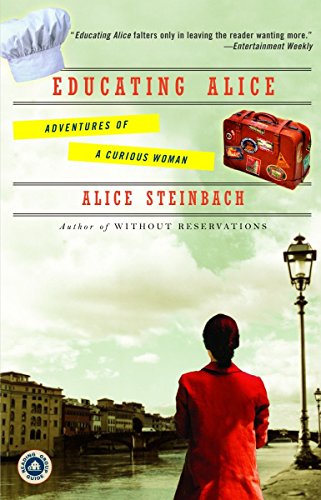
Synopsis
This funny and tender book combines three of Alice Steinbach’s greatest passions: learning, traveling, and writing. After chronicling her European journey of self-discovery in Without Reservations, this Pulitzer Prize—winning columnist for the Baltimore Sun quit her job and left home again. This time she roamed the world, taking lessons and courses in such things as French cooking in Paris, Border collie training in Scotland, traditional Japanese arts in Kyoto, and architecture and art in Havana. With warmth and wit, Steinbach guides us through the pleasures and perils of discovering how to be a student again. She also learns the true value of this second chance at educating herself: the opportunity to connect with and learn from the people she meets along the way.
Les informations fournies dans la section « Synopsis » peuvent faire référence à une autre édition de ce titre.
À propos de l'auteur
ALICE STEINBACH, whose work at the Baltimore Sun was awarded a Pulitzer Prize for Feature Writing, has been a freelance writer since 1999. Currently a Woodrow Wilson Visiting Fellow, she has taught journalism and writing at Princeton University, Washington and Lee University, and Loyola College. She lives in Baltimore.
Extrait. © Reproduit sur autorisation. Tous droits réservés.
Cookin' at the Ritz
A light snow was falling as I left my hotel and hurried across the narrow rue Cambon to the employees entrance of the Hotel Ritz. It surprised me that I had learned only two days earlier that such a door even existed. How, I wondered, in all my years of exploring the streets and passages of Paris had I missed it? After all, back doors were a major interest of mine. And so were side doors and courtyards hidden behind green gates and anything else that concealed the private Paris from me. Once, I spent two years writing letters and making phone calls before being allowed to visit the mysterious Maison de Verre, a house on the Left Bank designed in the late 1920s by the French architect Pierre Chareau. Compared to that heroic effort, gaining entrance to the back door of the Hotel Ritz was a snap: I had simply enrolled as a culinary student in the Ritz Escoffier École de Gastronomie Française.
Now here I was, on a snowy morning in February, about to enter the hotel not as an outsider but as an insider, a thrilling prospect. After all, I told myself, anyone willing and able to pay seven hundred dollars a pop to stay overnight could walk through the Ritz's imposing place Vendôme entrance. But only those carrying an employee's identification card were allowed through the back door on rue Cambon. Still, as eager as I was to begin what seemed an adventure, the truth is I was nervous about what to expect on the other side of the door. A French security officer who would turn me away? A snooty chef who would laugh at my limited French vocabulary? Classmates who would criticize my chopping and dicing techniques? A sudden, humiliating announcement from the schools Directeur that, for undisclosed reasons, he had revoked my student status?
It was in this Kafkaesque frame of mind that I pushed open the plain unmarked door and stepped into a small vestibule. A security guard sitting in a small room behind a counter stood up and carefully gave me the once-over. Immediately his stern appraising demeanor made me think of my root canal dentist.
"Bonjour," I said with fake nonchalance, holding out my photo ID in such a way that my thumb covered any evidence of a very bad haircut. He nodded and reached for the card. I watched as he looked at it and frowned. Was it my bad haircut that offended? "Is something wrong?" I asked. His response was to look at my face and then at the photo, comparing the two. He repeated this twice. Face-then-photo. Face-then-photo. Just as I started to explain that I'd drastically altered my hairstyle-for the better-since the photo was taken, a buzzer went off. A clicking sound followed as the gate to the long basement corridor unlocked and, with a wave of his hand, the guard motioned me through.
So this was it, then, the moment when I became a part of the venerable Hotel Ritz. After descending a flight of stairs, I looked down a corridor so long I couldn't see the end of it. What I could see, however, was a small army of employees engaged in a whirlwind of activity. Fascinated, I watched as men in crisp white uniforms picked up crates containing hundreds of bottles of Evian water and florists pushed carts filled with lavish arrangements of lilies, tulips, and irises. As I moved deeper into the corridor I saw workmen carting off worn pieces of Persian rugs and cabinetmakers moving a hand-painted Chinese chest marked "For repair." Service staff carrying covered silver breakfast trays entered and exited the service elevator. Some of the employees nodded to me in a collegial way as they passed by. I nodded back, trying to conceal my excitement at witnessing all the daily routines necessary to run a world-class hotel.
I continued on through the long corridor, past the sparkling white tile and stainless-steel kitchen classrooms of the cooking school, to the locker rooms where students changed into their uniforms. After a few minutes of struggling with the key, I unlocked the door on the right marked "Women." When I opened it a blast of hot, steamy air hit me; it smelled like the warm dampness I breathed as a child when changing clothes in the locker room of the YWCA pool.
Inside the small, L-shaped room there were thirty-five bright blue lockers, a few narrow benches, and an adjoining space with a toilet, a shower stall, two sinks, and a mirror. On a small table in the corner someone had left a hair comb and a large roll of Tums-a bad omen, perhaps, to find in the locker room of a cooking school. After locating the locker assigned to me-Number 210-I opened it and saw hanging inside the uniform I'd been fitted for on the previous day. The room was empty so I began to undress quickly, hoping to finish suiting up before my classmates arrived. Call me insecure, but I preferred not to meet my colleagues for the first time wearing only my underwear.
The uniform was formidable. First, I removed the sturdy closed-toe shoes students were advised to wear and stepped out of my khaki pants. Then I pulled on a pair of heavy cotton houndstooth-check trousers. My sweater came off next. It was replaced by a starched white double-breasted chef's jacket with double rows of buttons and the name of the school embroidered in blue on the left. Then came the napkin-like neckerchief that had to be tied in a very specific way. Next, I wrapped a starched white apron around my waist, tied it in front, and then tucked a thick white side towel under the apron string on my left side. By this time I was perspiring heavily.
Finally it was time to don the flat, starched white hat worn by students. I approached the hat with some trepidation. I still had not gotten over the humiliation of being told by the sympathetic French laundress who fitted me that I would require a very large hat. "A size 21," she said sadly. "There is no larger." Also I had no idea of how to wear this hat. Pushed back on my head like a beanie with hair showing? Or pulled down over my forehead, just above the eyebrows? Either way, it was not a becoming look. I decided to wear it in the more severe position: very low on my forehead, almost to my eyebrows, with all my hair covered. Somehow, it seemed more professional that way.
I looked at my watch; it had taken twenty minutes to suit up. I made a brief detour to the mirror and stopped to stare at myself. The person staring back, the one who was supposed to resemble a culinary student, looked in fact like a Red Army nurse, circa World War II. Actually I sort of liked the look. I fancied myself as looking very much like the Hemingway heroine in A Farewell to Arms, despite the fact she wasn't Russian and the story had nothing to do with World War II.
To complete the uniform I pinned on the nametag which, I had been warned at my fitting, "should in all cases be worn every day."
With half an hour to kill I headed for the employees' cafeteria, where I was entitled to eat at a student discount. The pretty, softly lit room was almost empty, so I sat down with a cup of latte and studied the dishes we would prepare over the next four and a half hours: sole fillets with a mandarin sauce; boeuf Bourguignon, waffle potatoes, souffléed potatoes, chocolate and orange mousse. We would also learn to prepare meat glaze and demi-glace. I flipped the pages containing the recipes, trying to familiarize myself with the conversion of measurements and weights from the European metric system into its American equivalent, a daunting task. Added to that was the further hurdle presented by having the course conducted in French with simultaneous translation into English. Between the foreign metric conversion and the foreign language translation, I saw the potential for big mistakes.
Indeed I had spent the night before worrying about whether I would measure up to the standards of the Ritz Escoffier Cooking School. After all it had been more than twenty years since I'd studied classic French cooking and almost as long since I'd cooked at that level. So, to be on the safe side, I had enrolled in a course listed in the school's brochure as designed for the "beginner to intermediate student." Still, the name alone-The César Ritz Course,-named after the hotel's founder-was intimidating to someone who grew up in a Scottish household where Grandmother dragged out the Wee Scottish Cookbook when company was coming and a fancy dish like steak pie or leek soup was called for.
I worried too about meeting my nine classmates, all of whom had started the six-week course together, beginning in Week One. I, on the other hand-having neither the time nor money for the full course-chose the option of starting halfway through the course in Week Four. What this meant, of course, was that I was the New Girl in Class, subject to all the disadvantages accruing to such an identity.
Kitchens are dangerous places. Within minutes of beginning our classroom work, two students caught on fire. Or to be more precise, their long side towels caught on fire. Real chefs, it turned out, don't use potholders. When something hot has to be handled they use their sturdy side towels. Which is exactly what Bruce and Paulina were doing-removing a huge stainless-steel pot of fish stock from the gas burner-when flames erupted. The blaze was put out quickly and no one seemed concerned. Except me.
Les informations fournies dans la section « A propos du livre » peuvent faire référence à une autre édition de ce titre.
Résultats de recherche pour Educating Alice: Adventures of a Curious Woman

Image d'archives
Educating Alice Adventures of
Edité par
Random House Publishing Group, 2005
ISBN 10 : 0812973607
ISBN 13 : 9780812973600
Ancien ou d'occasion
Couverture souple
Vendeur : World of Books (was SecondSale), Montgomery, IL, Etats-Unis
Évaluation du vendeur 5 sur 5 étoiles

Etat : Very Good. Item in very good condition! Textbooks may not include supplemental items i.e. CDs, access codes etc. N° de réf. du vendeur 00099000674
Acheter D'occasion
EUR 3,68
Livraison gratuite
Expédition nationale : Etats-Unis
Expédition nationale : Etats-Unis
Quantité disponible : 1 disponible(s)
Image d'archives
Educating Alice: Adventures of a Curious Woman
Edité par
Random House USA Inc, 2005
ISBN 10 : 0812973607
ISBN 13 : 9780812973600
Ancien ou d'occasion
Paperback
Vendeur : World of Books (was SecondSale), Montgomery, IL, Etats-Unis
Évaluation du vendeur 5 sur 5 étoiles
Paperback. Etat : Good. This funny and tender book combines three of Alice Steinbach's greatest passions: learning, traveling, and writing. After chronicling her European journey of self-discovery in Without Reservations, this Pulitzer Prize--winning columnist for the Baltimore Sun quit her job and left home again. This time she roamed the world, taking lessons and courses in such things as French cooking in Paris, Border collie training in Scotland, traditional Japanese arts in Kyoto, and architecture and art in Havana. With warmth and wit, Steinbach guides us through the pleasures and perils of discovering how to be a student again. She also learns the true value of this second chance at educating herself: the opportunity to connect with and learn from the people she meets along the way. N° de réf. du vendeur 00096394741
Acheter D'occasion
EUR 3,68
Livraison gratuite
Expédition nationale : Etats-Unis
Expédition nationale : Etats-Unis
Quantité disponible : 6 disponible(s)
Image d'archives
Educating Alice Adventures of
Edité par
Random House Publishing Group, 2005
ISBN 10 : 0812973607
ISBN 13 : 9780812973600
Ancien ou d'occasion
Couverture souple
Vendeur : World of Books (was SecondSale), Montgomery, IL, Etats-Unis
Évaluation du vendeur 5 sur 5 étoiles
Etat : Acceptable. Item in good condition. Textbooks may not include supplemental items i.e. CDs, access codes etc. N° de réf. du vendeur 00067177146
Acheter D'occasion
EUR 3,68
Livraison gratuite
Expédition nationale : Etats-Unis
Expédition nationale : Etats-Unis
Quantité disponible : 2 disponible(s)
Image d'archives
Educating Alice: Adventures of a Curious Woman
Edité par
Random House Trade Paperbacks, 2005
ISBN 10 : 0812973607
ISBN 13 : 9780812973600
Ancien ou d'occasion
Paperback
Vendeur : Your Online Bookstore, Houston, TX, Etats-Unis
Évaluation du vendeur 5 sur 5 étoiles
Paperback. Etat : Good. N° de réf. du vendeur 0812973607-3-22805418
Acheter D'occasion
EUR 3,69
Livraison gratuite
Expédition nationale : Etats-Unis
Expédition nationale : Etats-Unis
Quantité disponible : 1 disponible(s)
Image fournie par le vendeur
Educating Alice: Adventures of a Curious Woman
Edité par
Random House Publishing Group, 2005
ISBN 10 : 0812973607
ISBN 13 : 9780812973600
Ancien ou d'occasion
Couverture souple
Vendeur : Dream Books Co., Denver, CO, Etats-Unis
Évaluation du vendeur 5 sur 5 étoiles
Etat : acceptable. This copy has clearly been enjoyedâ"expect noticeable shelf wear and some minor creases to the cover. Binding is strong, and all pages are legible. May contain previous library markings or stamps. N° de réf. du vendeur DBV.0812973607.A
Acheter D'occasion
EUR 3,76
Livraison gratuite
Expédition nationale : Etats-Unis
Expédition nationale : Etats-Unis
Quantité disponible : 2 disponible(s)
Image fournie par le vendeur
Educating Alice: Adventures of a Curious Woman
Edité par
Random House Publishing Group, 2005
ISBN 10 : 0812973607
ISBN 13 : 9780812973600
Ancien ou d'occasion
Couverture souple
Vendeur : 3Brothers Bookstore, Egg harbor township, NJ, Etats-Unis
Évaluation du vendeur 5 sur 5 étoiles
Etat : good. Books may contain some notes and highlighting. Supplements such as Access Codes, Cd's Dust Jackets, etc. are not guaranteed with used book purchases. N° de réf. du vendeur EVV.0812973607.G
Acheter D'occasion
EUR 3,88
Livraison gratuite
Expédition nationale : Etats-Unis
Expédition nationale : Etats-Unis
Quantité disponible : 1 disponible(s)
Image fournie par le vendeur
Educating Alice: Adventures of a Curious Woman
Edité par
Random House Publishing Group, 2005
ISBN 10 : 0812973607
ISBN 13 : 9780812973600
Ancien ou d'occasion
Couverture souple
Vendeur : Zoom Books Company, Lynden, WA, Etats-Unis
Évaluation du vendeur 5 sur 5 étoiles
Etat : very_good. Book is in very good condition and may include minimal underlining highlighting. The book can also include "From the library of" labels. May not contain miscellaneous items toys, dvds, etc. . We offer 100% money back guarantee and 24 7 customer service. N° de réf. du vendeur ZBV.0812973607.VG
Acheter D'occasion
EUR 4,02
Livraison gratuite
Expédition nationale : Etats-Unis
Expédition nationale : Etats-Unis
Quantité disponible : 1 disponible(s)
Image fournie par le vendeur
Educating Alice: Adventures of a Curious Woman
Edité par
Random House Publishing Group, 2005
ISBN 10 : 0812973607
ISBN 13 : 9780812973600
Ancien ou d'occasion
Couverture souple
Vendeur : Zoom Books East, Glendale Heights, IL, Etats-Unis
Évaluation du vendeur 5 sur 5 étoiles
Etat : good. Book is in good condition and may include underlining highlighting and minimal wear. The book can also include "From the library of" labels. May not contain miscellaneous items toys, dvds, etc. . We offer 100% money back guarantee and 24 7 customer service. N° de réf. du vendeur ZEV.0812973607.G
Acheter D'occasion
EUR 4,02
Livraison gratuite
Expédition nationale : Etats-Unis
Expédition nationale : Etats-Unis
Quantité disponible : 1 disponible(s)
Image d'archives
Educating Alice: Adventures of a Curious Woman
Edité par
Random House Publishing Group (edition Reprint), 2005
ISBN 10 : 0812973607
ISBN 13 : 9780812973600
Ancien ou d'occasion
Paperback
Vendeur : BooksRun, Philadelphia, PA, Etats-Unis
Évaluation du vendeur 5 sur 5 étoiles
Paperback. Etat : Fair. Reprint. The item might be beaten up but readable. May contain markings or highlighting, as well as stains, bent corners, or any other major defect, but the text is not obscured in any way. N° de réf. du vendeur 0812973607-7-1
Acheter D'occasion
EUR 4,44
Livraison gratuite
Expédition nationale : Etats-Unis
Expédition nationale : Etats-Unis
Quantité disponible : 2 disponible(s)
Image fournie par le vendeur
Educating Alice: Adventures of a Curious Woman
Edité par
Random House Publishing Group, 2005
ISBN 10 : 0812973607
ISBN 13 : 9780812973600
Ancien ou d'occasion
Couverture souple
Vendeur : Aspen Book Co., Denver, CO, Etats-Unis
Évaluation du vendeur 5 sur 5 étoiles
Etat : very_good. Excellent condition with just a hint of character. Minor signs of love, but the pages are still clean and ready for adventure. N° de réf. du vendeur PKV.0812973607.VG
Acheter D'occasion
EUR 4,47
Livraison gratuite
Expédition nationale : Etats-Unis
Expédition nationale : Etats-Unis
Quantité disponible : 1 disponible(s)