
Articles liés à Disturbing Calculations: The Economics of Identity...
Disturbing Calculations: The Economics of Identity in Postcolonial Southern Literature, 1912-2002 - Couverture souple
Livre 2 sur 17: The New Southern Studies Ser.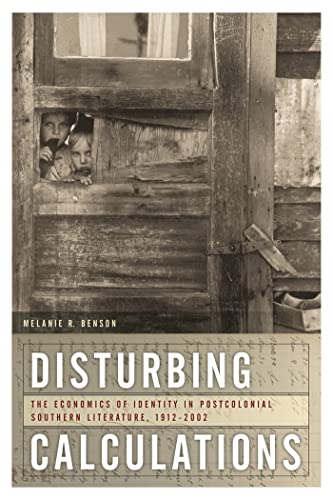
Synopsis
In Thomas Wolfe’s Look Homeward, Angel, Margaret Leonard says, “Never mind about algebra here. That’s for poor folks. There’s no need for algebra where two and two make five.” Moments of mathematical reckoning like this pervade twentieth-century southern literature, says Melanie R. Benson. In fiction by a large, diverse group of authors, including William Faulkner, Anita Loos, William Attaway, Dorothy Allison, and Lan Cao, Benson identifies a calculation-obsessed, anxiety-ridden discourse in which numbers are employed to determine social and racial hierarchies and establish individual worth and identity. This “narcissistic fetish of number” speaks to a tangle of desires and denials rooted in the history of the South, capitalism, and colonialism. No one evades participation in these “disturbing equations,” says Benson, wherein longing for increase, accumulation, and superiority collides with repudiation of the means by which material wealth is attained. Writers from marginalized groups—including African Americans, Native Americans, women, immigrants, and the poor—have deeply internalized and co-opted methods and tropes of the master narrative even as they have struggled to wield new voices unmarked by the discourse of the colonizer. Having nominally emerged from slavery’s legacy, the South is now situated in the agonized space between free market capitalism and social progressivism. Elite southerners work to distance themselves from capitalism’s dehumanizing mechanisms, while the marginalized yearn to realize the uniquely American narrative of accumulation and ascent. The fetish of numbers emerges to signify the futility of both.
Les informations fournies dans la section « Synopsis » peuvent faire référence à une autre édition de ce titre.
À propos de l'auteur
MELANIE BENSON TAYLOR is professor of English and creative writing and of Native American and Indigenous studies at Dartmouth College. She is the editor of The Cambridge History of Native American Literature and The Norton Critical Edition of Faulkner's Light in August, and the author of The Indian in American Southern Literature; Reconstructing the Native South: American Indian Literature and the Lost Cause; and Disturbing Calculations: The Economics of Identity in Postcolonial Southern Literature, 1912-2002 (both Georgia).
Les informations fournies dans la section « A propos du livre » peuvent faire référence à une autre édition de ce titre.
Résultats de recherche pour Disturbing Calculations: The Economics of Identity...

Image d'archives
Disturbing Calculations (Paperback)
Edité par
University of Georgia Press, Georgia, 2008
ISBN 10 : 0820331120
ISBN 13 : 9780820331126
Neuf
Paperback
Vendeur : Grand Eagle Retail, Bensenville, IL, Etats-Unis
Évaluation du vendeur 5 sur 5 étoiles

Paperback. Etat : new. Paperback. In Thomas Wolfes Look Homeward, Angel, Margaret Leonard says, Never mind about algebra here. Thats for poor folks. Theres no need for algebra where two and two make five. Moments of mathematical reckoning like this pervade twentieth-century southern literature, says Melanie R. Benson. In fiction by a large, diverse group of authors, including William Faulkner, Anita Loos, William Attaway, Dorothy Allison, and Lan Cao, Benson identifies a calculation-obsessed, anxiety-ridden discourse in which numbers are employed to determine social and racial hierarchies and establish individual worth and identity.This narcissistic fetish of number speaks to a tangle of desires and denials rooted in the history of the South, capitalism, and colonialism. No one evades participation in these disturbing equations, says Benson, wherein longing for increase, accumulation, and superiority collides with repudiation of the means by which material wealth is attained. Writers from marginalized groupsincluding African Americans, Native Americans, women, immigrants, and the poorhave deeply internalized and co-opted methods and tropes of the master narrative even as they have struggled to wield new voices unmarked by the discourse of the colonizer.Having nominally emerged from slaverys legacy, the South is now situated in the agonized space between free market capitalism and social progressivism. Elite southerners work to distance themselves from capitalisms dehumanizing mechanisms, while the marginalized yearn to realize the uniquely American narrative of accumulation and ascent. The fetish of numbers emerges to signify the futility of both. Moments of mathematical reckoning pervade twentieth-century southern literature by authors including William Faulkner, Anita Loos, William Attaway, and Dorothy Allison, revealing a calculation-obsessed, anxiety-ridden discourse in which numbers are employed to determine social and racial hierarchies and establish individual worth and identity. Shipping may be from multiple locations in the US or from the UK, depending on stock availability. N° de réf. du vendeur 9780820331126
Acheter neuf
EUR 49,46
Livraison gratuite
Expédition nationale : Etats-Unis
Expédition nationale : Etats-Unis
Quantité disponible : 1 disponible(s)
Image d'archives
Disturbing Calculations: The Economics of Identity in Postcolonial Southern Literature, 1912-2002 (The New Southern Studies)
Edité par
University of Georgia Press, 2008
ISBN 10 : 0820331120
ISBN 13 : 9780820331126
Neuf
Couverture souple
Vendeur : Kennys Bookshop and Art Galleries Ltd., Galway, GY, Irlande
Évaluation du vendeur 5 sur 5 étoiles
Etat : New. Reveals affinities between antebellum southern and modern American capitalist psychology. This book identifies a calculation-obsessed, anxiety-ridden discourse in which numbers are employed to determine social and racial hierarchies and establish individual worth and identity. Series: New Southern Studies. Num Pages: 320 pages. BIC Classification: 1KBBF; DSBH. Category: (P) Professional & Vocational; (UP) Postgraduate, Research & Scholarly; (UU) Undergraduate. Dimension: 229 x 152 x 18. Weight in Grams: 386. . 2008. Paperback. . . . . N° de réf. du vendeur V9780820331126
Acheter neuf
EUR 55,41
Expédition à EUR 9,50
Expédition depuis Irlande vers Etats-Unis
Expédition depuis Irlande vers Etats-Unis
Quantité disponible : 2 disponible(s)
Image d'archives
Disturbing Calculations The Economics of Identity in Postcolonial Southern Literature, 19122002
Vendeur : Revaluation Books, Exeter, Royaume-Uni
Évaluation du vendeur 5 sur 5 étoiles
Paperback. Etat : Brand New. 320 pages. 9.00x6.00x1.00 inches. In Stock. N° de réf. du vendeur x-0820331120
Acheter neuf
EUR 56,04
Expédition à EUR 14,79
Expédition depuis Royaume-Uni vers Etats-Unis
Expédition depuis Royaume-Uni vers Etats-Unis
Quantité disponible : 2 disponible(s)
Image d'archives
Disturbing Calculations: The Economics of Identity in Postcolonial Southern Literature, 1912-2002 (The New Southern Studies)
Edité par
University of Georgia Press, 2008
ISBN 10 : 0820331120
ISBN 13 : 9780820331126
Neuf
Couverture souple
Vendeur : Kennys Bookstore, Olney, MD, Etats-Unis
Évaluation du vendeur 5 sur 5 étoiles
Etat : New. Reveals affinities between antebellum southern and modern American capitalist psychology. This book identifies a calculation-obsessed, anxiety-ridden discourse in which numbers are employed to determine social and racial hierarchies and establish individual worth and identity. Series: New Southern Studies. Num Pages: 320 pages. BIC Classification: 1KBBF; DSBH. Category: (P) Professional & Vocational; (UP) Postgraduate, Research & Scholarly; (UU) Undergraduate. Dimension: 229 x 152 x 18. Weight in Grams: 386. . 2008. Paperback. . . . . Books ship from the US and Ireland. N° de réf. du vendeur V9780820331126
Acheter neuf
EUR 64,31
Expédition à EUR 9,37
Expédition nationale : Etats-Unis
Expédition nationale : Etats-Unis
Quantité disponible : 2 disponible(s)
Image fournie par le vendeur
Disturbing Calculations
Edité par
UNIV OF GEORGIA PR, 2008
ISBN 10 : 0820331120
ISBN 13 : 9780820331126
Neuf
Kartoniert / Broschiert
Vendeur : moluna, Greven, Allemagne
Évaluation du vendeur 5 sur 5 étoiles
Kartoniert / Broschiert. Etat : New. Reveals affinities between antebellum southern and modern American capitalist psychology. This book identifies a calculation-obsessed, anxiety-ridden discourse in which numbers are employed to determine social and racial hierarchies and establish individual. N° de réf. du vendeur 898829417
Acheter neuf
EUR 46,20
Expédition à EUR 48,99
Expédition depuis Allemagne vers Etats-Unis
Expédition depuis Allemagne vers Etats-Unis
Quantité disponible : 3 disponible(s)