
Articles liés à The Grimace of Macho Ratón: Artisans, Identity, and...
The Grimace of Macho Ratón: Artisans, Identity, and Nation in Late-Twentieth-Century Western Nicaragua - Couverture souple
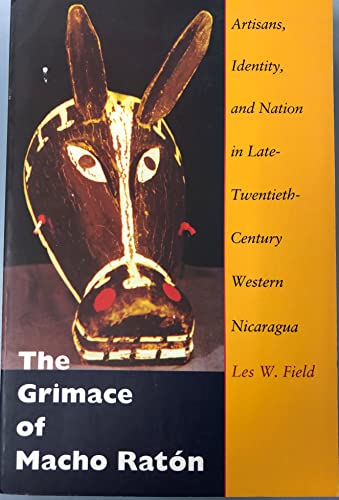
Synopsis
In this creative ethnography Les W. Field challenges a post-Sandinista national conception of identity, one that threatens to constrict the future of subaltern Nicaraguans. Drawing on the works and words of artisans and artisanas, Indians, and mestizos, Field critiques the national ideology of ethnic homogeneity and analyzes the new forms of social movement that have distinguished late-twentieth-century Nicaragua. As a framework for these analytic discussions, Field uses the colonial-era play El Güegüence o Macho Ratón and the literature relating to it.
Elite appropriations of El Güegüence construe it as an allegory of mestizo national identity in which mestizaje is defined as the production of a national majority of ethnically bounded non-Indians in active collaboration with the state. By contrast, Field interprets the play as a parable of cultural history and not a declaration of cultural identity, a scatological reflection on power and the state, and an evocation of collective loss and humor broadly associated with the national experience of disempowered social groups. By engaging with those most intimately involved in the performance of the play--and by including essays by some of these artisans--Field shows how El Güegüence tells a story about the passing of time, the absurdity of authority, and the contradictions of coping with inheritances of the past. Refusing essentialist notions of what it means to be Indian or artisan, Field explains the reemergence of politicized indigenous identity in western Nicaragua and relates this to the longer history of artisan political organization. Parting ways with many scholars who associate the notion of mestizaje with identity loss and hegemony, Field emphasizes its creative,
productive, and insightful meanings. With an emphasis on the particular struggles of women artisans, he explores the reasons why forms of collective identity have posed various kinds of predicaments for this marginalized class of western Nicaraguans.
This book will appeal to readers beyond the field of Latin American anthropology, including students and scholars of literature, intellectual history, women's studies, and the politics of ethnicity.
Les informations fournies dans la section « Synopsis » peuvent faire référence à une autre édition de ce titre.
À propos de l'auteur
Les W. Field is Assistant Professor of Anthropology at the University of New Mexico.
Les informations fournies dans la section « A propos du livre » peuvent faire référence à une autre édition de ce titre.
Résultats de recherche pour The Grimace of Macho Ratón: Artisans, Identity, and...

Image d'archives
The Grimace of Macho Ratà n : Artisans, Identity, and Nation in Late-Twentieth-Century Western Nicaragua
Edité par
Duke University Press, 1999
ISBN 10 : 0822322889
ISBN 13 : 9780822322887
Ancien ou d'occasion
Couverture souple
Vendeur : Better World Books, Mishawaka, IN, Etats-Unis
Évaluation du vendeur 5 sur 5 étoiles

Etat : Good. Former library copy. Pages intact with minimal writing/highlighting. The binding may be loose and creased. Dust jackets/supplements are not included. Includes library markings. Stock photo provided. Product includes identifying sticker. Better World Books: Buy Books. Do Good. N° de réf. du vendeur 6293039-6
Acheter D'occasion
EUR 8,05
Livraison gratuite
Expédition nationale : Etats-Unis
Expédition nationale : Etats-Unis
Quantité disponible : 1 disponible(s)
Image d'archives
The Grimace of Macho Raton: Artisans, Identity and Nation in Late-Twentieth Century Western Nicaragua
Edité par
Duke University Press, 1999
ISBN 10 : 0822322889
ISBN 13 : 9780822322887
Ancien ou d'occasion
Soft cover
Vendeur : N. Fagin Books, Chicago, IL, Etats-Unis
Évaluation du vendeur 5 sur 5 étoiles
Soft cover. Etat : Very Good. 1999. Mesoamerica. Duke University Press. Very good - fine paperback 283p. 11/23. N° de réf. du vendeur 1187162305
Acheter D'occasion
EUR 4,44
Expédition à EUR 5,18
Expédition nationale : Etats-Unis
Expédition nationale : Etats-Unis
Quantité disponible : 1 disponible(s)
Image d'archives
Grimace of Macho RatÃn: Artisans, Identity, & Nation in Late-Twentieth-Century Western Nicaragua
Edité par
Duke, 1999
ISBN 10 : 0822322889
ISBN 13 : 9780822322887
Ancien ou d'occasion
paperback
Edition originale
Vendeur : Powell's Bookstores Chicago, ABAA, Chicago, IL, Etats-Unis
Évaluation du vendeur 5 sur 5 étoiles
paperback. Etat : Used-Very Good. First Edition. Pap. Minor shelf-wear. N° de réf. du vendeur 1802847
Acheter D'occasion
EUR 7,11
Expédition à EUR 6,47
Expédition nationale : Etats-Unis
Expédition nationale : Etats-Unis
Quantité disponible : 1 disponible(s)
Image d'archives
The Grimace of Macho Ratà n: Artisans, Identity, and Nation in Late-Twentieth-Century Western Nicaragua
Edité par
Duke University Press, 1999
ISBN 10 : 0822322889
ISBN 13 : 9780822322887
Ancien ou d'occasion
paperback
Vendeur : HPB-Ruby, Dallas, TX, Etats-Unis
Évaluation du vendeur 5 sur 5 étoiles
paperback. Etat : Very Good. Connecting readers with great books since 1972! Used books may not include companion materials, and may have some shelf wear or limited writing. We ship orders daily and Customer Service is our top priority! N° de réf. du vendeur S_478912257
Acheter D'occasion
EUR 12,43
Expédition à EUR 3,23
Expédition nationale : Etats-Unis
Expédition nationale : Etats-Unis
Quantité disponible : 1 disponible(s)
Image fournie par le vendeur
Grimace of Macho Raton : Artisans, Identity, and Nation in Late-Twentieth-Century Western Nicaragua
Edité par
Duke University Press, 1999
ISBN 10 : 0822322889
ISBN 13 : 9780822322887
Ancien ou d'occasion
Couverture souple
Vendeur : GreatBookPrices, Columbia, MD, Etats-Unis
Évaluation du vendeur 5 sur 5 étoiles
Etat : As New. Unread book in perfect condition. N° de réf. du vendeur 202195
Acheter D'occasion
EUR 35,50
Expédition à EUR 2,28
Expédition nationale : Etats-Unis
Expédition nationale : Etats-Unis
Quantité disponible : 2 disponible(s)
Image d'archives
The Grimace of Macho Rat?n
Vendeur : PBShop.store UK, Fairford, GLOS, Royaume-Uni
Évaluation du vendeur 5 sur 5 étoiles
PAP. Etat : New. New Book. Shipped from UK. Established seller since 2000. N° de réf. du vendeur FW-9780822322887
Acheter neuf
EUR 35,41
Expédition à EUR 6,85
Expédition depuis Royaume-Uni vers Etats-Unis
Expédition depuis Royaume-Uni vers Etats-Unis
Quantité disponible : 2 disponible(s)
Image fournie par le vendeur
Grimace of Macho Raton : Artisans, Identity, and Nation in Late-Twentieth-Century Western Nicaragua
Edité par
Duke University Press, 1999
ISBN 10 : 0822322889
ISBN 13 : 9780822322887
Neuf
Couverture souple
Vendeur : GreatBookPrices, Columbia, MD, Etats-Unis
Évaluation du vendeur 5 sur 5 étoiles
Etat : New. N° de réf. du vendeur 202195-n
Acheter neuf
EUR 41,11
Expédition à EUR 2,28
Expédition nationale : Etats-Unis
Expédition nationale : Etats-Unis
Quantité disponible : 2 disponible(s)
Image fournie par le vendeur
The Grimace of Macho Ratón
Edité par
Duke University Press, US, 1999
ISBN 10 : 0822322889
ISBN 13 : 9780822322887
Neuf
Paperback
Vendeur : Rarewaves.com USA, London, LONDO, Royaume-Uni
Évaluation du vendeur 5 sur 5 étoiles
Paperback. Etat : New. In this creative ethnography Les W. Field challenges a post-Sandinista national conception of identity, one that threatens to constrict the future of subaltern Nicaraguans. Drawing on the works and words of artisans and artisanas, Indians, and mestizos, Field critiques the national ideology of ethnic homogeneity and analyzes the new forms of social movement that have distinguished late-twentieth-century Nicaragua. As a framework for these analytic discussions, Field uses the colonial-era play El GÜegÜence o Macho RatÓn and the literature relating to it.Elite appropriations of El GÜegÜence construe it as an allegory of mestizo national identity in which mestizaje is defined as the production of a national majority of ethnically bounded non-Indians in active collaboration with the state. By contrast, Field interprets the play as a parable of cultural history and not a declaration of cultural identity, a scatological reflection on power and the state, and an evocation of collective loss and humor broadly associated with the national experience of disempowered social groups. By engaging with those most intimately involved in the performance of the play-and by including essays by some of these artisans-Field shows how El GÜegÜence tells a story about the passing of time, the absurdity of authority, and the contradictions of coping with inheritances of the past. Refusing essentialist notions of what it means to be Indian or artisan, Field explains the reemergence of politicized indigenous identity in western Nicaragua and relates this to the longer history of artisan political organization. Parting ways with many scholars who associate the notion of mestizaje with identity loss and hegemony, Field emphasizes its creative,productive, and insightful meanings. With an emphasis on the particular struggles of women artisans, he explores the reasons why forms of collective identity have posed various kinds of predicaments for this marginalized class of western Nicaraguans.This book will appeal to readers beyond the field of Latin American anthropology, including students and scholars of literature, intellectual history, women's studies, and the politics of ethnicity. N° de réf. du vendeur LU-9780822322887
Acheter neuf
EUR 43,46
Livraison gratuite
Expédition depuis Royaume-Uni vers Etats-Unis
Expédition depuis Royaume-Uni vers Etats-Unis
Quantité disponible : 1 disponible(s)
Image d'archives
The grimace of Macho Ratón : artisans , identity , and nation in late-twentieth-century western Nicaragua.
Edité par
Duke University Press, 1999
ISBN 10 : 0822322889
ISBN 13 : 9780822322887
Ancien ou d'occasion
Couverture souple
Vendeur : Kloof Booksellers & Scientia Verlag, Amsterdam, Pays-Bas
Évaluation du vendeur 4 sur 5 étoiles

Etat : very good. Durham , NC : Duke University Press, 1999. Paperback. xxi, 282 p. : ill. ; 24 cm. Condition : very good copy. ISBN 9780822322887. Keywords : , Nicaragua. N° de réf. du vendeur 53379
Acheter D'occasion
EUR 16,95
Expédition à EUR 30
Expédition depuis Pays-Bas vers Etats-Unis
Expédition depuis Pays-Bas vers Etats-Unis
Quantité disponible : 1 disponible(s)
Image d'archives
The Grimace of Macho Ratón: Artisans, Identity, and Nation in Late-Twentieth-Century Western Nicaragua
Edité par
Duke University Press, 1999
ISBN 10 : 0822322889
ISBN 13 : 9780822322887
Neuf
Couverture souple
Vendeur : Ria Christie Collections, Uxbridge, Royaume-Uni
Évaluation du vendeur 5 sur 5 étoiles
Etat : New. In English. N° de réf. du vendeur ria9780822322887_new
Acheter neuf
EUR 34,74
Expédition à EUR 13,17
Expédition depuis Royaume-Uni vers Etats-Unis
Expédition depuis Royaume-Uni vers Etats-Unis
Quantité disponible : 2 disponible(s)