
Articles liés à Advances in the Biorational Control of Medical and...
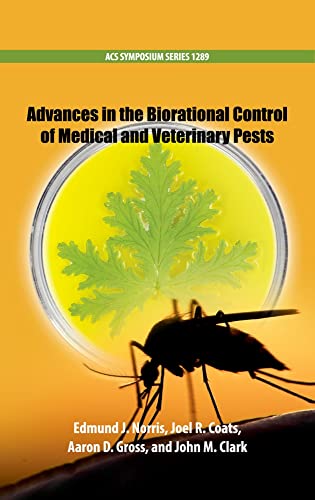
Synopsis
Insect vectors pose a significant threat to public health and veterinary medicine throughout the world. It is estimated that more than 700,000 people die annually from complications associated with mosquito-borne disease alone, without accounting for the impact caused by other arthropod pests of public health importance. As these pest insect populations become increasingly resistant to classical synthetic insecticides, new chemistries and control approaches need to be rapidly developed, characterized, and deployed. Biorational control methods are technologies derived from natural chemistry or exploit the physiology of the arthropod pest in question to limit potential harm to non-target organisms. As the global population grows and continues to encounter new and old arthropod-borne diseases, it is paramount that future arthropod control technologies are safe and sustainable to our communities and the environment around us.
Les informations fournies dans la section « Synopsis » peuvent faire référence à une autre édition de ce titre.
À propos de l'auteur
Edmund J. Norris, PhD, is Postdoctoral Research Associate in the Pesticide Toxicology Laboratory at Iowa State University. He received his PhD in both Entomology and Toxicology at Iowa State University under the supervision of Joel Coats, PhD, and Lyric Bartholomay, PhD. His research focuses on the development of new biorational pesticidal chemistries and technologies, with emphasis on the development of targeted strategies for the control of public health and veterinary pest arthropods. Joel R. Coats is Distinguished Professor of Entomology and Toxicology at Iowa State University. His insect toxicology research focuses on natural products as insecticides, insect repellents, and synergists. He has graduated 44 graduate students from his lab and currently has six PhD students. This is his 11th book published through ACS Books. Aaron D. Gross is Assistant Professor of Toxicology and Physiology at Virginia Polytechnic Institute and State University. He earned his doctoral degree from Iowa State University of Science and Technology under the supervision of Dr. Joel Coats and Dr. Michael Kimber. His postdoctoral research training was at the Emerging Pathogens Institute, University of Florida, under the supervision of Dr. Jeffrey Bloomquist. His research interest includes the discovery mechanisms of action of naturally occurring and synthetic pesticides with the goal of controlling arthropods that are important vectors of human and animal health. John M. Clark is Professor of Environmental Toxicology & Chemistry in the Department of Veterinary & Animal Science at the University of Massachusetts-Amherst and directs the Massachusetts Pesticide Analysis Laboratory for the Commonwealth of Massachusetts. Dr. Clark's research interests include pesticide modes of action (specializing on the pyrethroids), insecticide resistance mechanisms and management, and environmental fate and exposure assessment of pesticides. He is currently the Editor-in-Chief of the scientific journal Pesticide Biochemistry and Physiology.
Les informations fournies dans la section « A propos du livre » peuvent faire référence à une autre édition de ce titre.
Résultats de recherche pour Advances in the Biorational Control of Medical and...

Image d'archives
Advances in the Biorational Control of Medical and Veterinary Pests (ACS Symposium Series 1289)
Edité par
American Chemical Society, 2019
ISBN 10 : 0841233594
ISBN 13 : 9780841233591
Ancien ou d'occasion
Couverture rigide
Vendeur : BookHolders, Towson, MD, Etats-Unis
Évaluation du vendeur 5 sur 5 étoiles

Etat : Good. [ No Hassle 30 Day Returns ][ Ships Daily ] [ Underlining/Highlighting: SOME ] [ Writing: NONE ] [ Edition: First ] Annotations on first few pages Publisher: American Chemical Society Pub Date: 7/19/2019 Binding: Hardcover Pages: 285 First edition. N° de réf. du vendeur 6949062
Acheter D'occasion
EUR 139,02
Livraison gratuite
Expédition nationale : Etats-Unis
Expédition nationale : Etats-Unis
Quantité disponible : 1 disponible(s)