
Articles liés à The Republic
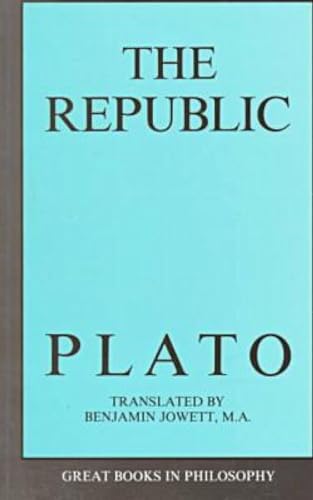
Synopsis
Throughout the history of Western Civilization many powerful works, penned by some of the greatest minds in philosophy, have influenced the development and evolution of political theory, but none has had the profound impact of Plato's Republic. Written by one of the founding fathers of Western philosophy, the Republic, like most of Plato's dialogues, sets the stage for debates that have occupied the minds of thoughtful persons for more than two millennia.
Why does government exist? What is its nature and purpose? Who should govern, and how is this decision to be made? Why should we obey the law? Answers to these and other questions are developed by Plato amid the give and take of a dialogue between his protagonist, Socrates, and a circle of concerned intellectuals. Metaphysical, epistemological, and ethical considerations combine to create an ideal state next to which all existing regimes can be compared.
Les informations fournies dans la section « Synopsis » peuvent faire référence à une autre édition de ce titre.
À propos de l'auteur
PLATO was born about 427 B.C.E. into the distinguished Athenian family of Ariston and Perictione. Although interested in politics as a young man, he became disenchanted with the cruel and immoral behavior of Athenian rulers. Some small ray of hope emerged when Athens deposed its dictators and established a democracy; however, when the citizens put the philosopher Socrates on trial and later executed him for impiety, Plato left Athens to travel abroad.
In 387 B.C.E., Plato finally returned to Athens and created the Academy, an intellectual center for philosophy and science that offered scholarly training in such fields as astronomy, biological sciences, mathematics, and political science. From this influential institution emerged Aristotle, Plato's most famous student. Plato dedicated himself to the Academy until his death in about 347 B.C.E.
During his lifetime Plato wrote a number of supremely important dialogues, which presented and critically analyzed significant philosophical ideas in metaphysics, epistemology, ethics, and social and political philosophy—all of which continue to engage posterity. His better-known dialogues include: The Apology, Cratylus, Crito, Euthyphro, Gorgias, The Laws, Meno, Parmenides, Phaedo, Phaedrus, Protagoras, The Republic, The Sophist, The Symposium, Theaetetus, and Timaeus.
Les informations fournies dans la section « A propos du livre » peuvent faire référence à une autre édition de ce titre.
Résultats de recherche pour The Republic

Image d'archives
The Republic
Edité par
Prometheus Books, 1986
ISBN 10 : 0879753455
ISBN 13 : 9780879753450
Ancien ou d'occasion
Paperback
Vendeur : ThriftBooks-Dallas, Dallas, TX, Etats-Unis
Évaluation du vendeur 5 sur 5 étoiles

Paperback. Etat : Fair. No Jacket. Readable copy. Pages may have considerable notes/highlighting. ~ ThriftBooks: Read More, Spend Less. N° de réf. du vendeur G0879753455I5N00
Acheter D'occasion
EUR 7,62
Livraison gratuite
Expédition nationale : Etats-Unis
Expédition nationale : Etats-Unis
Quantité disponible : 1 disponible(s)
Image d'archives
The Republic
Edité par
Prometheus Books, 1986
ISBN 10 : 0879753455
ISBN 13 : 9780879753450
Ancien ou d'occasion
Paperback
Vendeur : ThriftBooks-Atlanta, AUSTELL, GA, Etats-Unis
Évaluation du vendeur 5 sur 5 étoiles
Paperback. Etat : Very Good. No Jacket. May have limited writing in cover pages. Pages are unmarked. ~ ThriftBooks: Read More, Spend Less. N° de réf. du vendeur G0879753455I4N00
Acheter D'occasion
EUR 7,62
Livraison gratuite
Expédition nationale : Etats-Unis
Expédition nationale : Etats-Unis
Quantité disponible : 1 disponible(s)
Image d'archives
The Republic (Great Books in Philosophy)
Edité par
Prometheus, 1986
ISBN 10 : 0879753455
ISBN 13 : 9780879753450
Ancien ou d'occasion
paperback
Vendeur : Books From California, Simi Valley, CA, Etats-Unis
Évaluation du vendeur 4 sur 5 étoiles

paperback. Etat : Good. N° de réf. du vendeur mon0003273658
Acheter D'occasion
EUR 3,59
Expédition à EUR 4,36
Expédition nationale : Etats-Unis
Expédition nationale : Etats-Unis
Quantité disponible : 1 disponible(s)
Image d'archives
The Republic
Edité par
Prometheus Books, Buffalo, New York, 1986
ISBN 10 : 0879753455
ISBN 13 : 9780879753450
Ancien ou d'occasion
Soft cover
Vendeur : Great Expectations Rare Books, Staten Island, NYC, NY, Etats-Unis
Évaluation du vendeur 5 sur 5 étoiles
Soft cover. Etat : Very Good. First Edition Thus. Large trade paperback. 397pp., Translated by Benjamin Jowett. First edition thus. Previous owner's name on half-title. Else a clean, square, lightly read copy. No soine crease, no writing, underlining, or marking. Very good. N° de réf. du vendeur 010474
Acheter D'occasion
EUR 5,35
Expédition à EUR 5,68
Expédition nationale : Etats-Unis
Expédition nationale : Etats-Unis
Quantité disponible : 1 disponible(s)
Image d'archives
Republic (Great Books in Philosophy)
Edité par
Prometheus, 1986
ISBN 10 : 0879753455
ISBN 13 : 9780879753450
Ancien ou d'occasion
Couverture souple
Vendeur : Phatpocket Limited, Waltham Abbey, HERTS, Royaume-Uni
Évaluation du vendeur 5 sur 5 étoiles
Etat : Good. Your purchase helps support Sri Lankan Children's Charity 'The Rainbow Centre'. Ex-library, so some stamps and wear, but in good overall condition. Our donations to The Rainbow Centre have helped provide an education and a safe haven to hundreds of children who live in appalling conditions. N° de réf. du vendeur Z1-R-039-02563
Acheter D'occasion
EUR 19,12
Expédition à EUR 12,40
Expédition depuis Royaume-Uni vers Etats-Unis
Expédition depuis Royaume-Uni vers Etats-Unis
Quantité disponible : 1 disponible(s)
Image d'archives
Republic (Great Books in Philosophy)
Vendeur : Revaluation Books, Exeter, Royaume-Uni
Évaluation du vendeur 5 sur 5 étoiles
Paperback. Etat : Brand New. edition/printing not stated edition. 397 pages. 8.50x5.50x1.00 inches. In Stock. N° de réf. du vendeur 0879753455
Acheter neuf
EUR 29,17
Expédition à EUR 14,57
Expédition depuis Royaume-Uni vers Etats-Unis
Expédition depuis Royaume-Uni vers Etats-Unis
Quantité disponible : 1 disponible(s)
Image d'archives
Republic (Great Books in Philosophy)
Vendeur : SHIMEDIA, Brooklyn, NY, Etats-Unis
Évaluation du vendeur 4 sur 5 étoiles
Etat : New. Satisfaction Guaranteed or your money back. N° de réf. du vendeur 0879753455
Acheter neuf
EUR 58,47
Livraison gratuite
Expédition nationale : Etats-Unis
Expédition nationale : Etats-Unis
Quantité disponible : 1 disponible(s)