
Articles liés à René Guénon: Some Observations
Synopsis
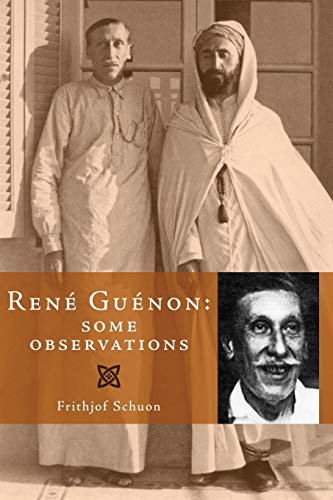
René Guénon (1886-1951) was the founder of the Traditionalist School. Along with Ananda K. Coomaraswamy and Frithjof Schuon, he reintroduced traditional metaphysics and esoterism into the Western world after a lapse of centuries, and was perhaps the first to present the doctrines of the Vedanta, Taoism, and Sufism not as Eurocentric orientalists or occult fantasts had done, but strictly in their own terms.To the 'mathematical' precision of Guénon's metaphysics, cosmology, and esoteric history, Frithjof Schuon (1907-1998) added a poetic or 'musical' element, inspired by his close relationship to the Divine Feminine. He also presented the spiritual path as a concrete praxis, involving the spiritual virtues and 'stations of wisdom', that was not so prominent in Guénon's writings. On the other hand, Guénon's prophetic eschatology, especially in The Reign of Quantity and the Signs of the Times, as well as his analysis of the 'counter-tradition', gives him a unexpectedly contemporary 'edge' that is perhaps less prominent in Schuon's more aesthetic approach.René Guénon and Frithjof Schuon illuminate each other, both through their unanimity and the specific points where they differ. Each is almost the only means of taking the other's measure. Questions of who was greater, who more traditional, are finally less interesting than the tremendous vision of human reality and spiritual truth that emerges from their shared role as renewers of traditional metaphysics and religious understanding. Schuon, as the younger man, was in a position to compose an evaluation of his early intellectual master, and in view of his long and illustrious career as an author after Guénon's death, Schuon's central essay René Guénon: Some Observations is also his profoundly appreciative as well as pointedly critical declaration of independence (though simultaneously a declaration of collegiality) from the man who, more than anyone else in the modern world, opened to him a fundamental view of 'principial' reality.
Les informations fournies dans la section « Synopsis » peuvent faire référence à une autre édition de ce titre.
Présentation de l'éditeur
René Guénon (1886-1951) was the founder of the Traditionalist School. Along with Ananda K. Coomaraswamy and Frithjof Schuon, he reintroduced traditional metaphysics and esoterism into the Western world after a lapse of centuries, and was perhaps the first to present the doctrines of the Vedanta, Taoism, and Sufism not as Eurocentric orientalists or occult fantasts had done, but strictly in their own terms. To the 'mathematical' precision of Guénon's metaphysics, cosmology, and esoteric history, Frithjof Schuon (1907-1998) added a poetic or 'musical' element, inspired by his close relationship to the Divine Feminine. He also presented the spiritual path as a concrete praxis, involving the spiritual virtues and 'stations of wisdom', that was not so prominent in Guénon's writings. On the other hand, Guénon's prophetic eschatology, especially in The Reign of Quantity and the Signs of the Times, as well as his analysis of the 'counter-tradition', gives him a unexpectedly contemporary 'edge' that is perhaps less prominent in Schuon's more aesthetic approach. René Guénon and Frithjof Schuon illuminate each other, both through their unanimity and the specific points where they differ. Each is almost the only means of taking the other's measure. Questions of who was greater, who more traditional, are finally less interesting than the tremendous vision of human reality and spiritual truth that emerges from their shared role as renewers of traditional metaphysics and religious understanding. Schuon, as the younger man, was in a position to compose an evaluation of his early intellectual master, and in view of his long and illustrious career as an author after Guénon's death, Schuon's central essay René Guénon: Some Observations is also his profoundly appreciative as well as pointedly critical declaration of independence (though simultaneously a declaration of collegiality) from the man who, more than anyone else in the modern world, opened to him a fundamental view of 'principial' reality.
Les informations fournies dans la section « A propos du livre » peuvent faire référence à une autre édition de ce titre.
Résultats de recherche pour René Guénon: Some Observations

Image d'archives
Rene Guenon: Some Observations
Edité par
Sophia Perennis et Universalis, 2004
ISBN 10 : 0900588853
ISBN 13 : 9780900588853
Ancien ou d'occasion
Paperback
Vendeur : ThriftBooks-Dallas, Dallas, TX, Etats-Unis
Évaluation du vendeur 5 sur 5 étoiles

Paperback. Etat : Good. No Jacket. Pages can have notes/highlighting. Spine may show signs of wear. ~ ThriftBooks: Read More, Spend Less. N° de réf. du vendeur G0900588853I3N00
Acheter D'occasion
EUR 12,63
Livraison gratuite
Expédition nationale : Etats-Unis
Expédition nationale : Etats-Unis
Quantité disponible : 1 disponible(s)
Image fournie par le vendeur
Rene Guenon : Some Observations
Vendeur : GreatBookPrices, Columbia, MD, Etats-Unis
Évaluation du vendeur 5 sur 5 étoiles
Etat : New. N° de réf. du vendeur 3167676-n
Acheter neuf
EUR 14,31
Expédition à EUR 2,36
Expédition nationale : Etats-Unis
Expédition nationale : Etats-Unis
Quantité disponible : Plus de 20 disponibles
Image fournie par le vendeur
Rene Guenon: Some Observations (Paperback or Softback)
Edité par
Sophia Perennis et Universalis 8/27/2004, 2004
ISBN 10 : 0900588853
ISBN 13 : 9780900588853
Neuf
Paperback or Softback
Vendeur : BargainBookStores, Grand Rapids, MI, Etats-Unis
Évaluation du vendeur 5 sur 5 étoiles
Paperback or Softback. Etat : New. Rene Guenon: Some Observations. Book. N° de réf. du vendeur BBS-9780900588853
Acheter neuf
EUR 16,75
Livraison gratuite
Expédition nationale : Etats-Unis
Expédition nationale : Etats-Unis
Quantité disponible : 5 disponible(s)
Image d'archives
Rene Guenon: Some Observations
Edité par
Sophia Perennis, Hillsdale, NY, 2004
ISBN 10 : 0900588853
ISBN 13 : 9780900588853
Ancien ou d'occasion
Soft cover
Vendeur : Used Esoteric Books, Fairfax, CA, Etats-Unis
Évaluation du vendeur 5 sur 5 étoiles
Soft cover. Etat : As New. Soft Cover, 63 pp. [==] As New. Fresh unmarked copy. N° de réf. du vendeur 7554
Acheter D'occasion
EUR 13,80
Expédition à EUR 3,57
Expédition nationale : Etats-Unis
Expédition nationale : Etats-Unis
Quantité disponible : 1 disponible(s)
Image fournie par le vendeur
Rene Guenon : Some Observations
Edité par
Sophia Perennis, 2004
ISBN 10 : 0900588853
ISBN 13 : 9780900588853
Ancien ou d'occasion
Couverture souple
Vendeur : GreatBookPrices, Columbia, MD, Etats-Unis
Évaluation du vendeur 5 sur 5 étoiles
Etat : As New. Unread book in perfect condition. N° de réf. du vendeur 3167676
Acheter D'occasion
EUR 15,04
Expédition à EUR 2,36
Expédition nationale : Etats-Unis
Expédition nationale : Etats-Unis
Quantité disponible : Plus de 20 disponibles
Image d'archives
Rene Guenon: Some Observations
Vendeur : California Books, Miami, FL, Etats-Unis
Évaluation du vendeur 5 sur 5 étoiles
Etat : New. N° de réf. du vendeur I-9780900588853
Acheter neuf
EUR 18,40
Livraison gratuite
Expédition nationale : Etats-Unis
Expédition nationale : Etats-Unis
Quantité disponible : Plus de 20 disponibles
Image d'archives
Rene Guenon (Paperback)
Edité par
Sophia Perennis et Universalis, 2004
ISBN 10 : 0900588853
ISBN 13 : 9780900588853
Neuf
Paperback
Vendeur : Grand Eagle Retail, Bensenville, IL, Etats-Unis
Évaluation du vendeur 5 sur 5 étoiles
Paperback. Etat : new. Paperback. Rene Guenon (1886-1951) was the founder of the Traditionalist School. Along with Ananda K. Coomaraswamy and Frithjof Schuon, he reintroduced traditional metaphysics and esoterism into the Western world after a lapse of centuries, and was perhaps the first to present the doctrines of the Vedanta, Taoism, and Sufism not as Eurocentric orientalists or occult fantasts had done, but strictly in their own terms. To the 'mathematical' precision of Guenon's metaphysics, cosmology, and esoteric history, Frithjof Schuon (1907-1998) added a poetic or 'musical' element, inspired by his close relationship to the Divine Feminine. He also presented the spiritual path as a concrete praxis, involving the spiritual virtues and 'stations of wisdom', that was not so prominent in Guenon's writings. On the other hand, Guenon's prophetic eschatology, especially in The Reign of Quantity and the Signs of the Times, as well as his analysis of the 'counter-tradition', gives him a unexpectedly contemporary 'edge' that is perhaps less prominent in Schuon's more aesthetic approach. Rene Guenon and Frithjof Schuon illuminate each other, both through their unanimity and the specific points where they differ.Each is almost the only means of taking the other's measure. Questions of who was greater, who more traditional, are finally less interesting than the tremendous vision of human reality and spiritual truth that emerges from their shared role as renewers of traditional metaphysics and religious understanding. Schuon, as the younger man, was in a position to compose an evaluation of his early intellectual master, and in view of his long and illustrious career as an author after Guenon's death, Schuon's central essay Rene Guenon: Some Observations is also his profoundly appreciative as well as pointedly critical declaration of independence (though simultaneously a declaration of collegiality) from the man who, more than anyone else in the modern world, opened to him a fundamental view of 'principial' reality. Rene Guenon (1886-1951) was the founder of the Traditionalist School. Along with Ananda K. Coomaraswamy and Frithjof Schuon, he reintroduced traditional metaphysics and esoterism into the Western world after a lapse of centuries, and was perhaps the first to present the doctrines of the Vedanta, Taoism, and Sufism not as Eurocentric orientalists or occult fantasts had done, but strictly in their own terms.To the 'mathematical' precision of Guenon's metaphysics, cosmology, and esoteric history, Frithjof Schuon (1907-1998) added a poetic or 'musical' element, inspired by his close relationship to the Divine Feminine. He also presented the spiritual path as a concrete praxis, involving the spiritual virtues and 'stations of wisdom', that was not so prominent in Guenon's writings. On the other hand, Guenon's prophetic eschatology, especially in The Reign of Quantity and the Signs of the Times, as well as his analysis of the 'counter-tradition', gives him a unexpectedly contemporary 'edge' that is perhaps less prominent in Schuon's more aesthetic approach.Rene Guenon and Frithjof Schuon illuminate each other, both through their unanimity and the specific points where they differ. Each is almost the only means of taking the other's measure. Questions of who was greater, who more traditional, are finally less interesting than the tremendous vision of human reality and spiritual truth that emerges from their shared role as renewers of traditional metaphysics and religious understanding. Schuon, as the younger man, was in a position to compose an evaluation of his early intellectual master, and in view of his long and illustrious career as an author after Guenon's death, Schuon's central essay Rene Guenon: Some Observations is also his profoundly appreciative as well as pointedly critical declaration of independence (though simultaneously a decl Shipping may be from multiple locations in the US or from the UK, depending on stock availability. N° de réf. du vendeur 9780900588853
Acheter neuf
EUR 19,26
Livraison gratuite
Expédition nationale : Etats-Unis
Expédition nationale : Etats-Unis
Quantité disponible : 1 disponible(s)
Image fournie par le vendeur
Rene Guenon
Edité par
Sophia Perennis et Universalis, US, 2004
ISBN 10 : 0900588853
ISBN 13 : 9780900588853
Neuf
Paperback
Vendeur : Rarewaves.com USA, London, LONDO, Royaume-Uni
Évaluation du vendeur 5 sur 5 étoiles
Paperback. Etat : New. N° de réf. du vendeur LU-9780900588853
Acheter neuf
EUR 20,71
Livraison gratuite
Expédition depuis Royaume-Uni vers Etats-Unis
Expédition depuis Royaume-Uni vers Etats-Unis
Quantité disponible : Plus de 20 disponibles
Image d'archives
Rene Guenon: Some Observations
impression à la demandeVendeur : Chiron Media, Wallingford, Royaume-Uni
Évaluation du vendeur 5 sur 5 étoiles
PF. Etat : New. This item is printed on demand. Brand new book, sourced directly from publisher. Dispatch time is 6-7 days from our warehouse. Book will be sent in robust, secure packaging to ensure it reaches you securely. N° de réf. du vendeur 6666-IUK-9780900588853
Acheter neuf
EUR 15,52
Expédition à EUR 5,31
Expédition depuis Royaume-Uni vers Etats-Unis
Expédition depuis Royaume-Uni vers Etats-Unis
Quantité disponible : 20 disponible(s)
Image d'archives
Rene Guenon
impression à la demandeVendeur : PBShop.store US, Wood Dale, IL, Etats-Unis
Évaluation du vendeur 5 sur 5 étoiles
PAP. Etat : New. New Book. Shipped from UK. THIS BOOK IS PRINTED ON DEMAND. Established seller since 2000. N° de réf. du vendeur L0-9780900588853
Acheter neuf
EUR 21,27
Livraison gratuite
Expédition nationale : Etats-Unis
Expédition nationale : Etats-Unis
Quantité disponible : Plus de 20 disponibles