
Articles liés à Get Past the Tags!: How to Read (and Write) an XML...
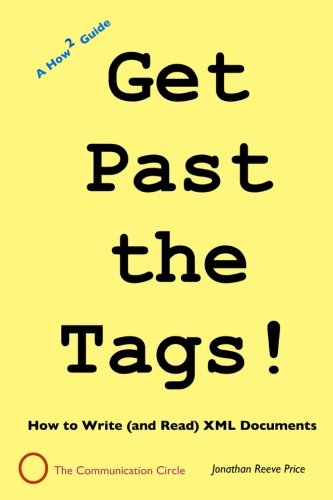
Synopsis
Is this book for you? Yes, if you are a writer. Not a programmer. Not a suit.
Yes, if you must create content that is
- Consistently structured and formatted
- Modular
- Re-usable
- Manipulated by many programs as you write, store, and publish
- Displayed in many formats on many platforms and in many media.
In this book: You’ll learn how XML grew out of familiar aspects of ordinary writing, such as proofreader’s marks. XML just formalizes many tactics we have already developed, in the history of writing. You’ll learn how to create content within an XML environment.
Payoff:When you complete this book, you’ll be able to read an XML document—getting past the tags. And you’ll be able to create XML elements, attributes, comments, processing instructions, and, yes, entity references.
How it works:You get step-by-step instructions on building each part of an XML document. No more abstract talk. You can see exactly how each tag is constructed, from beginning to end.
- Diagrams: You see the structure in a large diagram, so you can tell where each piece of punctuation goes, and what the components do.
- Examples: You get examples, so you can see exactly how the tags develop, and how they look when completed.
- Answers: If you have questions, we’ve got answers. Addressing the most common questions that writers raise in discussions, the FAQs give you context and background on the tags.
- Lookups: You’ll find a thorough glossary and index in the back, so you can use this book as a reference, to look up a concept, tag, or syntax.
Les informations fournies dans la section « Synopsis » peuvent faire référence à une autre édition de ce titre.
À propos de l'auteur
Jonathan Price works regularly in XML environments—gigantic web sites grinding away with content management software, mostly in ecommerce, high tech, and scientific research. He spent four years as a Senior Technical Writer at Apple , where he wrote a styleguide for the technical writers, How to Write an Apple Manual, which morphed into How to Write a Computer Manual, which became, later, How to Communicate Technical Information. After graduating from Apple, he wrote multiple help systems, and consulted with writing teams at an A to Z of high-tech firms on electronic customer assistance, first within programs, then on the Web. He has been creating structured content for the Web for more than 20 years, mostly for large corporations, writing tips, FAQs, and task topics, helping to develop information architectures, refining customer assistance, and coaching teams on content strategy. He gives workshops on writing at conferences and at universities such as the University of California Extension at Santa Cruz. He has published more than thirty nonfiction books, mostly on technical subjects. With his wife Lisa he published Hot Text: Web Writing that Works, a book on how to write effectively for the Web.
Les informations fournies dans la section « A propos du livre » peuvent faire référence à une autre édition de ce titre.
Résultats de recherche pour Get Past the Tags!: How to Read (and Write) an XML...

Image d'archives
Get Past the Tags!: How to Read (and Write) an XML Document
Edité par
The Communication Circle (edition ), 2018
ISBN 10 : 0971995494
ISBN 13 : 9780971995499
Ancien ou d'occasion
Paperback
Vendeur : BooksRun, Philadelphia, PA, Etats-Unis
Évaluation du vendeur 5 sur 5 étoiles

Paperback. Etat : Very Good. It's a well-cared-for item that has seen limited use. The item may show minor signs of wear. All the text is legible, with all pages included. It may have slight markings and/or highlighting. N° de réf. du vendeur 0971995494-11-1
Acheter D'occasion
EUR 4,48
Livraison gratuite
Expédition nationale : Etats-Unis
Expédition nationale : Etats-Unis
Quantité disponible : 1 disponible(s)
Image d'archives
Get Past the Tags How to Read
Edité par
The Communication Circle, 2018
ISBN 10 : 0971995494
ISBN 13 : 9780971995499
Ancien ou d'occasion
Couverture souple
Vendeur : World of Books (was SecondSale), Montgomery, IL, Etats-Unis
Évaluation du vendeur 5 sur 5 étoiles
Etat : Acceptable. Item in acceptable condition! Textbooks may not include supplemental items i.e. CDs, access codes etc. N° de réf. du vendeur 00108821350
Acheter D'occasion
EUR 5,44
Livraison gratuite
Expédition nationale : Etats-Unis
Expédition nationale : Etats-Unis
Quantité disponible : 1 disponible(s)
Image d'archives
Get Past the Tags!: How to Read (and Write) an XML Document
Edité par
The Communication Circle, 2018
ISBN 10 : 0971995494
ISBN 13 : 9780971995499
Neuf
Paperback
Vendeur : Revaluation Books, Exeter, Royaume-Uni
Évaluation du vendeur 5 sur 5 étoiles
Paperback. Etat : Brand New. 1st edition. 188 pages. 9.00x6.00x0.43 inches. In Stock. N° de réf. du vendeur zk0971995494
Acheter neuf
EUR 15,14
Expédition à EUR 11,67
Expédition depuis Royaume-Uni vers Etats-Unis
Expédition depuis Royaume-Uni vers Etats-Unis
Quantité disponible : 1 disponible(s)