
Articles liés à The Semantics of Compounding
Synopsis
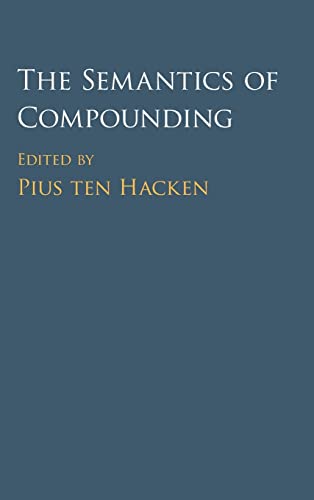
The question of how to determine the meaning of compounds was prominent in early generative morphology, but lost importance after the late 1970s. In the past decade, it has been revived by the emergence of a number of frameworks that are better suited to studying this question than earlier ones. In this book, three frameworks for studying the semantics of compounding are presented by their initiators: Jackendoff's Parallel Architecture, Lieber's theory of lexical semantics, and Štekauer's onomasiological theory. Common to these presentations is a focus on English noun-noun compounds. In the following chapters, these theories are then applied to different types of compounding (phrasal, A+N, neoclassical) and other languages (French, German, Swedish, Greek). Finally, a comparison highlights how each framework offers particular insight into the meaning of compounds. An exciting new contribution to the field, this book will be of interest to morphologists, semanticists and cognitive linguists.
Les informations fournies dans la section « Synopsis » peuvent faire référence à une autre édition de ce titre.
À propos de l'auteur
Pius ten Hacken studied French and general linguistics in Utrecht and has worked for the machine translation project Eurotra and at universities in Basel (computer science and general linguistics), Swansea (French and translation studies), and Innsbruck (translation studies). His research interests focus on word formation, terminology, lexicography and the nature of language as an object of linguistic study. He is the author of Defining Morphology (1994) and Chomskyan Linguistics and its Competitors (2007), the editor of Terminology, Computing and Translation (2006), and co-editor of The Semantics of Word Formation and Lexicalization (2013).
Les informations fournies dans la section « A propos du livre » peuvent faire référence à une autre édition de ce titre.
Résultats de recherche pour The Semantics of Compounding

Image d'archives
The Semantics of Compounding
Edité par
Cambridge University Press, 2016
ISBN 10 : 1107099706
ISBN 13 : 9781107099708
Neuf
Couverture rigide
Vendeur : California Books, Miami, FL, Etats-Unis
Évaluation du vendeur 5 sur 5 étoiles

Etat : New. N° de réf. du vendeur I-9781107099708
Acheter neuf
EUR 149,85
Livraison gratuite
Expédition nationale : Etats-Unis
Expédition nationale : Etats-Unis
Quantité disponible : Plus de 20 disponibles
Image d'archives
The Semantics of Compounding
Edité par
Cambridge University Press, 2016
ISBN 10 : 1107099706
ISBN 13 : 9781107099708
Neuf
Couverture rigide
Vendeur : Kennys Bookshop and Art Galleries Ltd., Galway, GY, Irlande
Évaluation du vendeur 5 sur 5 étoiles
Etat : New. Presents three frameworks for studying morphology, offering different insights into the meaning of compounds. Editor(s): Hacken, Pius Ten. Num Pages: 266 pages, 6 b/w illus. 10 tables. BIC Classification: CFGA. Category: (U) Tertiary Education (US: College). Dimension: 161 x 236 x 24. Weight in Grams: 536. . 2016. Illustrated. hardcover. . . . . N° de réf. du vendeur V9781107099708
Acheter neuf
EUR 149,44
Expédition à EUR 9,50
Expédition depuis Irlande vers Etats-Unis
Expédition depuis Irlande vers Etats-Unis
Quantité disponible : Plus de 20 disponibles
Image d'archives
The Semantics of Compounding
Edité par
Cambridge University Press, 2016
ISBN 10 : 1107099706
ISBN 13 : 9781107099708
Neuf
Couverture rigide
Vendeur : Ria Christie Collections, Uxbridge, Royaume-Uni
Évaluation du vendeur 5 sur 5 étoiles
Etat : New. In English. N° de réf. du vendeur ria9781107099708_new
Acheter neuf
EUR 155,96
Expédition à EUR 13,34
Expédition depuis Royaume-Uni vers Etats-Unis
Expédition depuis Royaume-Uni vers Etats-Unis
Quantité disponible : Plus de 20 disponibles
Image d'archives
The Semantics of Compounding
Edité par
Cambridge University Press, 2016
ISBN 10 : 1107099706
ISBN 13 : 9781107099708
Neuf
Couverture rigide
Vendeur : THE SAINT BOOKSTORE, Southport, Royaume-Uni
Évaluation du vendeur 5 sur 5 étoiles
Hardback. Etat : New. This item is printed on demand. New copy - Usually dispatched within 5-9 working days. N° de réf. du vendeur C9781107099708
Acheter neuf
EUR 151,83
Expédition à EUR 18,68
Expédition depuis Royaume-Uni vers Etats-Unis
Expédition depuis Royaume-Uni vers Etats-Unis
Quantité disponible : Plus de 20 disponibles
Image d'archives
The Semantics of Compounding (Hardcover)
Edité par
Cambridge University Press, Cambridge, 2016
ISBN 10 : 1107099706
ISBN 13 : 9781107099708
Neuf
Couverture rigide
Vendeur : CitiRetail, Stevenage, Royaume-Uni
Évaluation du vendeur 5 sur 5 étoiles
Hardcover. Etat : new. Hardcover. The question of how to determine the meaning of compounds was prominent in early generative morphology, but lost importance after the late 1970s. In the past decade, it has been revived by the emergence of a number of frameworks that are better suited to studying this question than earlier ones. In this book, three frameworks for studying the semantics of compounding are presented by their initiators: Jackendoff's Parallel Architecture, Lieber's theory of lexical semantics, and Stekauer's onomasiological theory. Common to these presentations is a focus on English noun-noun compounds. In the following chapters, these theories are then applied to different types of compounding (phrasal, A+N, neoclassical) and other languages (French, German, Swedish, Greek). Finally, a comparison highlights how each framework offers particular insight into the meaning of compounds. An exciting new contribution to the field, this book will be of interest to morphologists, semanticists and cognitive linguists. In a compound, two words are combined to make a new word. The meaning of the new word cannot easily be predicted on the basis of its constituent parts. This book presents three frameworks that give insights into the factors that contribute to the semantics of compounds in various languages. This item is printed on demand. Shipping may be from our UK warehouse or from our Australian or US warehouses, depending on stock availability. N° de réf. du vendeur 9781107099708
Acheter neuf
EUR 152,12
Expédition à EUR 43,72
Expédition depuis Royaume-Uni vers Etats-Unis
Expédition depuis Royaume-Uni vers Etats-Unis
Quantité disponible : 1 disponible(s)
Image fournie par le vendeur
The Semantics of Compounding
Edité par
Cambridge University Press, 2016
ISBN 10 : 1107099706
ISBN 13 : 9781107099708
Neuf
Couverture rigide
Vendeur : moluna, Greven, Allemagne
Évaluation du vendeur 5 sur 5 étoiles
Etat : New. Dieser Artikel ist ein Print on Demand Artikel und wird nach Ihrer Bestellung fuer Sie gedruckt. In a compound, two words are combined to make a new word. The meaning of the new word cannot easily be predicted on the basis of its constituent parts. This book presents three frameworks that give insights into the factors that contribute to the semantics . N° de réf. du vendeur 35206586
Acheter neuf
EUR 146,93
Expédition à EUR 48,99
Expédition depuis Allemagne vers Etats-Unis
Expédition depuis Allemagne vers Etats-Unis
Quantité disponible : Plus de 20 disponibles
Image d'archives
The Semantics of Compounding
Edité par
Cambridge University Press, 2016
ISBN 10 : 1107099706
ISBN 13 : 9781107099708
Neuf
Couverture rigide
Vendeur : Kennys Bookstore, Olney, MD, Etats-Unis
Évaluation du vendeur 5 sur 5 étoiles
Etat : New. Presents three frameworks for studying morphology, offering different insights into the meaning of compounds. Editor(s): Hacken, Pius Ten. Num Pages: 266 pages, 6 b/w illus. 10 tables. BIC Classification: CFGA. Category: (U) Tertiary Education (US: College). Dimension: 161 x 236 x 24. Weight in Grams: 536. . 2016. Illustrated. hardcover. . . . . Books ship from the US and Ireland. N° de réf. du vendeur V9781107099708
Acheter neuf
EUR 195,48
Expédition à EUR 9,37
Expédition nationale : Etats-Unis
Expédition nationale : Etats-Unis
Quantité disponible : Plus de 20 disponibles
Image d'archives
The Semantics of Compounding
Edité par
Cambridge Univ Pr, 2016
ISBN 10 : 1107099706
ISBN 13 : 9781107099708
Neuf
Couverture rigide
Vendeur : Revaluation Books, Exeter, Royaume-Uni
Évaluation du vendeur 5 sur 5 étoiles
Hardcover. Etat : Brand New. 190 pages. 9.00x6.00x0.75 inches. In Stock. N° de réf. du vendeur x-1107099706
Acheter neuf
EUR 196,89
Expédition à EUR 14,77
Expédition depuis Royaume-Uni vers Etats-Unis
Expédition depuis Royaume-Uni vers Etats-Unis
Quantité disponible : 2 disponible(s)
Image fournie par le vendeur
The Semantics of Compounding
Edité par
Cambridge University Press, 2016
ISBN 10 : 1107099706
ISBN 13 : 9781107099708
Neuf
Couverture rigide
Vendeur : preigu, Osnabrück, Allemagne
Évaluation du vendeur 5 sur 5 étoiles
Buch. Etat : Neu. The Semantics of Compounding | Pius Ten Hacken | Buch | Gebunden | Englisch | 2016 | Cambridge University Press | EAN 9781107099708 | Verantwortliche Person für die EU: Libri GmbH, Europaallee 1, 36244 Bad Hersfeld, gpsr[at]libri[dot]de | Anbieter: preigu Print on Demand. N° de réf. du vendeur 104572842
Acheter neuf
EUR 152,35
Expédition à EUR 70
Expédition depuis Allemagne vers Etats-Unis
Expédition depuis Allemagne vers Etats-Unis
Quantité disponible : 5 disponible(s)
Image fournie par le vendeur
The Semantics of Compounding
Edité par
Cambridge University Press, 2016
ISBN 10 : 1107099706
ISBN 13 : 9781107099708
Neuf
Couverture rigide
Vendeur : AHA-BUCH GmbH, Einbeck, Allemagne
Évaluation du vendeur 5 sur 5 étoiles
Buch. Etat : Neu. Druck auf Anfrage Neuware - Printed after ordering - The question of how to determine the meaning of compounds was prominent in early generative morphology, but lost importance after the late 1970s. In the past decade, it has been revived by the emergence of a number of frameworks that are better suited to studying this question than earlier ones. In this book, three frameworks for studying the semantics of compounding are presented by their initiators: Jackendoff's Parallel Architecture, Lieber's theory of lexical semantics, and ¿tekauer's onomasiological theory. Common to these presentations is a focus on English noun-noun compounds. In the following chapters, these theories are then applied to different types of compounding (phrasal, A+N, neoclassical) and other languages (French, German, Swedish, Greek). Finally, a comparison highlights how each framework offers particular insight into the meaning of compounds. An exciting new contribution to the field, this book will be of interest to morphologists, semanticists and cognitive linguists. N° de réf. du vendeur 9781107099708
Acheter neuf
EUR 195,70
Expédition à EUR 35
Expédition depuis Allemagne vers Etats-Unis
Expédition depuis Allemagne vers Etats-Unis
Quantité disponible : 1 disponible(s)