
Articles liés à Corpus Paroemiographorum Graecorum
Synopsis
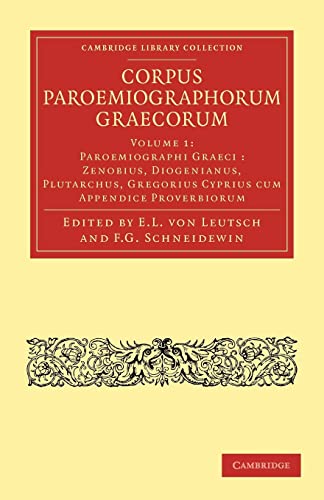
Between 1839 and 1851 Ernest Ludwig von Leutsch (1808–1887) and Friedrich Wilhelm Schneidewin (1810–1856), classics professors at the University of Göttingen, published this collection of ancient paroimia or proverbs written or collected by ancient Greek authors. Volume 1 contains writings by Zenobius, Diogenianus, Plutarchus, and Gregorius Cyprius. A critical apparatus for each text cites variant readings between manuscripts; a running Latin commentary is given below the critical apparatus; and a Latin preface, written by Schneidewin, introduces the volume and explains the editorial methods underlying the work. The Corpus has long been considered the definitive collection of Greek paroemiography and is still used as a model of textual editing by researchers today. Unsurpassed in its breath and scope, it remains an indispensable tool for students and scholars of the Greek proverbial tradition. It ranks as one of the outstanding achievements of nineteenth-century scholarship.
Les informations fournies dans la section « Synopsis » peuvent faire référence à une autre édition de ce titre.
Présentation de l'éditeur
Between 1839 and 1851 Ernest Ludwig von Leutsch (1808–1887) and Friedrich Wilhelm Schneidewin (1810–1856), classics professors at the University of Göttingen, published this collection of ancient paroimia or proverbs written or collected by ancient Greek authors. Volume 1 contains writings by Zenobius, Diogenianus, Plutarchus, and Gregorius Cyprius. A critical apparatus for each text cites variant readings between manuscripts; a running Latin commentary is given below the critical apparatus; and a Latin preface, written by Schneidewin, introduces the volume and explains the editorial methods underlying the work. The Corpus has long been considered the definitive collection of Greek paroemiography and is still used as a model of textual editing by researchers today. Unsurpassed in its breath and scope, it remains an indispensable tool for students and scholars of the Greek proverbial tradition. It ranks as one of the outstanding achievements of nineteenth-century scholarship.
Les informations fournies dans la section « A propos du livre » peuvent faire référence à une autre édition de ce titre.
Résultats de recherche pour Corpus Paroemiographorum Graecorum

Image d'archives
Corpus Paroemiographorum Graecorum: Paroemiographi Graeci: Zenobius, Diogenianus, Plutarchus, Gregorius, Cyprius Cum Appendice Proverbiorum: 1 (Cambridge Library Collection - Classics)
Edité par
Cambridge University Press 01/v /11 N, 2010
ISBN 10 : 1108015530
ISBN 13 : 9781108015530
Ancien ou d'occasion
Couverture souple
Vendeur : Bahamut Media, Reading, Royaume-Uni
Évaluation du vendeur 5 sur 5 étoiles

Etat : Very Good. Shipped within 24 hours from our UK warehouse. Clean, undamaged book with no damage to pages and minimal wear to the cover. Spine still tight, in very good condition. Remember if you are not happy, you are covered by our 100% money back guarantee. N° de réf. du vendeur 6545-9781108015530
Acheter D'occasion
EUR 12
Expédition à EUR 8,15
Expédition depuis Royaume-Uni vers Etats-Unis
Expédition depuis Royaume-Uni vers Etats-Unis
Quantité disponible : 1 disponible(s)
Image d'archives
Corpus Paroemiographorum Graecorum: Paroemiographi Graeci: Zenobius, Diogenianus, Plutarchus, Gregorius, Cyprius Cum Appendice Proverbiorum: 1 (Cambridge Library Collection - Classics)
Vendeur : AwesomeBooks, Wallingford, Royaume-Uni
Évaluation du vendeur 5 sur 5 étoiles
Paperback. Etat : Very Good. Corpus Paroemiographorum Graecorum: Paroemiographi Graeci: Zenobius, Diogenianus, Plutarchus, Gregorius, Cyprius Cum Appendice Proverbiorum: 1 (Cambridge Library Collection - Classics) This book is in very good condition and will be shipped within 24 hours of ordering. The cover may have some limited signs of wear but the pages are clean, intact and the spine remains undamaged. This book has clearly been well maintained and looked after thus far. Money back guarantee if you are not satisfied. See all our books here, order more than 1 book and get discounted shipping. N° de réf. du vendeur 7719-9781108015530
Acheter D'occasion
EUR 39,29
Expédition à EUR 4,81
Expédition depuis Royaume-Uni vers Etats-Unis
Expédition depuis Royaume-Uni vers Etats-Unis
Quantité disponible : 2 disponible(s)
Image d'archives
Corpus Paroemiographorum Graecorum: Volume 1, Paroemiographi Graeci: Zenobius, Diogenianus, Plutarchus, Gregorius Cyprius cum Appendice Proverbiorum ... - Classics) (Ancient Greek Edition)
Edité par
Cambridge University Press, 2010
ISBN 10 : 1108015530
ISBN 13 : 9781108015530
Neuf
Couverture souple
Vendeur : Ria Christie Collections, Uxbridge, Royaume-Uni
Évaluation du vendeur 5 sur 5 étoiles
Etat : New. In Greek, Ancient (to 1453). N° de réf. du vendeur ria9781108015530_new
Acheter neuf
EUR 64,80
Expédition à EUR 13,18
Expédition depuis Royaume-Uni vers Etats-Unis
Expédition depuis Royaume-Uni vers Etats-Unis
Quantité disponible : Plus de 20 disponibles
Image d'archives
Corpus Paroemiographorum Graecorum: Paroemiographi Graeci: Zenobius, Diogenianus, Plutarchus, Gregorius, Cyprius Cum Appendice Proverbiorum: 1 (Cambridge Library Collection - Classics)
Edité par
Cambridge University Press, 2010
ISBN 10 : 1108015530
ISBN 13 : 9781108015530
Neuf
Couverture souple
Vendeur : Kennys Bookshop and Art Galleries Ltd., Galway, GY, Irlande
Évaluation du vendeur 5 sur 5 étoiles
Etat : New. The definitive collection of ancient Greek proverbs, first published in Germany 1839-1851 and still unsurpassed. Editor(s): Leutsch, E. L. Von; Schneidewin, F. G. Series: Cambridge Library Collection - Classics. Num Pages: 590 pages, black & white illustrations. BIC Classification: DSBB. Category: (P) Professional & Vocational. Dimension: 216 x 140 x 33. Weight in Grams: 740. . 2010. paperback. . . . . N° de réf. du vendeur V9781108015530
Acheter neuf
EUR 72,25
Expédition à EUR 9,50
Expédition depuis Irlande vers Etats-Unis
Expédition depuis Irlande vers Etats-Unis
Quantité disponible : Plus de 20 disponibles
Image d'archives
Corpus Paroemiographorum Graecorum, Volume 1
Edité par
Cambridge University Press CUP, 2010
ISBN 10 : 1108015530
ISBN 13 : 9781108015530
Neuf
Couverture souple
Vendeur : Books Puddle, New York, NY, Etats-Unis
Évaluation du vendeur 4 sur 5 étoiles

Etat : New. pp. 590. N° de réf. du vendeur 26611160
Acheter neuf
EUR 95,47
Expédition à EUR 3,46
Expédition nationale : Etats-Unis
Expédition nationale : Etats-Unis
Quantité disponible : 4 disponible(s)
Image d'archives
Corpus Paroemiographorum Graecorum: Paroemiographi Graeci: Zenobius, Diogenianus, Plutarchus, Gregorius, Cyprius Cum Appendice Proverbiorum: 1 (Cambridge Library Collection - Classics)
Edité par
Cambridge University Press, 2010
ISBN 10 : 1108015530
ISBN 13 : 9781108015530
Neuf
Couverture souple
Vendeur : Kennys Bookstore, Olney, MD, Etats-Unis
Évaluation du vendeur 5 sur 5 étoiles
Etat : New. The definitive collection of ancient Greek proverbs, first published in Germany 1839-1851 and still unsurpassed. Editor(s): Leutsch, E. L. Von; Schneidewin, F. G. Series: Cambridge Library Collection - Classics. Num Pages: 590 pages, black & white illustrations. BIC Classification: DSBB. Category: (P) Professional & Vocational. Dimension: 216 x 140 x 33. Weight in Grams: 740. . 2010. paperback. . . . . Books ship from the US and Ireland. N° de réf. du vendeur V9781108015530
Acheter neuf
EUR 90,23
Expédition à EUR 9,10
Expédition nationale : Etats-Unis
Expédition nationale : Etats-Unis
Quantité disponible : Plus de 20 disponibles
Image d'archives
Corpus Paroemiographorum Graecorum, Volume 1
Edité par
Cambridge University Press, 2010
ISBN 10 : 1108015530
ISBN 13 : 9781108015530
Neuf
Couverture souple
Vendeur : Majestic Books, Hounslow, Royaume-Uni
Évaluation du vendeur 4 sur 5 étoiles
Etat : New. Print on Demand pp. 590 1:B&W 5.5 x 8.5 in or 216 x 140 mm (Demy 8vo) Perfect Bound on Creme w/Gloss Lam. N° de réf. du vendeur 8318087
Acheter neuf
EUR 95,71
Expédition à EUR 7,59
Expédition depuis Royaume-Uni vers Etats-Unis
Expédition depuis Royaume-Uni vers Etats-Unis
Quantité disponible : 4 disponible(s)
Image d'archives
Corpus Paroemiographorum Graecorum, Volume 1
Edité par
Cambridge University Press, 2010
ISBN 10 : 1108015530
ISBN 13 : 9781108015530
Neuf
Couverture souple
Vendeur : Biblios, Frankfurt am main, HESSE, Allemagne
Évaluation du vendeur 4 sur 5 étoiles
Etat : New. PRINT ON DEMAND pp. 590. N° de réf. du vendeur 18611154
Acheter neuf
EUR 96,38
Expédition à EUR 9,95
Expédition depuis Allemagne vers Etats-Unis
Expédition depuis Allemagne vers Etats-Unis
Quantité disponible : 4 disponible(s)
Image fournie par le vendeur
Corpus Paroemiographorum Graecorum, Volume 1
Edité par
Cambridge University Press, 2010
ISBN 10 : 1108015530
ISBN 13 : 9781108015530
Neuf
Couverture souple
Vendeur : moluna, Greven, Allemagne
Évaluation du vendeur 5 sur 5 étoiles
Etat : New. Dieser Artikel ist ein Print on Demand Artikel und wird nach Ihrer Bestellung fuer Sie gedruckt. First published between 1839 and 1851, this is still widely considered to be the definitive collection of ancient Greek proverbs and ranks among the outstanding works of nineteenth-century classical scholarship. Volume 1 contains texts by Zenobius, Diogenia. N° de réf. du vendeur 447224870
Acheter neuf
EUR 71,14
Expédition à EUR 48,99
Expédition depuis Allemagne vers Etats-Unis
Expédition depuis Allemagne vers Etats-Unis
Quantité disponible : Plus de 20 disponibles
Image fournie par le vendeur
Corpus Paroemiographorum Graecorum, Volume 1 : Paroemiographi Graeci: Zenobius, Diogenianus, Plutarchus, Gregorius, Cyprius Cum Appendice Proverbiorum
Edité par
Cambridge University Press, 2010
ISBN 10 : 1108015530
ISBN 13 : 9781108015530
Neuf
Taschenbuch
Vendeur : AHA-BUCH GmbH, Einbeck, Allemagne
Évaluation du vendeur 5 sur 5 étoiles
Taschenbuch. Etat : Neu. Druck auf Anfrage Neuware - Printed after ordering - Between 1839 and 1851 Ernest Ludwig von Leutsch (1808-1887) and Friedrich Wilhelm Schneidewin (1810-1856), classics professors at the University of Göttingen, published this collection of ancient paroimia or proverbs written or collected by ancient Greek authors. Volume 1 contains writings by Zenobius, Diogenianus, Plutarchus, and Gregorius Cyprius. A critical apparatus for each text cites variant readings between manuscripts; a running Latin commentary is given below the critical apparatus; and a Latin preface, written by Schneidewin, introduces the volume and explains the editorial methods underlying the work. The Corpus has long been considered the definitive collection of Greek paroemiography and is still used as a model of textual editing by researchers today. Unsurpassed in its breath and scope, it remains an indispensable tool for students and scholars of the Greek proverbial tradition. It ranks as one of the outstanding achievements of nineteenth-century scholarship. N° de réf. du vendeur 9781108015530
Acheter neuf
EUR 113
Expédition à EUR 30,50
Expédition depuis Allemagne vers Etats-Unis
Expédition depuis Allemagne vers Etats-Unis
Quantité disponible : 1 disponible(s)