
Articles liés à Utopia: The Influential Classic
Synopsis
What we can learn from a Renaissance nowhere
In 1516, a book was published in Latin with the enigmatic Greek-derived word as its title. Utopia--which could mean either "good-place" or "no-place"--gives a traveler's account of a newly discovered island somewhere in the New World where the inhabitants enjoy a social order based purely on natural reason and justice. As the traveler describes the harmony, prosperity, and equality found there, a dramatic contrast is drawn between the ideal community he portrays and the poverty, crime, and often frightening political conditions of 16th century Europe. Written by Sir Thomas More (1477-1535)--then a rising intellectual star of the Renaissance and ultimately the advisor and friend of Henry VIII who was executed for his devoutly Catholic opposition to the king--Utopia is as complex as its author.
In the form of a Platonic dialogue, Utopia explores topics such as money, property, crime, education, religious tolerance, euthanasia, and feminism. Claimed as a paean to communism (Lenin had More's name inscribed on a statue in Moscow) as often as it has been seen as a defense of traditional medieval values, Utopia began the lineage of utopian thinkers who use storytelling to explore new possibilities for human society--and remains as relevant today as when it was written in Antwerp 500 years ago.
- Explore the issues like feminism, euthanasia, and equality through Renaissance eyes
- Early communist tract or a defense of medieval values? You decide.
- Peer inside the enigmatic mind of the man who dared stand up to Henry VIII
- Appreciate the postmodern possibilities of Platonic dialogue
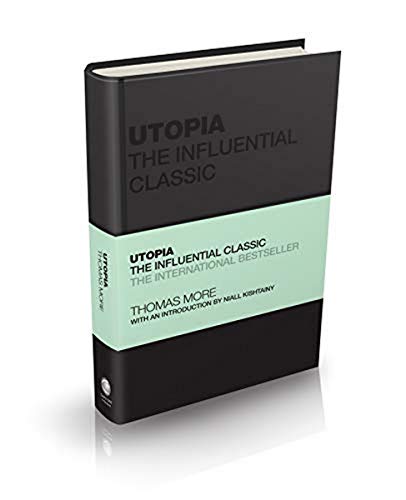
Part of the bestselling Capstone Classics series edited by Tom Butler-Bowdon, this edition features an introduction from writer, economist, and historian Niall Kishtainy.
Les informations fournies dans la section « Synopsis » peuvent faire référence à une autre édition de ce titre.
À propos de l'auteur
SIR THOMAS MORE was a rising intellectual star of Renaissance Europe. His brilliance made him an advisor and friend of King Henry VIII. More's Utopia contrasts the squalor and brutal politics of the England of his time with a picture of a peaceful and prosperous society.
NIALL KISHTAINY is a writer with interests in economics and in the history of ideas. He holds a PhD in economics from the University of Warwick and has taught economic history at the London School of Economics. His most recent book, A Little History of Economics, was published by Yale University Press in 2017.
TOM BUTLER-BOWDEN is Series Editor of the Capstone Classics series, and has provided introductions for Plato's Republic, Adam Smith's Wealth of Nations, Machiavelli's The Prince, Florence Scovel Shinn's The Game of Life and How to Play It, and Kahlil Gibran's The Prophet. A graduate of the London School of Economics, he is also the author of 50 Economics Classics (2017) and 50 Politics Classics (2015).
www.butler-bowdon.com
Les informations fournies dans la section « A propos du livre » peuvent faire référence à une autre édition de ce titre.
Résultats de recherche pour Utopia: The Influential Classic

Image d'archives
Utopia : The Influential Classic
Edité par
Capstone, 2021
ISBN 10 : 1119754380
ISBN 13 : 9781119754381
Ancien ou d'occasion
Couverture rigide
Vendeur : GreatBookPrices, Columbia, MD, Etats-Unis
Évaluation du vendeur 5 sur 5 étoiles

Etat : As New. Unread book in perfect condition. N° de réf. du vendeur 41424412
Acheter D'occasion
EUR 10,17
Expédition à EUR 2,35
Expédition nationale : Etats-Unis
Expédition nationale : Etats-Unis
Quantité disponible : Plus de 20 disponibles
Image d'archives
Utopia : The Influential Classic
Vendeur : GreatBookPrices, Columbia, MD, Etats-Unis
Évaluation du vendeur 5 sur 5 étoiles
Etat : New. N° de réf. du vendeur 41424412-n
Acheter neuf
EUR 11,40
Expédition à EUR 2,35
Expédition nationale : Etats-Unis
Expédition nationale : Etats-Unis
Quantité disponible : Plus de 20 disponibles
Image fournie par le vendeur
Utopia
Edité par
John Wiley and Sons Ltd, GB, 2021
ISBN 10 : 1119754380
ISBN 13 : 9781119754381
Neuf
Couverture rigide
Vendeur : Rarewaves.com USA, London, LONDO, Royaume-Uni
Évaluation du vendeur 5 sur 5 étoiles
Hardback. Etat : New. What we can learn from a Renaissance nowhere In 1516, a book was published in Latin with the enigmatic Greek-derived word as its title. Utopia-which could mean either "good-place" or "no-place"-gives a traveler's account of a newly discovered island somewhere in the New World where the inhabitants enjoy a social order based purely on natural reason and justice. As the traveler describes the harmony, prosperity, and equality found there, a dramatic contrast is drawn between the ideal community he portrays and the poverty, crime, and often frightening political conditions of 16th century Europe. Written by Sir Thomas More (1477-1535)-then a rising intellectual star of the Renaissance and ultimately the advisor and friend of Henry VIII who was executed for his devoutly Catholic opposition to the king-Utopia is as complex as its author. In the form of a Platonic dialogue, Utopia explores topics such as money, property, crime, education, religious tolerance, euthanasia, and feminism. Claimed as a paean to communism (Lenin had More's name inscribed on a statue in Moscow) as often as it has been seen as a defense of traditional medieval values, Utopia began the lineage of utopian thinkers who use storytelling to explore new possibilities for human society-and remains as relevant today as when it was written in Antwerp 500 years ago. Explore the issues like feminism, euthanasia, and equality through Renaissance eyesEarly communist tract or a defense of medieval values? You decide.Peer inside the enigmatic mind of the man who dared stand up to Henry VIIIAppreciate the postmodern possibilities of Platonic dialogue Part of the bestselling Capstone Classics series edited by Tom Butler-Bowdon, this edition features an introduction from writer, economist, and historian Niall Kishtainy. N° de réf. du vendeur LU-9781119754381
Acheter neuf
EUR 13,81
Livraison gratuite
Expédition depuis Royaume-Uni vers Etats-Unis
Expédition depuis Royaume-Uni vers Etats-Unis
Quantité disponible : Plus de 20 disponibles
Image d'archives
Utopia: The Influential Classic (Capstone Classics)
Edité par
Capstone, 2021
ISBN 10 : 1119754380
ISBN 13 : 9781119754381
Ancien ou d'occasion
Couverture rigide
Vendeur : Booksavers of Virginia, Harrisonburg, VA, Etats-Unis
Évaluation du vendeur 5 sur 5 étoiles
hardcover. Etat : Very Good. Etat de la jaquette : Very Good. In very good, unmarked condition. Appears to be unused. Dust jacket is very good. Your purchase benefits the world-wide relief efforts of Mennonite Central Committee. N° de réf. du vendeur mon0000371968
Acheter D'occasion
EUR 10,69
Expédition à EUR 4,43
Expédition nationale : Etats-Unis
Expédition nationale : Etats-Unis
Quantité disponible : 1 disponible(s)
Image fournie par le vendeur
Utopia (Hardcover)
Edité par
John Wiley And Sons Ltd, Hoboken, 2021
ISBN 10 : 1119754380
ISBN 13 : 9781119754381
Neuf
Couverture rigide
Vendeur : Grand Eagle Retail, Bensenville, IL, Etats-Unis
Évaluation du vendeur 5 sur 5 étoiles
Hardcover. Etat : new. Hardcover. In 1516, a book was published in Latin with the enigmatic Greek-derived word as its title. Utopiawhich could mean either good-place or no-placegives a travelers account of a newly discovered island somewhere in the New World where the inhabitants enjoy a social order based purely on natural reason and justice. As the traveler describes the harmony, prosperity, and equality found there, a dramatic contrast is drawn between the ideal community he portrays and the poverty, crime, and often frightening political conditions of 16th century Europe. Written by Sir Thomas More (14771535)then a rising intellectual star of the Renaissance and ultimately the advisor and friend of Henry VIII who was executed for his devoutly Catholic opposition to the kingUtopia is as complex as its author. In the form of a Platonic dialogue, Utopia explores topics such as money, property, crime, education, religious tolerance, euthanasia, and feminism. Claimed as a paean to communism (Lenin had Mores name inscribed on a statue in Moscow) as often as it has been seen as a defense of traditional medieval values, Utopia began the lineage of utopian thinkers who use storytelling to explore new possibilities for human societyand remains as relevant today as when it was written in Antwerp 500 years ago. Explore the issues like feminism, euthanasia, and equality through Renaissance eyes Early communist tract or a defense of medieval values? You decide. Peer inside the enigmatic mind of the man who dared stand up to Henry VIII Appreciate the postmodern possibilities of Platonic dialogue Part of the bestselling Capstone Classics series edited by Tom Butler-Bowdon, this edition features an introduction from writer, economist, and historian Niall Kishtainy. Shipping may be from multiple locations in the US or from the UK, depending on stock availability. N° de réf. du vendeur 9781119754381
Acheter neuf
EUR 17,37
Livraison gratuite
Expédition nationale : Etats-Unis
Expédition nationale : Etats-Unis
Quantité disponible : 1 disponible(s)
Image d'archives
Utopia
Vendeur : PBShop.store UK, Fairford, GLOS, Royaume-Uni
Évaluation du vendeur 5 sur 5 étoiles
HRD. Etat : New. New Book. Shipped from UK. Established seller since 2000. N° de réf. du vendeur FW-9781119754381
Acheter neuf
EUR 12,92
Expédition à EUR 4,89
Expédition depuis Royaume-Uni vers Etats-Unis
Expédition depuis Royaume-Uni vers Etats-Unis
Quantité disponible : 15 disponible(s)
Image d'archives
Utopia: The Influential Classic
Vendeur : Majestic Books, Hounslow, Royaume-Uni
Évaluation du vendeur 4 sur 5 étoiles

Etat : New. N° de réf. du vendeur 392320509
Acheter neuf
EUR 14,41
Expédition à EUR 7,65
Expédition depuis Royaume-Uni vers Etats-Unis
Expédition depuis Royaume-Uni vers Etats-Unis
Quantité disponible : 3 disponible(s)
Image d'archives
Utopia The Influential Classic
Vendeur : Revaluation Books, Exeter, Royaume-Uni
Évaluation du vendeur 5 sur 5 étoiles
Hardcover. Etat : Brand New. 198 pages. 8.00x5.25x1.00 inches. In Stock. N° de réf. du vendeur __1119754380
Acheter neuf
EUR 10,66
Expédition à EUR 11,77
Expédition depuis Royaume-Uni vers Etats-Unis
Expédition depuis Royaume-Uni vers Etats-Unis
Quantité disponible : 2 disponible(s)
Image d'archives
Utopia: The Influential Classic (eng)
Vendeur : Brook Bookstore On Demand, Napoli, NA, Italie
Évaluation du vendeur 5 sur 5 étoiles
Etat : new. N° de réf. du vendeur 62a8b5e521b95b32b754d1ab1b0f120d
Acheter neuf
EUR 13,91
Expédition à EUR 11
Expédition depuis Italie vers Etats-Unis
Expédition depuis Italie vers Etats-Unis
Quantité disponible : Plus de 20 disponibles
Image d'archives
Utopia: The Influential Classic
Edité par
John Wiley and Sons Ltd, 2021
ISBN 10 : 1119754380
ISBN 13 : 9781119754381
Neuf
Couverture rigide
Edition originale
Vendeur : Kennys Bookshop and Art Galleries Ltd., Galway, GY, Irlande
Évaluation du vendeur 5 sur 5 étoiles
Etat : New. 2021. 1st Edition. Hardcover. . . . . . N° de réf. du vendeur V9781119754381
Acheter neuf
EUR 16,33
Expédition à EUR 9,50
Expédition depuis Irlande vers Etats-Unis
Expédition depuis Irlande vers Etats-Unis
Quantité disponible : 3 disponible(s)