
Synopsis
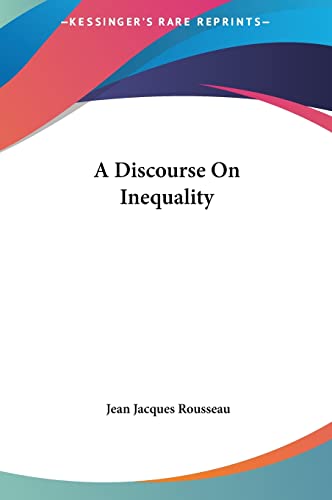
A Discourse On Inequality is a philosophical treatise written by Jean Jacques Rousseau in 1754. The book is divided into two parts, the first of which explores the origins and foundations of inequality among humans, while the second part examines the consequences of inequality and its impact on society. Rousseau argues that inequality is not a natural state of being, but rather the result of human development and the emergence of private property. He contends that the invention of agriculture and the establishment of property rights led to the creation of social classes and the exploitation of the poor by the wealthy. Furthermore, Rousseau suggests that inequality has led to the erosion of social bonds and the emergence of individualism, which has resulted in a loss of community and a rise in conflict and competition. He proposes that the only way to restore a sense of social harmony and justice is through the establishment of a social contract in which individuals willingly surrender their individual rights for the greater good of society as a whole. Overall, A Discourse On Inequality is a thought-provoking and influential work that continues to shape modern political and social thought. It is a must-read for anyone interested in the origins and consequences of inequality and the role of government in creating a just and equitable society.It Is Of Man That I Have To Speak; And The Question I Am Investigating Shows Me That It Is To Men That I Must Address Myself: For Questions Of This Sort Are Not Asked By Those Who Are Afraid To Honour Truth. I Shall Then Confidently Uphold The Cause Of Humanity Before The Wise Men Who Invite Me To Do So, And Shall Not Be Dissatisfied If I Acquit Myself In A Manner Worthy Of My Subject And Of My Judges.This scarce antiquarian book is a facsimile reprint of the old original and may contain some imperfections such as library marks and notations. Because we believe this work is culturally important, we have made it available as part of our commitment for protecting, preserving, and promoting the world's literature in affordable, high quality, modern editions, that are true to their original work.
Les informations fournies dans la section « Synopsis » peuvent faire référence à une autre édition de ce titre.
Biographie de l'auteur
JEAN-JACQUES ROUSSEAU was born in Geneva in 1712. Abandoned by his father at the age of ten he tried his hand as an engraver's apprentice before he left the city in 1728. From then on he was to wander Europe seeking an elusive happiness. At Turin he became a Catholic convert; and as a footman, seminarist, music teacher or tutor visited many parts of Switzerland and France. In 1732 he settled for eight years at Chambéry or Les Charmettes, the country house of Madame de Warens, remembered by Rousseau as an idyllic place in the Confessions. In 1741 he set out for Paris where he met Diderot who commissioned him to write the musical articles for the Encyclopédie. In the meantime he fathered five children by Thérèse Levasseur, a servant girl, and abandoned them to a foundling home. The 1750s witnessed a breach with Voltaire and Diderot and his writing struck a new note of defiant independence. In his Discours sur les sciences et les arts and the Discours sur l'origine de l'inégalité he showed how the growth of civilization corrupted natural goodness and increased inequality between men. In 1758 he attacked his former friends, the Encyclopaedists, in the Lettre à d'Alembert sur les spectacles which pilloried cultured society. In 1757 he moved to Montmorency and these five years were the most fruitful of his life. His remarkable novel La nouvelle Héloise (1761), met with immediate and enormous success. In this and in Émile, which followed a year later, Rousseau invoked the inviolability of personal ideals against the power of the state and the pressures of society. The crowning achievement of his political philosophy was The Social Contract, published in 1762. That same year he wrote an attack on revealed religion, the Profession de foi du vicaire savoyard. He was driven from Switzerland and fled to England where he only succeeded in making an enemy of Hume and returned to his continental peregrinations. In 1770 Rousseau completed his Confessions. His last years were spent largely in France where he died in 1778.
Présentation de l'éditeur
In A Discourse on Inequality Rousseau sets out to demonstrate how the growth of civilization corrupts man's natural happiness and freedom by creating artificial inequalities of wealth, power and social privilege. Contending that primitive man was equal to his fellows, Rousseau believed that as societies become more sophisticated, the strongest and most intelligent members of the community gain an unnatural advantage over their weaker brethren, and that constitutions set up to rectify these imbalances through peace and justice in fact do nothing but perpetuate them. Rousseau's political and social arguments in the Discourse were a hugely influential denunciation of the social conditions of his time and one of the most revolutionary documents of the eighteenth-century.
Les informations fournies dans la section « A propos du livre » peuvent faire référence à une autre édition de ce titre.
Autres éditions populaires du même titre

Résultats de recherche pour A Discourse On Inequality

Image d'archives
A Discourse On Inequality
Edité par
Kessinger Publishing, 2010
ISBN 10 : 1161428607
ISBN 13 : 9781161428605
Neuf
Couverture rigide
Vendeur : California Books, Miami, FL, Etats-Unis
Évaluation du vendeur 4 sur 5 étoiles

Etat : New. N° de réf. du vendeur I-9781161428605
Acheter neuf
EUR 35,17
Livraison gratuite
Expédition nationale : Etats-Unis
Expédition nationale : Etats-Unis
Quantité disponible : Plus de 20 disponibles