
Articles liés à Cement, Concrete and Bricks (Classic Reprint)
Synopsis
Practical guidance for building with reinforced concrete and steel Discover how steel and concrete work together in modern structures, with clear explanations you can apply in design and construction.
This edition explains the fundamentals of reinforced concrete, including how to choose materials, estimate loads, and establish safe working stresses. It covers the properties of mild steel, suitable carbon content, and why welding is often avoided. The text also outlines important design considerations, such as redundancy, safety factors, and how to interpret live and dead loads in real projects.
- Learn how to select steel and concrete combinations that resist tension, compression, and shear.
- Understand standard tests, elongation requirements, and the importance of avoiding defects.
- See how designers set factors of safety, live-to-dead load ratios, and permissive stress limits.
- Get practical guidance on calculating loads for floors, beams, and columns, plus guidance on fixing and detailing reinforcement.
Ideal for readers of engineering and construction topics who want a grounded, reference-friendly overview of reinforced concrete principles and practical design considerations.
Les informations fournies dans la section « Synopsis » peuvent faire référence à une autre édition de ce titre.
Résultats de recherche pour Cement, Concrete and Bricks (Classic Reprint)

Image fournie par le vendeur
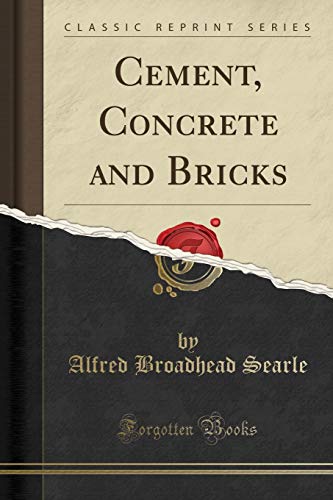
Cement, Concrete and Bricks (Classic Reprint)
impression à la demandeVendeur : Forgotten Books, London, Royaume-Uni
Évaluation du vendeur 5 sur 5 étoiles

Paperback. Etat : New. Print on Demand. This book delves into the world of cement, concrete, and bricks, exploring the materials that form the foundation of our built environment. It examines the rich history of these materials, tracing their origins and development from ancient times to the early 20th century, a period marked by significant advancements in their production and application. The author, a recognized expert in the field, provides a comprehensive overview of the raw materials used in the manufacture of these building materials, including their sources, properties, and impact on the final product. The book's strength lies in its exploration of the complex relationships between these materials, particularly the surprising connections between cement and bricks, with concrete acting as a bridge between them. It highlights the crucial role of scientific understanding in achieving consistency and quality in the production of these materials, a knowledge that was still evolving during the period in which the book was written. Through a detailed analysis of the chemical and physical processes involved in their manufacture, the book offers valuable insights into the fundamental principles that underpin the production of these essential building materials, making it a valuable resource for anyone interested in the history, science, and practice of construction. This book is a reproduction of an important historical work, digitally reconstructed using state-of-the-art technology to preserve the original format. In rare cases, an imperfection in the original, such as a blemish or missing page, may be replicated in the book. print-on-demand item. N° de réf. du vendeur 9781330432129_0
Acheter neuf
EUR 21,92
Livraison gratuite
Expédition depuis Royaume-Uni vers Etats-Unis
Expédition depuis Royaume-Uni vers Etats-Unis
Quantité disponible : Plus de 20 disponibles
Image d'archives
Cement, Concrete and Bricks Classic Reprint
Vendeur : PBShop.store US, Wood Dale, IL, Etats-Unis
Évaluation du vendeur 5 sur 5 étoiles
PAP. Etat : New. New Book. Shipped from UK. Established seller since 2000. N° de réf. du vendeur LW-9781330432129
Acheter neuf
EUR 34,74
Livraison gratuite
Expédition nationale : Etats-Unis
Expédition nationale : Etats-Unis
Quantité disponible : 15 disponible(s)
Image d'archives
Cement, Concrete and Bricks Classic Reprint
Vendeur : PBShop.store UK, Fairford, GLOS, Royaume-Uni
Évaluation du vendeur 5 sur 5 étoiles
PAP. Etat : New. New Book. Shipped from UK. Established seller since 2000. N° de réf. du vendeur LW-9781330432129
Acheter neuf
EUR 30,70
Expédition à EUR 5,93
Expédition depuis Royaume-Uni vers Etats-Unis
Expédition depuis Royaume-Uni vers Etats-Unis
Quantité disponible : 15 disponible(s)
Image d'archives
Cement, Concrete and Bricks (Classic Reprint)
impression à la demandeVendeur : Revaluation Books, Exeter, Royaume-Uni
Évaluation du vendeur 5 sur 5 étoiles
Paperback. Etat : Brand New. 436 pages. 9.02x5.98x0.89 inches. This item is printed on demand. N° de réf. du vendeur zk1330432126
Acheter neuf
EUR 35,41
Expédition à EUR 14,77
Expédition depuis Royaume-Uni vers Etats-Unis
Expédition depuis Royaume-Uni vers Etats-Unis
Quantité disponible : 1 disponible(s)