
Articles liés à Distributive Justice (Classic Reprint): The Right and...
Distributive Justice (Classic Reprint): The Right and Wrong of Our Present Distribution of Wealth - Couverture souple
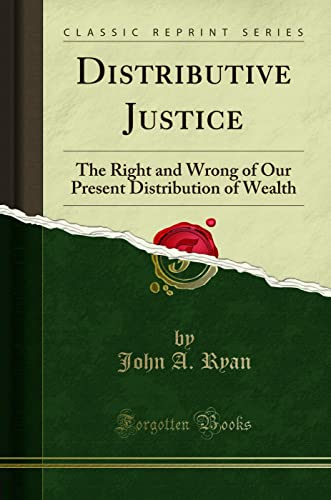
Synopsis
Exploring the morality of how wealth is divided today. This book examines why the current distribution of land, capital, and labor raises questions of justice, and it offers thoughtful ways to rethink economic fairness.
In a clear, systematic approach, it analyzes private land ownership, the role of rent, and the pay of workers. It also discusses how capital and profits fit into a just society, and proposes reform ideas such as cooperative enterprise and targeted taxation to reduce inequality without stifling growth.
- Understand the core questions about land, rent, and ownership that shape economic justice.
- Learn how profits, wages, and productivity are connected to fairness in a market economy.
- Explore practical reform ideas, including cooperative credit, agricultural cooperation, and tax concepts aimed at reducing excessive fortunes.
- See how different ethical traditions view duties to workers, owners, and the broader community.
Ideal for readers interested in ethics and economics, public policy, or the history of distributive justice.
Les informations fournies dans la section « Synopsis » peuvent faire référence à une autre édition de ce titre.
Présentation de l'éditeur
Five of the nine members of the late Federal Commission on Industrial Relations united in the declaration that the first cause of industrial unrest is, unjust distribution of wealth and income. In all probability this judgment is shared by the majority of the American people. Regarding the precise nature and extent of the injustice, however, there is no such preponderance of opinion. Even the makers of ethical and economic treatises fail to give us anything like uniform or definite pronouncements concerning the moral defects of the present distribution. While the Socialists and the Single Taxers are sufficiently positive in their statements, they form only a small portion of the total population, and include only an insignificant fraction of the recognised authorities on either ethics or economics. The volume in hand represents an attempt to discuss systematically and comprehensively the justice of the processes by which the product of industry is distributed. Inasmuch as the product is actually apportioned among landowners, capitalists, business men, and labourers, the moral aspects of the distribution are studied with reference to these four classes. While their rights and obligations form the main subject of the book, the effort is also made to propose reforms that would remove the principal defects of the present system and bring about a larger measure of justice.
(Typographical errors above are due to OCR software and don't occur in the book.)
About the Publisher
Forgotten Books is a publisher of historical writings, such as: Philosophy, Classics, Science, Religion, History, Folklore and Mythology.
Forgotten Books' Classic Reprint Series utilizes the latest technology to regenerate facsimiles of historically important writings. Careful attention has been made to accurately preserve the original format of each page whilst digitally enhancing the aged text.
Présentation de l'éditeur
This book was originally published prior to 1923, and represents a reproduction of an important historical work, maintaining the same format as the original work. While some publishers have opted to apply OCR (optical character recognition) technology to the process, we believe this leads to sub-optimal results (frequent typographical errors, strange characters and confusing formatting) and does not adequately preserve the historical character of the original artifact. We believe this work is culturally important in its original archival form. While we strive to adequately clean and digitally enhance the original work, there are occasionally instances where imperfections such as blurred or missing pages, poor pictures or errant marks may have been introduced due to either the quality of the original work or the scanning process itself. Despite these occasional imperfections, we have brought it back into print as part of our ongoing global book preservation commitment, providing customers with access to the best possible historical reprints. We appreciate your understanding of these occasional imperfections, and sincerely hope you enjoy seeing the book in a format as close as possible to that intended by the original publisher.
Les informations fournies dans la section « A propos du livre » peuvent faire référence à une autre édition de ce titre.
Résultats de recherche pour Distributive Justice (Classic Reprint): The Right and...

Image fournie par le vendeur
Distributive Justice: The Right and Wrong of Our Present Distribution of Wealth
impression à la demandeVendeur : Forgotten Books, London, Royaume-Uni
Évaluation du vendeur 5 sur 5 étoiles

Paperback. Etat : New. Print on Demand. This book delves into a fundamental question that has preoccupied thinkers for centuries: how should the fruits of our collective labor be fairly distributed? The author focuses specifically on the morality of income derived from participation in the process of production, examining the rights and obligations of landowners, capitalists, businessmen, and laborers. The book explores the historical development of landownership and the arguments for and against private land tenure, providing a compelling analysis of the role of land in society. The author then delves into the ethical implications of the distribution of wealth, examining the justice of profits, interest, and wages, and considering the potential for social reforms that would bring about a greater measure of fairness. The book provides a thoughtful and engaging exploration of a crucial topic that continues to be relevant in today's world. This book is a reproduction of an important historical work, digitally reconstructed using state-of-the-art technology to preserve the original format. In rare cases, an imperfection in the original, such as a blemish or missing page, may be replicated in the book. print-on-demand item. N° de réf. du vendeur 9781330775974_0
Acheter neuf
EUR 21,53
Livraison gratuite
Expédition depuis Royaume-Uni vers Etats-Unis
Expédition depuis Royaume-Uni vers Etats-Unis
Quantité disponible : Plus de 20 disponibles
Image d'archives
Distributive Justice
Vendeur : PBShop.store US, Wood Dale, IL, Etats-Unis
Évaluation du vendeur 5 sur 5 étoiles
PAP. Etat : New. New Book. Shipped from UK. Established seller since 2000. N° de réf. du vendeur LW-9781330775974
Acheter neuf
EUR 34,12
Livraison gratuite
Expédition nationale : Etats-Unis
Expédition nationale : Etats-Unis
Quantité disponible : 15 disponible(s)
Image d'archives
Distributive Justice
Vendeur : PBShop.store UK, Fairford, GLOS, Royaume-Uni
Évaluation du vendeur 5 sur 5 étoiles
PAP. Etat : New. New Book. Shipped from UK. Established seller since 2000. N° de réf. du vendeur LW-9781330775974
Acheter neuf
EUR 30,70
Expédition à EUR 5,85
Expédition depuis Royaume-Uni vers Etats-Unis
Expédition depuis Royaume-Uni vers Etats-Unis
Quantité disponible : 15 disponible(s)
Image fournie par le vendeur
Distributive Justice : The Right and Wrong of Our Present Distribution of Wealth (Classic Reprint)
Edité par
Forgotten Books Apr 2018, 2018
ISBN 10 : 133077597X
ISBN 13 : 9781330775974
Neuf
Taschenbuch
Vendeur : AHA-BUCH GmbH, Einbeck, Allemagne
Évaluation du vendeur 5 sur 5 étoiles
Taschenbuch. Etat : Neu. Neuware. N° de réf. du vendeur 9781330775974
Acheter neuf
EUR 46,94
Expédition à EUR 39,54
Expédition depuis Allemagne vers Etats-Unis
Expédition depuis Allemagne vers Etats-Unis
Quantité disponible : 2 disponible(s)