
Articles liés à The Principles of Mathematics (Classic Reprint)
Synopsis
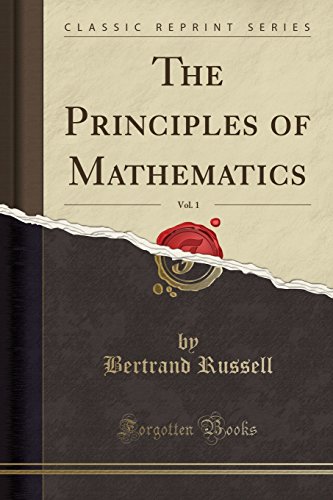
Exploring the foundations of math and logic, The Principles of Mathematics unlocks how thinking structures numbers, space, and proof.
This edition presents Russell’s philosophy of mathematics for readers who want both clarity and depth, balancing technical ideas with accessible explanations. The text sets out how pure mathematics uses hypothetical objects and logical constants, not necessarily real-world things. It explains the relationship between mathematics and philosophy, and how symbols, definitions, and proofs build a coherent view of numbers, space, and motion. The book also discusses the work of key thinkers and the author’s own aims, acknowledging the challenges of a wide, difficult topic.
- How mathematical reasoning relies on general properties and logical constants
- How definitions create existence theorems and resolve logical questions
- Ways in which mathematics relates to philosophy and empirical inquiry
- Guidance on reading strategy and the edition’s structure for mathematicians and philosophers
Les informations fournies dans la section « Synopsis » peuvent faire référence à une autre édition de ce titre.
Présentation de l'éditeur
Principles of Mathematics was published in 1903, and most of JL it was written in 1900, In the subsequent years the subjects of which it treats have been widely discussed, and the technique of mathematical logic has been greatly improved ;while some new problems have arisen, some old ones have been solved, and others, though they remain in a controversial condition, have taken on completely new forms. In these circumstances, it seemed useless to attempt to amend this or that, in the book, which no longer expresses my present views. Such interest as the book now possesses is historical, and consists in the fact that it represents a certain stage in the development of its subject. I have therefore altered nothing, but shall endeavour, in this I ntroduction, to say in what respects I adhere to the opinions which it expresses, and in what other respects subsequent research seems to me to have shown them to be erroneous. The fundamental thesis of the following pages, that mathematics and logic are identical, is one which I have never since seen any reason to modify. This thesis was, at first, unpopular, because logic is traditionally associated with philosophy and A ristotle, so that mathematicians felt it to be none of their business, and those who considered themselves logicians resented being asked to master a new and rather difficult mathematical technique. But such feelings would have had no lasting influence if they had been unable to find support in more serious reasons for doubt. These reasons are, broadly speaking, of two opposite kinds :first, that there are certain unsolved difficulties in mathematical logic, which make it appear less certain than mathematics is believed to be ;and secondly that, if the logical basis of mathematics is accepted, it justifies, or tends to justify, much work, such as that of Georg Cantor, which is viewed with suspicion by
(Typographical errors above are due to OCR software and don't occur in the book.)
Présentation de l'éditeur
The Principles of Mathematics: Vol. 1 is a terrific introduction to the fundamental concepts of mathematics. Although the book's title involves mathematics, it is not a textbook packed with equations and theorems. Instead philosopher Bertrand Russell uses mathematics to explore the structure of logic. Russell's ultimate point is that mathematics is logic and logic itself is truth.
The book is substantial and covers all subjects of mathematics. It is divided into seven sections: indefinables in mathematics, number, quantity, order, infinity and continuity, space, matter and motion. Russell covers all the major developments of mathematics and the contributions of important figures to the field. His sharp mind is evident throughout The Principles of Mathematics, as he challenges established rules and teachers readers how to think through difficult problems using logic.
Russell was one of the great minds of the 20th Century. In this book he discusses how his ideas were influenced by the logician Peano. He also debates other philosophers and mathematicians, and even anticipates the Theory of Relativity, which had not yet been published by Einstein.
One does not need to love mathematics to gain insights from The Principles of Mathematics: Vol. 1. Those who are interested in logic, intellectualism, philosophy or history will find significant insights into logical principles. Readers who desire an intellectual challenge will truly enjoy The Principles of Mathematics: Vol. 1.
About the Publisher
Forgotten Books publishes hundreds of thousands of rare and classic books. Find more at www.forgottenbooks.com
Les informations fournies dans la section « A propos du livre » peuvent faire référence à une autre édition de ce titre.
Résultats de recherche pour The Principles of Mathematics (Classic Reprint)

Image fournie par le vendeur
The Principles of Mathematics, Vol. 1 (Classic Reprint)
impression à la demandeVendeur : Forgotten Books, London, Royaume-Uni
Évaluation du vendeur 5 sur 5 étoiles

Paperback. Etat : New. Print on Demand. This book embarks on a rigorous exploration of the foundations of mathematics, revealing its surprising connection to the realm of logic. The author meticulously analyzes the fundamental concepts employed in mathematical reasoning, demonstrating how they can be constructed from a small set of basic logical notions. Delving into historical debates surrounding the meaning and truth of mathematics, the author offers a compelling resolution. By leveraging the power of symbolic logic, the book presents a groundbreaking thesis: all of mathematics, from arithmetic to geometry and beyond, can be formally derived from a handful of logical principles. This revolutionary perspective sheds new light on longstanding philosophical questions about the nature of infinity, space, and even the very essence of mathematical proof. The author invites both mathematicians and philosophers to engage in this intellectual journey, offering a clear and accessible path through complex concepts. Ultimately, this book challenges us to re-examine our understanding of mathematics, revealing its profound connection to the very fabric of human thought. This book is a reproduction of an important historical work, digitally reconstructed using state-of-the-art technology to preserve the original format. In rare cases, an imperfection in the original, such as a blemish or missing page, may be replicated in the book. print-on-demand item. N° de réf. du vendeur 9781330871430_0
Acheter neuf
EUR 24,02
Livraison gratuite
Expédition depuis Royaume-Uni vers Etats-Unis
Expédition depuis Royaume-Uni vers Etats-Unis
Quantité disponible : Plus de 20 disponibles
Image d'archives
The Principles of Mathematics, Vol. 1 (Classic Reprint)
Vendeur : PBShop.store US, Wood Dale, IL, Etats-Unis
Évaluation du vendeur 5 sur 5 étoiles
PAP. Etat : New. New Book. Shipped from UK. Established seller since 2000. N° de réf. du vendeur LW-9781330871430
Acheter neuf
EUR 38,75
Livraison gratuite
Expédition nationale : Etats-Unis
Expédition nationale : Etats-Unis
Quantité disponible : 15 disponible(s)
Image d'archives
The Principles of Mathematics, Vol. 1 (Classic Reprint)
Vendeur : PBShop.store UK, Fairford, GLOS, Royaume-Uni
Évaluation du vendeur 5 sur 5 étoiles
PAP. Etat : New. New Book. Shipped from UK. Established seller since 2000. N° de réf. du vendeur LW-9781330871430
Acheter neuf
EUR 32,84
Expédition à EUR 6,94
Expédition depuis Royaume-Uni vers Etats-Unis
Expédition depuis Royaume-Uni vers Etats-Unis
Quantité disponible : 15 disponible(s)
Image fournie par le vendeur
PRINCIPLES OF MATHEMATICS VOL
Vendeur : moluna, Greven, Allemagne
Évaluation du vendeur 5 sur 5 étoiles
Etat : New. KlappentextThe Principles of Mathematics: Vol. 1 is a terrific introduction to the fundamental concepts of mathematics. Although the book s title involves mathematics, it is not a textbook packed with equations and theorems. Instead ph. N° de réf. du vendeur 2147804272
Acheter neuf
EUR 36,69
Expédition à EUR 48,99
Expédition depuis Allemagne vers Etats-Unis
Expédition depuis Allemagne vers Etats-Unis
Quantité disponible : Plus de 20 disponibles
Image fournie par le vendeur
The Principles of Mathematics, Vol. 1 (Classic Reprint)
Edité par
Forgotten Books Apr 2018, 2018
ISBN 10 : 133087143X
ISBN 13 : 9781330871430
Neuf
Taschenbuch
Vendeur : AHA-BUCH GmbH, Einbeck, Allemagne
Évaluation du vendeur 5 sur 5 étoiles
Taschenbuch. Etat : Neu. Neuware. N° de réf. du vendeur 9781330871430
Acheter neuf
EUR 51,05
Expédition à EUR 46,19
Expédition depuis Allemagne vers Etats-Unis
Expédition depuis Allemagne vers Etats-Unis
Quantité disponible : 2 disponible(s)