
Articles liés à The Prince Of Frogtown
Synopsis
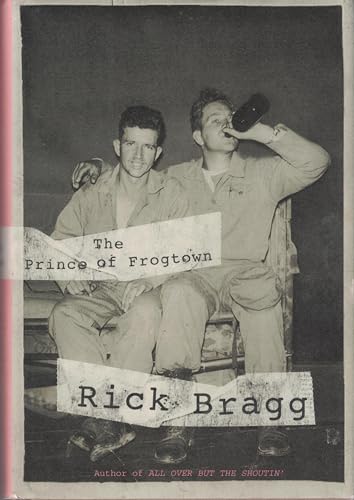
Book by Bragg Rick
Les informations fournies dans la section « Synopsis » peuvent faire référence à une autre édition de ce titre.
Extrait
The ditch cleaved frogtown into two realms, and two powerful spirits heldsway,one on each side. One was old, old as the Cross, and the other had aged only a few days in a gallon can. Both had the power to change men’s lives. On one side of the ditch, a packed-in, pleading faithful fell hard to their knees and called the Holy Ghost into their jerking bodies in unknown tongues. On the other side, two boys, too much alike to be anything but brothers, flung open the doors of a black Chevrolet and lurched into the yard of 117 D Street, hallelujahs falling dead around them in the weeds. In the house, a sad-eyed little woman looked out, afraid it might be the law. When your boys are gone you’re always afraid it might be the law. But it was just her two oldest sons, Roy and Troy, floating home inside the bubble of her prayer, still in crumpled, cattin’-around clothes from Saturday night, still a little drunk on Sunday morning. They were fine boys, though, beautiful boys. They were just steps away now, a few steps. She would fry eggs by the platterful and pour black coffee, and be glad they were not in a smoking hulk wrapped around a tree, or at the mercy of the police. She thought sometimes of walking over to the church to see it all, to hear the lovely music, but that would leave her boys and man unsupervised for too long. Her third son was eleven or so then. He could hear the piano ring across the ditch, even hear people shout, but he could smell the liquor that was always in the house on a Sunday and even steal a taste of it when no one was looking, so it was more real.
The holy ghost moved invisible, but they could feel it in the rafters, sense it racing inside the walls. It was as real as a jag of lightning, or an electrical fire.
The preacher stood on a humble, foot-high dais, to show that he did not believe he was better than them. “Do you believe in the Holy
Ghost?” he asked, and they said they did. He preached then of the end of the world, and it was beautiful.
They were still a new denomination then, but had spread rapidly in the last fifty years around a nation of exploited factory workers, coal
miners, and rural and inner-city poor. Here, it was a church of lintheads, pulpwooders and sharecroppers, shoutin’ people, who said
amen like they were throwing a mule shoe. Biblical scholars turned their noses up, calling it hysteria, theatrics, a faith of the illiterate. But in a place where machines ate people alive, faith had to pour even hotter than blood.
It had no steeple, no stained glass, no bell tower, but it was the house of Abraham and Isaac, of Moses and Joshua, of the Lord thy
God. People tithed in Mercury dimes and buffalo nickels, and pews filled with old men who wore ancient black suit coats over overalls,
and young men in short-sleeved dress shirts and clip-on ties. Women sat plain, not one smear of lipstick or daub of makeup on their
faces, and not one scrap of lace at their wrists or necks. Their hair was long, because Paul wrote that “if a woman have long hair, it is a glory to her, for her hair is given her for a covering.” Their hair and long dresses were always getting caught in the machines, but it was in the Scripture, so they obeyed. Some wore it pinned up for church, because of the heat, but before it was over hairpins would litter the
floor.
They listened as the preacher laid down a list of sins so complete it left a person no place to go but down.
“They preached it hard, so hard a feller couldn’t live it,” said Homer Barnwell, who went there as a boy.
The people, some gasping from the brown lung, ignored the weakness in their wind and pain in their chests and sang “I’ll Fly Away”
and “Kneel at the Cross” and “That Good Ol’ Gospel Ship.” A woman named Cora Lee Garmon, famous for her range, used to hit
the high notes so hard “the leaders would stand out in her neck,” Homer said.
Then, with the unstoppable momentum of a train going down a grade, the service picked up speed. The Reverend evoked a harsh
God, who turned Lot’s wife into a pillar of salt, and condemned the Children of Israel, who gave their golden earrings to Aaron to fashion Baal, the false god. “I have seen this people,” God told Moses, “and behold, it is a stiff-necked people. Now therefore let me alone, so that my wrath may wax hot against them.”
As children looked with misery on a service without end, the preacher read chapter 2 of the Acts of the Apostles:
And when the day of Pentecost was fully come, they were all with
one accord in one place. And suddenly there came a sound from
heaven as of a rushing mighty wind, and it filled all the house
where they were sitting. And there appeared unto them cloven
tongues like as of fire, and it sat upon each of them. And they were
all filled with the Holy Ghost, and began to speak with other
tongues . . .
The congregants’ eyes were shut tight.
“Do you feel the Spirit?” the Reverend shouted.
Their hands reached high.
“Can you feel the Holy Ghost?”
They answered one by one, in the light of the full Gospel.
“Yeeeeesssss.”
Then, as if they had reached for a sizzling clothesline in the middle of an electrical storm, one by one they began to jerk, convulsing in the grip of unseen power. Others threw their arms open wide, and the Holy Ghost touched them soul by soul.
Some just stood and shivered.
Some danced, spinning.
Some leapt high in the air.
Some wept.
Some shrieked.
Some of the women shook their heads so violently that their hair came free and whipped through the air, three feet long. Hairpins flew.
The Ghost was in them now.
They began to speak in tongues.
The older church people interpreted, and the congregation leaned in, to hear the miracle. It sounded like ancient Hebrew,maybe, a little,
and other times it sounded like nothing they had heard or imagined. They rushed to the front of the church and knelt in a line, facing the
altar, so the preacher could lay his hands on them, and–through the Father, in the presence of the Holy Ghost–make them whole.
One by one, they were slain in the Spirit, and fell backward, some of them, fainting on the floor. The services could last for hours, till the congregants’ stomachs growled. “If it’s goin’ good,” Homer said, “why switch it off ?”
As strong as it was, as close, it was as if sounding brass or a tinkling cymbal, across that ditch.
“We could have by God stayed longer if you’d have brought some damn money,” griped Roy, as they meandered toward the house. It is unclear where they had been that weekend, but apparently they had a real good time. Roy, the prettiest of all of them, leaned against the car for balance, and cussed his older brother a little more.Roy’s eyes were just like my father’s, a bright blue, and his hair was black. He was tall for a Bragg, and the meanest when he drank. He was not a dandy and just threw on his clothes, but was one of those men who would have looked elegant standing in a mudhole.
Troy cussed him back, but cheerfully. He always wore snow-white T-shirts, black pants and black penny loafer shoes, and as he blithely dog-cussed his brother he bent over, took off one loafer and dumped several neatly folded bills into his hand. Then, hopping around on one foot, he waved the bills in his brother’s face.
“You lying son of a bitch,”Roy said.
Troy, his shoe still in his hand, just hopped and grinned, trying not to get his white sock dirty.
He sniffed the money, like it was flowers.
“I’ll kill you,”Roy said.
But they were always threatening to kill somebody.
Troy, in a wobbly pirouette, laughed out loud.
In seconds, they were in the dirt, tearing at clothes and screaming curses, and rolled clear into the middle of D Street, in a whirl of blood
and cinders.
The commotion drew first Velma and then Bobby from inside the house.Velma, unheard and ignored, pleaded for them to stop. Bobby,
on a binge and still dressed only in his long-handles, cackled, hopped, and did a do-si-do.
My father banged through the door and into the yard, and, like a pair of long underwear sucked off a clothesline by a tornado, was carried away by the melee.
In the rising dust, they clubbed each other about the head with their fists, split lips and blacked eyes and bruised ribs. My father, smaller than his brothers, was knocked down and almost out. Velma bent over my father, to make sure he was breathing, and yelled at the
older two: “I’ll call the law.” Then she left walking, to find a telephone.
How many times did Velma make that walk to a borrowed telephone, having to choose between her sons’ freedom and their safety?
My Aunt Juanita, driving through the village, remembers seeing her walking fast down the street. “Her heels was just a’clickin’ on the
road,” she said.
She stopped and, through the window, asked Velma if she was all right.
“The boys is killing each other,” she said.
In the yard, the boys were staggering now, about used-up. The neighbors watched from their porches, but no one got in the way. The
distant scream of a police siren drifted into the yard.Velma had found a telephone.
By the time the police came, the street was empty and quiet in front of 117, the brothers inside, ruining Velma’s washrags with their blood. Bobby had enjoyed himself immensely, and gone a half day without pants of any kind. Velma walked back, her flat shoes clicking slowly now. But her boys were safe, and nothing mattered next to that.
In the ...
Revue de presse
Praise for The Prince of Frogtown
“Bragg crafts flowing sentences that vividly describe the southern Appalachian landscape and ways of life both old and new. . . . His father’s story walks the line between humorous and heartbreaking . . . This book, much like his previous two memoirs, is lush with narratives about manhood, fathers and sons, families and the changing face of the rural South.”
—Publishers Weekly (starred review)
“Smooth and rich as bourbon.”
—Kirkus
“Bragg continues in the vein of his legendary storytelling, breathing life into a father he barely knew while learning to love a son.”
—Library Journal
Praise for Ava’s Man
“Rick Bragg has written a powerful and poignant book about his kin, the kind of people we hear about too seldom . . . At the end I shared Rick’s pride and awe of what his family had endured.”
—Tom Brokaw
“It is hard to think of a writer who reminds us more forcefully and wonderfully of what people and families are all about.”
—The New York Times Book Review
“Earthy, mischievous, yet gorgeous. . . . [Bragg’s] tales . . . would not be out of place if they were told around a campfire.”
—San Francisco Chronicle
“[Bragg] is every bit the equal of . . . Harper Lee and Truman Capote.”
—People
“[Bragg has] a true gift for great storytelling (the kind. . . that makes you think it’s just a plain old story, until he gets to the end and you’re either weeping or covered with goosebumps).”
—New Orleans Times-Picayune
“Here is a man with wit, devotion and a fierce sense of dignity.”
—Time Out New York
“Bragg writes like his grandfather drank. . . . He cuts loose with wonderful flowering descriptive floods . . . that can cripple another writer with envy.”
—The Miami Herald
Praise for All Over but the Shoutin’
“An absolutely wonderful book.”
—Russell Baker
“Rick Bragg writes like a man on fire. And All Over but the Shoutin’ is a work of art. While reading this book, I fell in love with Rick Bragg’s mother, Margaret Bragg, a hundred times. I felt like I was reading one of the prophets in the Old Testament when reading parts of this book. I thought of Melville, I thought of Faulkner. Because I love the English language, I knew I was reading one of the best books I’ve ever read. By explaining his life to the world, Rick Bragg explained part of my life to me. You feel things in every line this man writes. His sentences bleed on you. I wept when the book ended. I never met Rick Bragg in my life, but I called him up and told him he’d written a masterpiece, and I sent flowers to his mother.”
—Pat Conroy
“Searingly honest, beautifully written, All Over but the Shoutin’ is perhaps the most courageous thing Pulitzer Prize-winning journalist Rick Bragg has ever written. Making his reputation on his ‘dark gothic’ stories of urban riots, community disasters, and Haitian bloodbaths, Bragg has never failed to record the grace and dignity of people who live their lives in the margins. All Over but the Shoutin’ is one more such story. But it is braver because the marginal people he gives us are himself, a child of ‘poor white Southern trash,’ and his family–an alcoholic, mostly absent father, and an extraordinary mother, quietly heroic in the face of devastating poverty. Bragg looks down the corridors of his past with love, hate, humor, regret, self-doubt, and understanding. In the telling, he may occasionally flinch, but he never turns away.”
—Willie Morris
“This is a great book: a poem disguised as a memoir, a gift from a son to his mother, a primer on reporting.... Language at its loveliest.”
—Entertainment Weekly,
In his sad, beautiful, funny and moving memoir, All Over but the Shoutin', Rick Bragg gives us a report from the forgotten heart of "white trash" America.... Bragg is showing us a place we have not seen before, not quite like this. And he is joining an elite group of American writers who have used the literature of childhood to affect our understanding of our society, standing in the tradition of Huck and Tom, Holden Caulfield and Dorothy Allison's Bone Boatwright...
—The New York Times Book Review
“Bragg . . . has a strong voice and a sweeping style that, like his approach to newspaper writing, is rich, empathetic, and compelling. His memoir is a model of humility combined with pride in one’s accomplishments.”
—Kirkus
“A record of life that has been harrowing, cruel and yet triumphant, written so beautifully he makes the book a marvel.”
—Los Angeles Times
“A deeply affecting book. . . . Bragg captures the rhythms of small-town life with grace and pathos.”
—Chicago Tribune
“Bragg tells about the South with such power and bone-naked love . . . he will make you cry.”
—Atlanta Journal-Constitution
Les informations fournies dans la section « A propos du livre » peuvent faire référence à une autre édition de ce titre.
Résultats de recherche pour The Prince Of Frogtown

Image d'archives
The Prince Of Frogtown
Edité par
Knopf, 2008
ISBN 10 : 140004040X
ISBN 13 : 9781400040407
Ancien ou d'occasion
Couverture rigide
Vendeur : World of Books (was SecondSale), Montgomery, IL, Etats-Unis
Évaluation du vendeur 5 sur 5 étoiles

Etat : Acceptable. Item in acceptable condition! Textbooks may not include supplemental items i.e. CDs, access codes etc. N° de réf. du vendeur 00104246201
Acheter D'occasion
EUR 3,75
Livraison gratuite
Expédition nationale : Etats-Unis
Expédition nationale : Etats-Unis
Quantité disponible : 4 disponible(s)
Image d'archives
The Prince Of Frogtown
Edité par
Knopf, 2008
ISBN 10 : 140004040X
ISBN 13 : 9781400040407
Ancien ou d'occasion
Couverture rigide
Vendeur : World of Books (was SecondSale), Montgomery, IL, Etats-Unis
Évaluation du vendeur 5 sur 5 étoiles
Etat : Very Good. Item in very good condition! Textbooks may not include supplemental items i.e. CDs, access codes etc. N° de réf. du vendeur 00109215188
Acheter D'occasion
EUR 3,75
Livraison gratuite
Expédition nationale : Etats-Unis
Expédition nationale : Etats-Unis
Quantité disponible : 1 disponible(s)
Image d'archives
The Prince Of Frogtown
Edité par
Knopf, 2008
ISBN 10 : 140004040X
ISBN 13 : 9781400040407
Ancien ou d'occasion
Couverture rigide
Vendeur : World of Books (was SecondSale), Montgomery, IL, Etats-Unis
Évaluation du vendeur 5 sur 5 étoiles
Etat : Good. Item in good condition. Textbooks may not include supplemental items i.e. CDs, access codes etc. N° de réf. du vendeur 00096117302
Acheter D'occasion
EUR 3,75
Livraison gratuite
Expédition nationale : Etats-Unis
Expédition nationale : Etats-Unis
Quantité disponible : 4 disponible(s)
Image d'archives
The Prince Of Frogtown
Edité par
Knopf, 2008
ISBN 10 : 140004040X
ISBN 13 : 9781400040407
Ancien ou d'occasion
Couverture rigide
Vendeur : World of Books (was SecondSale), Montgomery, IL, Etats-Unis
Évaluation du vendeur 5 sur 5 étoiles
Etat : Good. Good condition ex-library book with usual library markings and stickers. N° de réf. du vendeur 00110571956
Acheter D'occasion
EUR 3,75
Livraison gratuite
Expédition nationale : Etats-Unis
Expédition nationale : Etats-Unis
Quantité disponible : 1 disponible(s)
Image d'archives
The Prince of Frogtown
Edité par
Knopf, 2008
ISBN 10 : 140004040X
ISBN 13 : 9781400040407
Ancien ou d'occasion
Couverture rigide
Vendeur : Orion Tech, Kingwood, TX, Etats-Unis
Évaluation du vendeur 5 sur 5 étoiles
Hardcover. Etat : Good. N° de réf. du vendeur 140004040X-3-18363983
Acheter D'occasion
EUR 3,76
Livraison gratuite
Expédition nationale : Etats-Unis
Expédition nationale : Etats-Unis
Quantité disponible : 1 disponible(s)
Image d'archives
The Prince of Frogtown
Edité par
Knopf, 2008
ISBN 10 : 140004040X
ISBN 13 : 9781400040407
Ancien ou d'occasion
Couverture rigide
Vendeur : Gulf Coast Books, Cypress, TX, Etats-Unis
Évaluation du vendeur 5 sur 5 étoiles
Hardcover. Etat : Good. N° de réf. du vendeur 140004040X-3-21342455
Acheter D'occasion
EUR 3,76
Livraison gratuite
Expédition nationale : Etats-Unis
Expédition nationale : Etats-Unis
Quantité disponible : 1 disponible(s)
Image fournie par le vendeur
The Prince of Frogtown
Edité par
Knopf, 2008
ISBN 10 : 140004040X
ISBN 13 : 9781400040407
Ancien ou d'occasion
Couverture rigide
Vendeur : Greenworld Books, Arlington, TX, Etats-Unis
Évaluation du vendeur 5 sur 5 étoiles
Etat : good. Fast Free Shipping â" Good condition. It may show normal signs of use, such as light writing, highlighting, or library markings, but all pages are intact and the book is fully readable. A solid, complete copy that's ready to enjoy. N° de réf. du vendeur GWV.140004040X.G
Acheter D'occasion
EUR 4,59
Livraison gratuite
Expédition nationale : Etats-Unis
Expédition nationale : Etats-Unis
Quantité disponible : 4 disponible(s)
Image d'archives
The Prince of Frogtown
Edité par
Knopf, 2008
ISBN 10 : 140004040X
ISBN 13 : 9781400040407
Ancien ou d'occasion
Couverture rigide
Vendeur : More Than Words, Waltham, MA, Etats-Unis
Évaluation du vendeur 5 sur 5 étoiles
Etat : Good. A sound copy with only light wear. Overall a solid copy at a great price! N° de réf. du vendeur BOS-B-08c-02256
Acheter D'occasion
EUR 1,13
Expédition à EUR 3,48
Expédition nationale : Etats-Unis
Expédition nationale : Etats-Unis
Quantité disponible : 1 disponible(s)
Image d'archives
The Prince of Frogtown
Edité par
Knopf Publishing Group, 2008
ISBN 10 : 140004040X
ISBN 13 : 9781400040407
Ancien ou d'occasion
Couverture rigide
Vendeur : World of Books Inc, Montgomery, IL, Etats-Unis
Évaluation du vendeur 4 sur 5 étoiles

Hardback. Etat : Very Good. The final volume of Rick Bragg's bestselling and beloved American saga documents a mesmerizing journey back in time to the lush Alabama landscape of Rick's youth, to Jacksonville's one-hundred-year-old mill and to Rick's father, the troubled, charismatic hustler coming of age in its shadow. Inspired by Rick Bragg's love for his stepson, The Prince of Frogtown also chronicles his own journey into fatherhood, as he learns to avoid the pitfalls of his forebearers. With candor, insight, and tremendous humor, Bragg seamlessly weaves these luminous narrative threads together and delivers an unforgettable rumination about fathers and sons. N° de réf. du vendeur CIN140004040XVG
Acheter D'occasion
EUR 5,55
Livraison gratuite
Expédition nationale : Etats-Unis
Expédition nationale : Etats-Unis
Quantité disponible : 1 disponible(s)
Image d'archives
The Prince of Frogtown
Edité par
Knopf Publishing Group, 2008
ISBN 10 : 140004040X
ISBN 13 : 9781400040407
Ancien ou d'occasion
Couverture rigide
Vendeur : World of Books Inc, Montgomery, IL, Etats-Unis
Évaluation du vendeur 4 sur 5 étoiles
Hardback. Etat : Good. The final volume of Rick Bragg's bestselling and beloved American saga documents a mesmerizing journey back in time to the lush Alabama landscape of Rick's youth, to Jacksonville's one-hundred-year-old mill and to Rick's father, the troubled, charismatic hustler coming of age in its shadow. Inspired by Rick Bragg's love for his stepson, The Prince of Frogtown also chronicles his own journey into fatherhood, as he learns to avoid the pitfalls of his forebearers. With candor, insight, and tremendous humor, Bragg seamlessly weaves these luminous narrative threads together and delivers an unforgettable rumination about fathers and sons. N° de réf. du vendeur CIN140004040XG
Acheter D'occasion
EUR 5,55
Livraison gratuite
Expédition nationale : Etats-Unis
Expédition nationale : Etats-Unis
Quantité disponible : 6 disponible(s)