
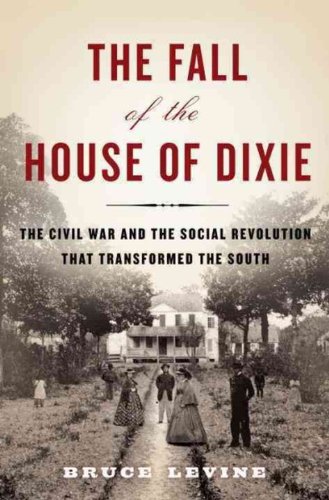
The Fall of the House of Dixie: The Civil War and the Social Revolution That Transformed the South - Couverture rigide
Synopsis
The Fall of the House of Dixie In this major new history of the Civil War, Bruce Levine tells the riveting story of how that conflict upended the economic, political, and social life of the old South, utterly destroying the Confederacy and the society it represented and defended. Told through the words of the people who lived it, "The Fall of the House of Dixie "illuminates the way a war undertaken to preserve the status quo be... Full description
Les informations fournies dans la section « Synopsis » peuvent faire référence à une autre édition de ce titre.
Extrait
Introduction
In the middle of the nineteenth century, southern writers and politicians boasted often--and with considerable justification--that their states were the richest, most socially stable, and most politically powerful in the United States as a whole. Southern farms and plantations yielded handsome profits to their owners, who were some of the wealthiest people in the country, and the southern elite had also controlled all three branches of the federal government during most of its existence. At the root of this all this economic and political power lay the institution of slavery--an institution which, as the former slave Frederick Douglass would later recall, then “seemed impregnable.” Few could then have imagined, he noted, “that in less than ten years from that time, no master would wield a lash and no slave would clank a chain in the United States.”
But what almost no one foresaw in 1860 is exactly what came to pass. In Mark Twain’s words, the Civil War and its aftermath “uprooted institutions that were centuries old, changed the politics of a people, transformed the social life of half the country.” The most important and dramatic of these transformations was the radical destruction of slavery. One out of every three people in the South suddenly emerged from bondage into freedom, a change of such enormous significance and full of so many implications as almost to defy description.
For the South’s ruling families, meanwhile, the war turned the world upside down. It stripped them of their privileged status and their most valuable property. It deprived them of the totalitarian power they had previously wielded over the men, women, and children who produced most of the South’s great wealth. “The events of the last five years,” a Memphis newspaper editor summarized in 1865, “have produced an entire revolution in the entire Southern country. The old arrangement of things is broken up.” The ex-Confederate general Richard Taylor lodged the same complaint that year. “Society has been completely changed by the war,” he wrote. Even the stormy French revolution of the previous century “did not produce a greater change in the ‘Ancien Regime’ than has this in our social life.” Abraham Lincoln applauded this “total revolution of labor” as “a new birth of freedom.” Black South Carolinians cheered this “mighty revolution which must affect the future destiny of the world.”
Even as it upended society in the South, the Civil War era transformed the shape of national politics in the United States as a whole. Beginning with Lincoln’s election in 1860, it finally broke the southern elite’s once-iron grip on the federal government and drove its leaders into the political wilderness. Into the offices that planters and their friends had previously occupied there now stepped northerners with very different values, priorities, and outlooks. These new men used their political might to encourage the growth and development of manufacturing, transportation, finance, and commerce and thereby speed the country’s transformation into the economic colossus familiar to the late nineteenth and twentieth centuries. Under the hands of these same men, meanwhile, the post-Civil War federal government assumed key roles previously assigned to the states, including the power and the responsibility to safeguard the freedom and rights of the nation’s citizens--citizens whose ranks now expanded to include millions of former slaves. Constitutional amendments adopted in the war’s aftermath laid the legal basis for and pointed the way towards transforming the United States into a multi-racial republic.
Relatively few people today are aware of just how all this happened. Although “the military movements connected with the Civil War are well known,” a witness to those events commented decades afterward, “the great mass of American people know but little, and so think less” about the destruction of slavery and all that it entailed. That observation holds true after the passage of another century and more.
The Fall of the House of Dixie was written to help fill that gaping hole in our collective memory. It traces the origins and development of America’s “second revolution,” explaining why it occurred and how it unfolded--especially how this great and terrible war undermined the economic, social, and political foundations of the old South, destroying human bondage and the storied world of the slaveholding elite. In recent years many scholarly books and articles have analyzed the Civil War’s momentous consequences. But bookstore shelves allotted to the Civil War are to this day filled principally with detailed accounts of armies, officers, and the battles they fought, great and small. Nearly every major study of the Civil War as a whole--especially those aimed at a wide audience--continues to take the military story as its organizing principle and narrative spine.
The Fall of the House of Dixie by no means ignores that subject. The slave-based society of the American South required powerful external blows to break it along its lines of internal stress. Union armies delivered those blows—blows that therefore make up a crucial part of the story told in this book. But the chapters that follow focus especially upon the transformation of that war from a conventional military conflict into a revolutionary struggle. And they emphasize the ways in which very different groups of people—slave owners, slaves, the great mass of slaveless southern whites, and soldiers both Union and Confederate, black as well as white—experienced and helped to bring about what one newspaper at the time called "the greatest social and political revolution of the age."
Revue de presse
“This is the Civil War as it is seldom seen . . . and a portrait of a country in transition . . . as vivid as any that has been written.”—The Boston Globe
“An absorbing social history . . . For readers whose Civil War bibliography runs to standard works by Bruce Catton and James McPherson . . . [Bruce] Levine’s book offers fresh insights.”—The Wall Street Journal
“More poignantly than any book before, The Fall of the House of Dixie shows how deeply intertwined the Confederacy was with slavery, and how the destruction of both made possible a ‘second American revolution’ as far-reaching as the first.”—David W. Blight, author of American Oracle
“Splendidly colorful . . . Levine recounts this tale of Southern institutional rot with the ease and authority born of decades of study.”—Kirkus Reviews (starred review)
“A deep, rich, and complex analysis of the period surrounding and including the American Civil War.”—Publishers Weekly (starred review)
“This book limns the relationship between slavery and the rise and fall of the Confederacy more clearly and starkly than any other study. General readers and seasoned scholars alike will find new information and insights in this eye-opening account.”—James M. McPherson, author of Battle Cry Freedom
“With his characteristic judiciousness and crystalline prose, Bruce Levine demonstrates the toll that disaffection and dissent took on the Confederate cause and brings into sharp focus what the Union victory, enduringly, achieved. He has, in short, written another modern classic.”—Elizabeth R. Varon, author of Disunion!: The Coming of the American Civil War, 1789–1859
“A gripping, lucid grassroots history of the Civil War that declines the strict use of great battles and Big Men as its fulcrum, opting instead for the people. In the tradition of James McPherson, Bruce Levine has produced a book that is a work of both history and literature.”—Ta-Nehisi Coates, author of The Beautiful Struggle
“Levine illuminates the experiences of southern men and women—white and black, free and enslaved, civilians and soldiers—with a sure grasp of the historical sources and a deft literary touch. He masterfully recaptures an era of unsurpassed drama and importance.”—Gary W. Gallagher, author of The Confederate War
“A compelling, valuable and eye-opening work [that] will inform and entertain the most discerning student of ‘the second American revolution.’”—The San Antonio Express-News
“Masterful . . . Levine’s employment of testimonies by slaveholders, slaves, and pro-Union Southerners is effective and often poignant.”—Booklist
“Levine’s engrossing story chronicles the collapse of a doomed republic—the Confederate States of America—built on the unstable sands of delusion, cruelty, and folly.”—Adam Goodheart, author of 1861: The Civil War Awakening
“Bruce Levine vividly traces the origins of the ‘slaveholders’ rebellion’ and its dramatic wartime collapse. With this book, he confirms his standing among the leading Civil War historians of our time.”—James Oakes, author of Freedom National
“Eloquent and illuminating . . . Shifting away from traditional accounts that emphasize generals and campaigns, Levine instead offers a brilliant and provocative analysis of the way in which slaves and non-elite whites transformed the conflict into a second American Revolution.”—Douglas R. Egerton, author of Year of Meteors
“The idea that Southern secession was unconnected to the defense of slavery has a surprising hold on the popular historical imagination, North and South. Levine’s demolition of such a misapprehension profoundly succeeds as both argument and drama.”—David Roediger, coauthor of The Production of Difference
“Thorough, convincing, and, in a word, brilliant. Our understanding of this central event in American history will never be the same.”—Marcus Rediker, author of The Slave Ship
“The Fall of the House of Dixie will delight and disturb—and provide much needed clarity as Americans take a fresh look at the meaning of the Civil War.”—Ronald C. White, Jr., author of A. Lincoln
“The story of a war waged off the battlefield, a war of politics and ideology that transformed both Southern and Northern culture unfolds brilliantly in the able hands of this fine historian.”—Carol Berkin, author of Revolutionary Mothers
“Levine offers a fresh perspective on this oft-told story by relying heavily on personal letters, journals and diaries. . . . Brushing aside the notion that slavery was merely one of many issues over which the war was fought, Levine . . . shows that it was at the center of everything—the economy, culture, social relationships and worldview.”—BookPage
“Levine’s well-documented study . . . provides a concise and well-written overview of the conflict and a cogent discussion of . . . still-polarizing issues.”—The Dallas Morning News
Les informations fournies dans la section « A propos du livre » peuvent faire référence à une autre édition de ce titre.
Autres éditions populaires du même titre

Résultats de recherche pour The Fall of the House of Dixie: The Civil War and the...

Image fournie par le vendeur
The Fall of the House of Dixie: The Civil War and the Social Revolution That Transformed the South
Edité par
Random House, 2013
ISBN 10 : 1400067030
ISBN 13 : 9781400067039
Ancien ou d'occasion
Couverture rigide
Vendeur : -OnTimeBooks-, Phoenix, AZ, Etats-Unis
Évaluation du vendeur 5 sur 5 étoiles

Etat : very_good. Gently read. May have name of previous ownership, or ex-library edition. Binding tight; spine straight and smooth, with no creasing; covers clean and crisp. Minimal signs of handling or shelving. 100% GUARANTEE! Shipped with delivery confirmation, if you're not satisfied with purchase please return item! Ships USPS Media Mail. N° de réf. du vendeur OTV.1400067030.VG
Acheter D'occasion
EUR 6,53
Livraison gratuite
Expédition nationale : Etats-Unis
Expédition nationale : Etats-Unis
Quantité disponible : 1 disponible(s)
Image fournie par le vendeur
The Fall of the House of Dixie: The Civil War and the Social Revolution That Transformed the South
Edité par
Random House, 2013
ISBN 10 : 1400067030
ISBN 13 : 9781400067039
Ancien ou d'occasion
Couverture rigide
Vendeur : -OnTimeBooks-, Phoenix, AZ, Etats-Unis
Évaluation du vendeur 5 sur 5 étoiles
Etat : good. A copy that has been read, remains in good condition. All pages are intact, and the cover is intact. The spine and cover show signs of wear. Pages can include notes and highlighting and show signs of wear, and the copy can include "From the library of" labels or previous owner inscriptions. 100% GUARANTEE! Shipped with delivery confirmation, if you're not satisfied with purchase please return item! Ships via media mail. N° de réf. du vendeur OTV.1400067030.G
Acheter D'occasion
EUR 6,53
Livraison gratuite
Expédition nationale : Etats-Unis
Expédition nationale : Etats-Unis
Quantité disponible : 1 disponible(s)
Image d'archives
The Fall of the House of Dixie : The Civil War and the Social Revolution That Transformed the South
Edité par
Random House, Incorporated, 2013
ISBN 10 : 1400067030
ISBN 13 : 9781400067039
Ancien ou d'occasion
Couverture rigide
Vendeur : Better World Books: West, Reno, NV, Etats-Unis
Évaluation du vendeur 5 sur 5 étoiles
Etat : Good. 1st Printing. Former library copy. Pages intact with minimal writing/highlighting. The binding may be loose and creased. Dust jackets/supplements are not included. Includes library markings. Stock photo provided. Product includes identifying sticker. Better World Books: Buy Books. Do Good. N° de réf. du vendeur 4223113-6
Acheter D'occasion
EUR 6,82
Livraison gratuite
Expédition nationale : Etats-Unis
Expédition nationale : Etats-Unis
Quantité disponible : 3 disponible(s)
Image d'archives
The Fall of the House of Dixie : The Civil War and the Social Revolution That Transformed the South
Edité par
Random House, Incorporated, 2013
ISBN 10 : 1400067030
ISBN 13 : 9781400067039
Ancien ou d'occasion
Couverture rigide
Vendeur : Better World Books, Mishawaka, IN, Etats-Unis
Évaluation du vendeur 5 sur 5 étoiles
Etat : Good. 1st Printing. Former library copy. Pages intact with minimal writing/highlighting. The binding may be loose and creased. Dust jackets/supplements are not included. Includes library markings. Stock photo provided. Product includes identifying sticker. Better World Books: Buy Books. Do Good. N° de réf. du vendeur 4223113-6
Acheter D'occasion
EUR 6,82
Livraison gratuite
Expédition nationale : Etats-Unis
Expédition nationale : Etats-Unis
Quantité disponible : 5 disponible(s)
Image d'archives
The Fall of the House of Dixie: The Civil War and the Social Revolution That Transformed the South
Edité par
Random House, 2013
ISBN 10 : 1400067030
ISBN 13 : 9781400067039
Ancien ou d'occasion
Couverture rigide
Vendeur : Half Price Books Inc., Dallas, TX, Etats-Unis
Évaluation du vendeur 5 sur 5 étoiles
Hardcover. Etat : Very Good. Connecting readers with great books since 1972! Used books may not include companion materials, and may have some shelf wear or limited writing. We ship orders daily and Customer Service is our top priority! N° de réf. du vendeur S_469908889
Acheter D'occasion
EUR 3,85
Expédition à EUR 3,07
Expédition nationale : Etats-Unis
Expédition nationale : Etats-Unis
Quantité disponible : 1 disponible(s)
Image d'archives
The Fall of the House of Dixie
Edité par
Random House, 2013
ISBN 10 : 1400067030
ISBN 13 : 9781400067039
Ancien ou d'occasion
Couverture rigide
Vendeur : World of Books (was SecondSale), Montgomery, IL, Etats-Unis
Évaluation du vendeur 5 sur 5 étoiles
Etat : Very Good. Item in very good condition! Textbooks may not include supplemental items i.e. CDs, access codes etc. N° de réf. du vendeur 00105732977
Acheter D'occasion
EUR 7,08
Livraison gratuite
Expédition nationale : Etats-Unis
Expédition nationale : Etats-Unis
Quantité disponible : 1 disponible(s)
Image d'archives
The Fall of the House of Dixie
Edité par
Random House, 2013
ISBN 10 : 1400067030
ISBN 13 : 9781400067039
Ancien ou d'occasion
Couverture rigide
Vendeur : World of Books (was SecondSale), Montgomery, IL, Etats-Unis
Évaluation du vendeur 5 sur 5 étoiles
Etat : Good. Item in good condition. Textbooks may not include supplemental items i.e. CDs, access codes etc. N° de réf. du vendeur 00106400322
Acheter D'occasion
EUR 7,08
Livraison gratuite
Expédition nationale : Etats-Unis
Expédition nationale : Etats-Unis
Quantité disponible : 1 disponible(s)
Image d'archives
The Fall of the House of Dixie
Edité par
Random House, 2013
ISBN 10 : 1400067030
ISBN 13 : 9781400067039
Ancien ou d'occasion
Couverture rigide
Vendeur : World of Books (was SecondSale), Montgomery, IL, Etats-Unis
Évaluation du vendeur 5 sur 5 étoiles
Etat : Good. Good condition ex-library book with usual library markings and stickers. N° de réf. du vendeur 00106255628
Acheter D'occasion
EUR 7,08
Livraison gratuite
Expédition nationale : Etats-Unis
Expédition nationale : Etats-Unis
Quantité disponible : 2 disponible(s)
Image d'archives
The Fall of the House of Dixie: The Civil War and the Social Revolution That Transformed the South
Edité par
Random House, 2013
ISBN 10 : 1400067030
ISBN 13 : 9781400067039
Ancien ou d'occasion
Couverture rigide
Vendeur : HPB-Diamond, Dallas, TX, Etats-Unis
Évaluation du vendeur 5 sur 5 étoiles
Hardcover. Etat : Very Good. Connecting readers with great books since 1972! Used books may not include companion materials, and may have some shelf wear or limited writing. We ship orders daily and Customer Service is our top priority! N° de réf. du vendeur S_468586497
Acheter D'occasion
EUR 3,85
Expédition à EUR 3,30
Expédition nationale : Etats-Unis
Expédition nationale : Etats-Unis
Quantité disponible : 1 disponible(s)
Image d'archives
The Fall of the House of Dixie: The Civil War and the Social Revolution That Transformed the South
Edité par
Random House, 2013
ISBN 10 : 1400067030
ISBN 13 : 9781400067039
Ancien ou d'occasion
Couverture rigide
Vendeur : HPB-Red, Dallas, TX, Etats-Unis
Évaluation du vendeur 5 sur 5 étoiles
hardcover. Etat : Good. Connecting readers with great books since 1972! Used textbooks may not include companion materials such as access codes, etc. May have some wear or writing/highlighting. We ship orders daily and Customer Service is our top priority! N° de réf. du vendeur S_464575619
Acheter D'occasion
EUR 4,53
Expédition à EUR 3,30
Expédition nationale : Etats-Unis
Expédition nationale : Etats-Unis
Quantité disponible : 1 disponible(s)