
Articles liés à A Guide to Protein Isolation
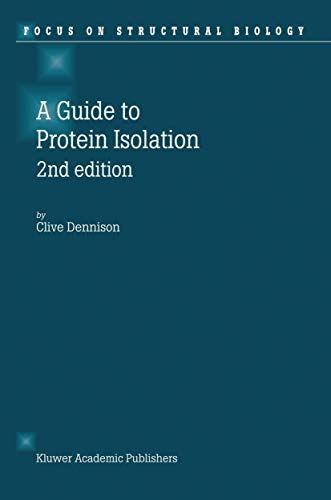
Synopsis
It is a truism of science that the more fundamental the subject, the more universally applicable it is. Neverthelens, it is important to strike a level of "fundamentalness" appropriate to the task in hand. For example, an in-depth study of the mechanics of motor cars would tell one nothing about the dynamics of traffic. Traffic exists on a different "level" - it is dependent upon the existence of motor vehicles but the physics and mathematics of traffic can be adequately addressed by considering motor vehicles as mobile "blobs", with no consideration of how they become mobile. To start a discourse on traffic with a consideration of the mechanics of motor vehicles would thus be inappropropriate. In writing this volume, I have wrestled with the question of the appropriate level at which to address the physics underlying many of the techniques used in protein isolation. I have tried to strike a level as would be used by a mechanic (with perhaps a slight leaning towards an engineer) - i.e. a practical level, offering appropriate insight but with minimal mathematics. Some people involved in biochemical research have a minimal grounding in chemistry and physics and so I have tried to keep it as simple as possible.
Les informations fournies dans la section « Synopsis » peuvent faire référence à une autre édition de ce titre.
Présentation de l'éditeur
The logic of the overall approach to protein isolation is explained and the physical principles of each separation method are made clear by the use of simple models and analogies drawn from everyday experiences. The author's aim has been to deepen the readers' insight into protein isolation methods, so that they may tackle new problems and perhaps devise new approaches to old problems. Many of the methods described are drawn from the author's own research and are thus uniquely described here; examples are three-phase partitioning, non-linear electrophoresis and a simple approach to buffer making. In this 2nd edition, the treatment of the basic physical principles has been expanded and clarified, the importance of ionic strength in measuring enzyme pH optima is emphasised and a computer program for the calculation of buffers of defined ionic strength is provided. The section on three-phase partitioning has been expanded to include the latest research findings on the use of t-butanol to inhibit enzymes and minimise homogenisation artefacts, the treatment of Hplc has been expanded and the most common practical methods are explained in detail in a new chapter. Additional study questions are provided, as are the answers to all study questions.
Les informations fournies dans la section « A propos du livre » peuvent faire référence à une autre édition de ce titre.
Résultats de recherche pour A Guide to Protein Isolation

Edition internationale
Guide To Protein Isolation, 2nd Edition
Edition internationaleVendeur : Romtrade Corp., STERLING HEIGHTS, MI, Etats-Unis
Évaluation du vendeur 5 sur 5 étoiles

Etat : New. Brand New. Soft Cover International Edition. Different ISBN and Cover Image. Priced lower than the standard editions which is usually intended to make them more affordable for students abroad. The core content of the book is generally the same as the standard edition. The country selling restrictions may be printed on the book but is no problem for the self-use. This Item maybe shipped from US or any other country as we have multiple locations worldwide. N° de réf. du vendeur ABBB-14075
Acheter neuf
EUR 29,55
Livraison gratuite
Expédition nationale : Etats-Unis
Expédition nationale : Etats-Unis
Quantité disponible : 1 disponible(s)

Image d'archives
A Guide to Protein Isolation (Focus on Structural Biology, 3)
Edité par
Springer, 2003
ISBN 10 : 1402012241
ISBN 13 : 9781402012242
Ancien ou d'occasion
Couverture rigide
Vendeur : Phatpocket Limited, Waltham Abbey, HERTS, Royaume-Uni
Évaluation du vendeur 5 sur 5 étoiles
Etat : Good. Your purchase helps support Sri Lankan Children's Charity 'The Rainbow Centre'. Ex-library, so some stamps and wear, but in good overall condition. Our donations to The Rainbow Centre have helped provide an education and a safe haven to hundreds of children who live in appalling conditions. N° de réf. du vendeur Z1-J-012-03042
Acheter D'occasion
EUR 17,52
Expédition à EUR 12,70
Expédition depuis Royaume-Uni vers Etats-Unis
Expédition depuis Royaume-Uni vers Etats-Unis
Quantité disponible : 1 disponible(s)
Image d'archives
A Guide to Protein Isolation
Edité par
Kluwer Academic, 2003
ISBN 10 : 1402012241
ISBN 13 : 9781402012242
Ancien ou d'occasion
Couverture rigide
Vendeur : Anybook.com, Lincoln, Royaume-Uni
Évaluation du vendeur 5 sur 5 étoiles
Etat : Good. This is an ex-library book and may have the usual library/used-book markings inside.This book has hardback covers. In good all round condition. Please note the Image in this listing is a stock photo and may not match the covers of the actual item,700grams, ISBN:9781402012242. N° de réf. du vendeur 9226651
Acheter D'occasion
EUR 17,91
Expédition à EUR 15,57
Expédition depuis Royaume-Uni vers Etats-Unis
Expédition depuis Royaume-Uni vers Etats-Unis
Quantité disponible : 1 disponible(s)
Image d'archives
A Guide to Protein Isolation
Edité par
Kluwer, Dordrecht, 2003
ISBN 10 : 1402012241
ISBN 13 : 9781402012242
Ancien ou d'occasion
Couverture rigide
Edition originale
Vendeur : Webbooks, Wigtown, Wigtown, Royaume-Uni
Évaluation du vendeur 5 sur 5 étoiles
Hard Cover. Etat : Good. No Jacket. Second Edition. From an academic library with the usual stamps etc. N° de réf. du vendeur 011547
Acheter D'occasion
EUR 17,22
Expédition à EUR 35,82
Expédition depuis Royaume-Uni vers Etats-Unis
Expédition depuis Royaume-Uni vers Etats-Unis
Quantité disponible : 1 disponible(s)
Image d'archives
A Guide to Protein Isolation (Focus on Structural Biology, 3)
Vendeur : GoldBooks, Denver, CO, Etats-Unis
Évaluation du vendeur 5 sur 5 étoiles
Hardcover. Etat : new. New Copy. Customer Service Guaranteed. N° de réf. du vendeur 35J47_42_1402012241
Acheter neuf
EUR 107,31
Expédition à EUR 4,91
Expédition nationale : Etats-Unis
Expédition nationale : Etats-Unis
Quantité disponible : 1 disponible(s)
Image fournie par le vendeur
Guide to Protein Isolation
Vendeur : GreatBookPrices, Columbia, MD, Etats-Unis
Évaluation du vendeur 5 sur 5 étoiles
Etat : New. N° de réf. du vendeur 1822783-n
Acheter neuf
EUR 110,13
Expédition à EUR 2,36
Expédition nationale : Etats-Unis
Expédition nationale : Etats-Unis
Quantité disponible : Plus de 20 disponibles
Image fournie par le vendeur
Guide to Protein Isolation
Edité par
Springer, 2003
ISBN 10 : 1402012241
ISBN 13 : 9781402012242
Ancien ou d'occasion
Couverture rigide
Vendeur : GreatBookPrices, Columbia, MD, Etats-Unis
Évaluation du vendeur 5 sur 5 étoiles
Etat : As New. Unread book in perfect condition. N° de réf. du vendeur 1822783
Acheter D'occasion
EUR 127,27
Expédition à EUR 2,36
Expédition nationale : Etats-Unis
Expédition nationale : Etats-Unis
Quantité disponible : Plus de 20 disponibles
Image fournie par le vendeur
A Guide to Protein Isolation
Edité par
Springer Netherlands, 2003
ISBN 10 : 1402012241
ISBN 13 : 9781402012242
Neuf
Couverture rigide
Vendeur : moluna, Greven, Allemagne
Évaluation du vendeur 5 sur 5 étoiles
Etat : New. Dieser Artikel ist ein Print on Demand Artikel und wird nach Ihrer Bestellung fuer Sie gedruckt. It is a truism of science that the more fundamental the subject, the more universally applicable it is. Neverthelens, it is important to strike a level of fundamentalness appropriate to the task in hand. For example, an in-depth study of the mechanics of . N° de réf. du vendeur 4092422
Acheter neuf
EUR 92,27
Expédition à EUR 48,99
Expédition depuis Allemagne vers Etats-Unis
Expédition depuis Allemagne vers Etats-Unis
Quantité disponible : Plus de 20 disponibles
Image d'archives
Guide to Protein Isolation
Vendeur : GreatBookPricesUK, Woodford Green, Royaume-Uni
Évaluation du vendeur 5 sur 5 étoiles
Etat : New. N° de réf. du vendeur 1822783-n
Acheter neuf
EUR 123,63
Expédition à EUR 17,91
Expédition depuis Royaume-Uni vers Etats-Unis
Expédition depuis Royaume-Uni vers Etats-Unis
Quantité disponible : Plus de 20 disponibles
Image d'archives
Guide to Protein Isolation
Edité par
Kluwer Academic Publishers, 2003
ISBN 10 : 1402012241
ISBN 13 : 9781402012242
Neuf
Couverture rigide
Vendeur : Kennys Bookshop and Art Galleries Ltd., Galway, GY, Irlande
Évaluation du vendeur 5 sur 5 étoiles
Etat : New. Emphasizes the importance of ionic strength in measuring enzyme pH optima and provides a computer program for the calculation of buffers of defined ionic strength. This work features a section on three-phase partitioning, including the research findings on the use of t-butanol to inhibit enzymes and minimise homogenisation artefacts. Series: Focus on Structural Biology. Num Pages: 249 pages, biography. BIC Classification: PSBC. Category: (UP) Postgraduate, Research & Scholarly; (UU) Undergraduate. Dimension: 241 x 166 x 22. Weight in Grams: 526. . 2003. 2nd ed. 2003. Hardback. . . . . N° de réf. du vendeur V9781402012242
Acheter neuf
EUR 134,38
Expédition à EUR 9,50
Expédition depuis Irlande vers Etats-Unis
Expédition depuis Irlande vers Etats-Unis
Quantité disponible : 15 disponible(s)