
Articles liés à Signal Transduction and Cardiac Hypertrophy
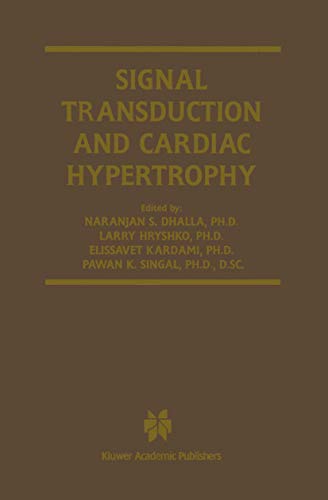
Synopsis
Cellular signaling in cardiac muscle refers to the myriad of stimuli and responses that direct and control the physiological operation of this organ. Our understand- ing of these complex signaling cascades has increased dramatically over the past few decades with the advent of molecular tools for their dissection. Moreover, this infor- mation is beginning to provide tangible targets towards manipulating cardiac func- tion in the setting of cardiovascular disease. The mechanisms and factors that regulate cardiac cell growth are of particular interest as both adaptive and maladaptive responses can occur during cardiac hypertrophy. Cardiac hypertrophy describes the increase in individual cardiac myocyte size that is accomplished through the series and/or parallel addition of sarcomeres. The ability of cardiac muscle to increase in size through hyperplasia becomes highly restricted or negligible shortly after birth. Consequently, the increase in heart size associated with development and growth of an individual occurs through hypertrophy. In response to a chronic increase in workload, cardiac muscle cells can dramatically increase in size to face their increasing contractile demands. While this plasticity is clearly a ben- eficial response under many conditions, it can be highly deleterious and inappropri- ate under others. For example, cardiac hypertrophy associated with endurance exercise clearly enhances athletic performance. In contrast, the hypertrophy associated with chronic hypertension, stenotic or regurgitant heart valves, or following a myocardial infarction often continues far beyond the period where this adaptive response is ben- eficial.
Les informations fournies dans la section « Synopsis » peuvent faire référence à une autre édition de ce titre.
Résultats de recherche pour Signal Transduction and Cardiac Hypertrophy

Image d'archives
Signal Transduction And Cardiac Hypertrophy (progress In Experimental Cardiology)
Vendeur : Basi6 International, Irving, TX, Etats-Unis
Évaluation du vendeur 5 sur 5 étoiles

Etat : Brand New. New. US edition. Expediting shipping for all USA and Europe orders excluding PO Box. Excellent Customer Service. N° de réf. du vendeur ABEOCT25-155198
Acheter neuf
EUR 195,34
Livraison gratuite
Expédition nationale : Etats-Unis
Expédition nationale : Etats-Unis
Quantité disponible : 1 disponible(s)
Image d'archives
Signal Transduction And Cardiac Hypertrophy (progress In Experimental Cardiology)
Vendeur : Romtrade Corp., STERLING HEIGHTS, MI, Etats-Unis
Évaluation du vendeur 5 sur 5 étoiles
Etat : New. This is a Brand-new US Edition. This Item may be shipped from US or any other country as we have multiple locations worldwide. N° de réf. du vendeur ABBB-160679
Acheter neuf
EUR 197,93
Livraison gratuite
Expédition nationale : Etats-Unis
Expédition nationale : Etats-Unis
Quantité disponible : 1 disponible(s)
Image d'archives
Signal Transduction and Cardiac Hypertrophy
Vendeur : GreatBookPrices, Columbia, MD, Etats-Unis
Évaluation du vendeur 5 sur 5 étoiles
Etat : New. N° de réf. du vendeur 1176867-n
Acheter neuf
EUR 254,14
Expédition à EUR 2,37
Expédition nationale : Etats-Unis
Expédition nationale : Etats-Unis
Quantité disponible : Plus de 20 disponibles
Image d'archives
Signal Transduction and Cardiac Hypertrophy (Progress in Experimental Cardiology, 7)
Vendeur : California Books, Miami, FL, Etats-Unis
Évaluation du vendeur 5 sur 5 étoiles
Etat : New. N° de réf. du vendeur I-9781402072185
Acheter neuf
EUR 256,58
Livraison gratuite
Expédition nationale : Etats-Unis
Expédition nationale : Etats-Unis
Quantité disponible : Plus de 20 disponibles
Image d'archives
Signal Transduction and Cardiac Hypertrophy
Edité par
Kluwer Academic Publishers, 2003
ISBN 10 : 140207218X
ISBN 13 : 9781402072185
Neuf
Couverture rigide
Vendeur : Kennys Bookshop and Art Galleries Ltd., Galway, GY, Irlande
Évaluation du vendeur 5 sur 5 étoiles
Etat : New. The limitation in number of donor hearts led to the establishment of alternative treatments such as left ventricular assist devices (LVAD). This work clarifies the underlying biological mechanisms of this process, known as "reverse remodelling". Editor(s): Dhalla, Naranjan S.; Hryshko, Larry; Kardami, Elissavet; Singal, Pawan K. Series: Progress in Experimental Cardiology. Num Pages: 508 pages, biography. BIC Classification: MJD. Category: (P) Professional & Vocational; (UP) Postgraduate, Research & Scholarly; (UU) Undergraduate. Dimension: 234 x 156 x 28. Weight in Grams: 917. . 2003. Hardback. . . . . N° de réf. du vendeur V9781402072185
Acheter neuf
EUR 261,03
Expédition à EUR 9,50
Expédition depuis Irlande vers Etats-Unis
Expédition depuis Irlande vers Etats-Unis
Quantité disponible : 15 disponible(s)
Image d'archives
Signal Transduction and Cardiac Hypertrophy (Progress in Experimental Cardiology, 7)
Vendeur : Ria Christie Collections, Uxbridge, Royaume-Uni
Évaluation du vendeur 5 sur 5 étoiles
Etat : New. In English. N° de réf. du vendeur ria9781402072185_new
Acheter neuf
EUR 253,88
Expédition à EUR 17,68
Expédition depuis Royaume-Uni vers Etats-Unis
Expédition depuis Royaume-Uni vers Etats-Unis
Quantité disponible : Plus de 20 disponibles
Image fournie par le vendeur
Signal Transduction and Cardiac Hypertrophy
Vendeur : GreatBookPricesUK, Woodford Green, Royaume-Uni
Évaluation du vendeur 5 sur 5 étoiles
Etat : New. N° de réf. du vendeur 1176867-n
Acheter neuf
EUR 253,87
Expédition à EUR 17,76
Expédition depuis Royaume-Uni vers Etats-Unis
Expédition depuis Royaume-Uni vers Etats-Unis
Quantité disponible : Plus de 20 disponibles
Image fournie par le vendeur
Signal Transduction and Cardiac Hypertrophy
Vendeur : moluna, Greven, Allemagne
Évaluation du vendeur 5 sur 5 étoiles
Gebunden. Etat : New. N° de réf. du vendeur 64775415
Acheter neuf
EUR 246,91
Expédition à EUR 48,99
Expédition depuis Allemagne vers Etats-Unis
Expédition depuis Allemagne vers Etats-Unis
Quantité disponible : Plus de 20 disponibles
Image d'archives
Signal Transduction and Cardiac Hypertrophy
Edité par
Kluwer Academic Publishers, 2003
ISBN 10 : 140207218X
ISBN 13 : 9781402072185
Neuf
Couverture rigide
Vendeur : Kennys Bookstore, Olney, MD, Etats-Unis
Évaluation du vendeur 5 sur 5 étoiles
Etat : New. The limitation in number of donor hearts led to the establishment of alternative treatments such as left ventricular assist devices (LVAD). This work clarifies the underlying biological mechanisms of this process, known as "reverse remodelling". Editor(s): Dhalla, Naranjan S.; Hryshko, Larry; Kardami, Elissavet; Singal, Pawan K. Series: Progress in Experimental Cardiology. Num Pages: 508 pages, biography. BIC Classification: MJD. Category: (P) Professional & Vocational; (UP) Postgraduate, Research & Scholarly; (UU) Undergraduate. Dimension: 234 x 156 x 28. Weight in Grams: 917. . 2003. Hardback. . . . . Books ship from the US and Ireland. N° de réf. du vendeur V9781402072185
Acheter neuf
EUR 339,44
Expédition à EUR 9,41
Expédition nationale : Etats-Unis
Expédition nationale : Etats-Unis
Quantité disponible : 15 disponible(s)
Image fournie par le vendeur
Signal Transduction and Cardiac Hypertrophy
Edité par
Springer Us Jan 2003, 2003
ISBN 10 : 140207218X
ISBN 13 : 9781402072185
Neuf
Couverture rigide
Vendeur : AHA-BUCH GmbH, Einbeck, Allemagne
Évaluation du vendeur 5 sur 5 étoiles
Buch. Etat : Neu. Neuware - Cellular signaling in cardiac muscle refers to the myriad of stimuli and responses that direct and control the physiological operation of this organ. Our understand ing of these complex signaling cascades has increased dramatically over the past few decades with the advent of molecular tools for their dissection. Moreover, this infor mation is beginning to provide tangible targets towards manipulating cardiac func tion in the setting of cardiovascular disease. The mechanisms and factors that regulate cardiac cell growth are of particular interest as both adaptive and maladaptive responses can occur during cardiac hypertrophy. Cardiac hypertrophy describes the increase in individual cardiac myocyte size that is accomplished through the series and/or parallel addition of sarcomeres. The ability of cardiac muscle to increase in size through hyperplasia becomes highly restricted or negligible shortly after birth. Consequently, the increase in heart size associated with development and growth of an individual occurs through hypertrophy. In response to a chronic increase in workload, cardiac muscle cells can dramatically increase in size to face their increasing contractile demands. While this plasticity is clearly a ben eficial response under many conditions, it can be highly deleterious and inappropri ate under others. For example, cardiac hypertrophy associated with endurance exercise clearly enhances athletic performance. In contrast, the hypertrophy associated with chronic hypertension, stenotic or regurgitant heart valves, or following a myocardial infarction often continues far beyond the period where this adaptive response is ben eficial. N° de réf. du vendeur 9781402072185
Acheter neuf
EUR 329,25
Expédition à EUR 35
Expédition depuis Allemagne vers Etats-Unis
Expédition depuis Allemagne vers Etats-Unis
Quantité disponible : 2 disponible(s)