
Articles liés à Granular Computing: An Introduction
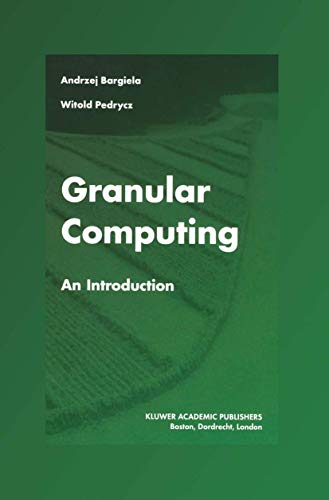
Synopsis
This book is about Granular Computing (GC) - an emerging conceptual and of information processing. As the name suggests, GC concerns computing paradigm processing of complex information entities - information granules. In essence, information granules arise in the process of abstraction of data and derivation of knowledge from information. Information granules are everywhere. We commonly use granules of time (seconds, months, years). We granulate images; millions of pixels manipulated individually by computers appear to us as granules representing physical objects. In natural language, we operate on the basis of word-granules that become crucial entities used to realize interaction and communication between humans. Intuitively, we sense that information granules are at the heart of all our perceptual activities. In the past, several formal frameworks and tools, geared for processing specific information granules, have been proposed. Interval analysis, rough sets, fuzzy sets have all played important role in knowledge representation and processing. Subsequently, information granulation and information granules arose in numerous application domains. Well-known ideas of rule-based systems dwell inherently on information granules. Qualitative modeling, being one of the leading threads of AI, operates on a level of information granules. Multi-tier architectures and hierarchical systems (such as those encountered in control engineering), planning and scheduling systems all exploit information granularity. We also utilize information granules when it comes to functionality granulation, reusability of information and efficient ways of developing underlying information infrastructures.
Les informations fournies dans la section « Synopsis » peuvent faire référence à une autre édition de ce titre.
Résultats de recherche pour Granular Computing: An Introduction

Image fournie par le vendeur
Granular Computing: An Introduction (The Springer International Series in Engineering and Computer Science, 717)
Edité par
Kluwer Academic, USA, 2003
ISBN 10 : 1402072732
ISBN 13 : 9781402072734
Ancien ou d'occasion
Couverture rigide
Vendeur : BookHome, San Jose, CA, Etats-Unis
Évaluation du vendeur 5 sur 5 étoiles

Hardcover. Etat : Very Good. No Jacket. Condition: very good with slight shelf wear "Granular Computing is an emerging conceptual and computing paradigm of information processing. It has been motivated by the urgent need for intelligent processing of empirical data that is now commonly available in vast quantities, into a humanly manageable abstract knowledge. In this sense, granular computing offers a landmark change from the current machine-centric to human-centric approach to information and knowledge. The theoretical foundations of granular computing are exceptionally sound and involve set theory (interval mathematics), fuzzy sets, rough sets, and random sets linked together in a highly comprehensive treatment of this emerging paradigm. ". N° de réf. du vendeur 000050
Acheter D'occasion
EUR 32,14
Livraison gratuite
Expédition nationale : Etats-Unis
Expédition nationale : Etats-Unis
Quantité disponible : 1 disponible(s)
Image d'archives
Granular Computing:
Vendeur : Basi6 International, Irving, TX, Etats-Unis
Évaluation du vendeur 5 sur 5 étoiles
Etat : Brand New. New. US edition. Expediting shipping for all USA and Europe orders excluding PO Box. Excellent Customer Service. N° de réf. du vendeur ABEOCT25-155225
Acheter neuf
EUR 147,12
Livraison gratuite
Expédition nationale : Etats-Unis
Expédition nationale : Etats-Unis
Quantité disponible : 1 disponible(s)
Image d'archives
Granular Computing:
Vendeur : Romtrade Corp., STERLING HEIGHTS, MI, Etats-Unis
Évaluation du vendeur 5 sur 5 étoiles
Etat : New. This is a Brand-new US Edition. This Item may be shipped from US or any other country as we have multiple locations worldwide. N° de réf. du vendeur ABBB-156386
Acheter neuf
EUR 149,06
Livraison gratuite
Expédition nationale : Etats-Unis
Expédition nationale : Etats-Unis
Quantité disponible : 1 disponible(s)
Image fournie par le vendeur
Granular Computing
impression à la demandeVendeur : moluna, Greven, Allemagne
Évaluation du vendeur 5 sur 5 étoiles
Gebunden. Etat : New. Dieser Artikel ist ein Print on Demand Artikel und wird nach Ihrer Bestellung fuer Sie gedruckt. This book is about Granular Computing (GC) - an emerging conceptual and of information processing. As the name suggests, GC concerns computing paradigm processing of complex information entities - information granules. In essence, information granules arise. N° de réf. du vendeur 4094961
Acheter neuf
EUR 180,07
Expédition à EUR 48,99
Expédition depuis Allemagne vers Etats-Unis
Expédition depuis Allemagne vers Etats-Unis
Quantité disponible : Plus de 20 disponibles
Image fournie par le vendeur
Granular Computing : An Introduction
Vendeur : GreatBookPricesUK, Woodford Green, Royaume-Uni
Évaluation du vendeur 5 sur 5 étoiles
Etat : New. N° de réf. du vendeur 1707724-n
Acheter neuf
EUR 216,73
Expédition à EUR 17,75
Expédition depuis Royaume-Uni vers Etats-Unis
Expédition depuis Royaume-Uni vers Etats-Unis
Quantité disponible : Plus de 20 disponibles
Image fournie par le vendeur
Granular Computing
Edité par
Springer US Nov 2002, 2002
ISBN 10 : 1402072732
ISBN 13 : 9781402072734
Neuf
Couverture rigide
Vendeur : BuchWeltWeit Ludwig Meier e.K., Bergisch Gladbach, Allemagne
Évaluation du vendeur 5 sur 5 étoiles
Buch. Etat : Neu. This item is printed on demand - it takes 3-4 days longer - Neuware -This book is about Granular Computing (GC) - an emerging conceptual and of information processing. As the name suggests, GC concerns computing paradigm processing of complex information entities - information granules. In essence, information granules arise in the process of abstraction of data and derivation of knowledge from information. Information granules are everywhere. We commonly use granules of time (seconds, months, years). We granulate images; millions of pixels manipulated individually by computers appear to us as granules representing physical objects. In natural language, we operate on the basis of word-granules that become crucial entities used to realize interaction and communication between humans. Intuitively, we sense that information granules are at the heart of all our perceptual activities. In the past, several formal frameworks and tools, geared for processing specific information granules, have been proposed. Interval analysis, rough sets, fuzzy sets have all played important role in knowledge representation and processing. Subsequently, information granulation and information granules arose in numerous application domains. Well-known ideas of rule-based systems dwell inherently on information granules. Qualitative modeling, being one of the leading threads of AI, operates on a level of information granules. Multi-tier architectures and hierarchical systems (such as those encountered in control engineering), planning and scheduling systems all exploit information granularity. We also utilize information granules when it comes to functionality granulation, reusability of information and efficient ways of developing underlying information infrastructures. 480 pp. Englisch. N° de réf. du vendeur 9781402072734
Acheter neuf
EUR 213,99
Expédition à EUR 23
Expédition depuis Allemagne vers Etats-Unis
Expédition depuis Allemagne vers Etats-Unis
Quantité disponible : 2 disponible(s)
Image fournie par le vendeur
Granular Computing : An Introduction
Vendeur : GreatBookPrices, Columbia, MD, Etats-Unis
Évaluation du vendeur 5 sur 5 étoiles
Etat : New. N° de réf. du vendeur 1707724-n
Acheter neuf
EUR 239,05
Expédition à EUR 2,36
Expédition nationale : Etats-Unis
Expédition nationale : Etats-Unis
Quantité disponible : Plus de 20 disponibles
Image fournie par le vendeur
Granular Computing | An Introduction
impression à la demandeVendeur : preigu, Osnabrück, Allemagne
Évaluation du vendeur 5 sur 5 étoiles
Buch. Etat : Neu. Granular Computing | An Introduction | Andrzej Bargiela (u. a.) | Buch | xix | Englisch | 2002 | Springer | EAN 9781402072734 | Verantwortliche Person für die EU: Springer Verlag GmbH, Tiergartenstr. 17, 69121 Heidelberg, juergen[dot]hartmann[at]springer[dot]com | Anbieter: preigu Print on Demand. N° de réf. du vendeur 102386919
Acheter neuf
EUR 186,70
Expédition à EUR 70
Expédition depuis Allemagne vers Etats-Unis
Expédition depuis Allemagne vers Etats-Unis
Quantité disponible : 5 disponible(s)
Image d'archives
Granular Computing: An Introduction (The Springer International Series in Engineering and Computer Science, 717)
Vendeur : Ria Christie Collections, Uxbridge, Royaume-Uni
Évaluation du vendeur 5 sur 5 étoiles
Etat : New. In English. N° de réf. du vendeur ria9781402072734_new
Acheter neuf
EUR 253,85
Expédition à EUR 13,36
Expédition depuis Royaume-Uni vers Etats-Unis
Expédition depuis Royaume-Uni vers Etats-Unis
Quantité disponible : Plus de 20 disponibles
Image fournie par le vendeur
Granular Computing
Edité par
Springer, Springer Nov 2002, 2002
ISBN 10 : 1402072732
ISBN 13 : 9781402072734
Neuf
Couverture rigide
Vendeur : buchversandmimpf2000, Emtmannsberg, BAYE, Allemagne
Évaluation du vendeur 5 sur 5 étoiles
Buch. Etat : Neu. This item is printed on demand - Print on Demand Titel. Neuware -This book is about Granular Computing (GC) - an emerging conceptual and of information processing. As the name suggests, GC concerns computing paradigm processing of complex information entities - information granules. In essence, information granules arise in the process of abstraction of data and derivation of knowledge from information. Information granules are everywhere. We commonly use granules of time (seconds, months, years). We granulate images; millions of pixels manipulated individually by computers appear to us as granules representing physical objects. In natural language, we operate on the basis of word-granules that become crucial entities used to realize interaction and communication between humans. Intuitively, we sense that information granules are at the heart of all our perceptual activities. In the past, several formal frameworks and tools, geared for processing specific information granules, have been proposed. Interval analysis, rough sets, fuzzy sets have all played important role in knowledge representation and processing. Subsequently, information granulation and information granules arose in numerous application domains. Well-known ideas of rule-based systems dwell inherently on information granules. Qualitative modeling, being one of the leading threads of AI, operates on a level of information granules. Multi-tier architectures and hierarchical systems (such as those encountered in control engineering), planning and scheduling systems all exploit information granularity. We also utilize information granules when it comes to functionality granulation, reusability of information and efficient ways of developing underlying information infrastructures.Springer-Verlag KG, Sachsenplatz 4-6, 1201 Wien 480 pp. Englisch. N° de réf. du vendeur 9781402072734
Acheter neuf
EUR 213,99
Expédition à EUR 60
Expédition depuis Allemagne vers Etats-Unis
Expédition depuis Allemagne vers Etats-Unis
Quantité disponible : 1 disponible(s)