
Articles liés à National Geographic Concise History of Science and...
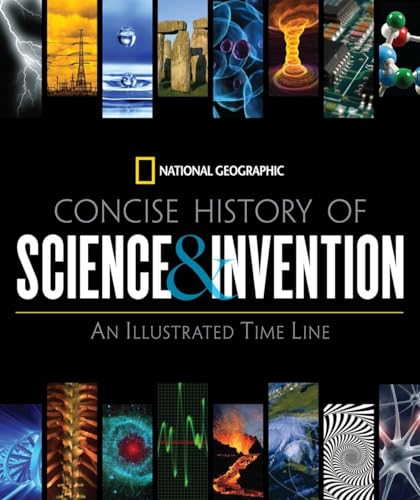
National Geographic Concise History of Science and Invention: An Illustrated Time Line - Couverture rigide
Synopsis
From the ancient conquest of fire and the first turn of a wheel to the latest in scientific leaps toward the stars, this easy-access history offers a panoramic perspective on humankind’s restless quest for the laws, theories, and tools by which we can grasp and master our universe. This concise, concentrated, consistently organized look at our species’ key scientific and innovative achievements spans all human history, presenting ten distinct eras from the first glimmers of intelligence to the cutting-edge technologies of the modern world. Within these intuitive divisions, all human scientific endeavors and achievement are divided into four general fields of inquiry and arrayed into four basic geocultural regions for easy comparison in a logical, systematic grid format highlighted by 350 photographs, maps, illustrations, and diagrams that add graphic emphasis to key information. Special two-page feature spreads explore the most revolutionary developments in greater depth; compelling, expertly composed essays and memorable quotations add sparkle; and informative sidebars provide specifically focused items of information about particular inventions, ideas, or themes. Completing this comprehensive approach, an extensive glossary explains unfamiliar terms, and a detailed index makes it a simple matter to follow a particular field or process from its origin through its complete cross-cultural evolution. This is a reference as usefully accessible as it is inherently fascinating.
Les informations fournies dans la section « Synopsis » peuvent faire référence à une autre édition de ce titre.
À propos de l'auteur
NATIONAL GEOGRAPHIC is one of the world’s leading nonfiction publishers, proudly supporting the work of scientists, explorers, photographers, and authors, as well as publishing a diverse list of books that celebrate the world and all that is in it. National Geographic Books creates and distributes print and digital works that inspire, entertain, teach, and give readers access to a world of discovery and possibility on a wide range of nonfiction subjects from animals to travel, cartography to history, fun facts to moving stories. A portion of all National Geographic proceeds is used to fund exploration, conservation, and education through ongoing contributions to the work of the National Geographic Society.
Extrait. © Reproduit sur autorisation. Tous droits réservés.
Seven Scientific Turning Points That Changed the World
From the new book, National Geographic Concise History of Science and Invention: An Illustrated Time Line
1. The World’s First City
The settlement at Çatal Hüyük in Anatolia (modern Turkey) dates from about 6000 B.C.E. at the latest. The houses butted closely together and had flat roofs, reached by means of ladders. The people grew crops and irrigated the fields. They supplemented their diet by hunting animals. They wove cloth, made baskets and clay pots, and tanned hides to make leather. Nearby volcanoes produced a hard, glasslike obsidian, which the people of Çatal Hüyük made into knives and other tools. The obsidian was also traded with neighboring peoples. Each house had a religious shrine decorated with figurines and the heads and horns of animals. The dead were left outside exposed to the elements before their remains were buried under the houses.
2. The Library at Alexandria
The greatest collection of documents in classical times was kept in a library in Alexandria, northern Egypt. The library was founded by pharaoh Ptolemy I Soter (r. 323–283 B.C.E.) at the beginning of the third century B.C.E. and built up by his son Ptolemy II Philadelphus (r. 283–46 B.C.E.). Established as part of the research “department” of the Alexandrian Museum, it had a smaller section, the Serapeum, located in the nearby Temple of Serapis that was established by Ptolemy III Euergetes (r. 246–22 B.C.E.). The hundreds of thousands of vellum and papyrus scrolls included nearly all the works of the Greek poets and dramatists, based originally on copies of the works in Aristotle’s library in Athens. The large staff included translators, editors, and scribes, who kept adding texts to the collection. Fire damaged part of the library in 269 C.E., and rioting during a civil war led to its final destruction. The Serapeum was pillaged by a Christian mob in 391.
3. Avicenna
The first European printing of the Canon of Medicine was a milestone in the development of medicine. Its author, Ibn-Sina—whose name was Latinized as “Avicenna” for publication in a field still dominated by the ideas of ancient Roman and Greek physicians—was a Persian philosopher and physician. He was born in a village near Bokhara (now Bukhara in present-day Uzbekistan). He studied there and traveled widely. He learned all the classical Arab texts and mastered astronomy, Greek, mathematics, and all the available texts on medicine. At age 18 he became a court physician, then vizier (advisor) at the Buyid court in Hamadan, and from 1024 was physician to several sultans. As well as introducing the works of Aristotle to the Islamic world, Ibn-Sina also wrote more than 100 works on science, philosophy, and religion. His pioneering medical work, however, was his most important contribution to the spread of knowledge. The Canon of Medicine, written in 1000, remained a standard medical textbook for centuries. It contains instructions for testing medications, guidelines for diagnosing disease by examining the patient, and advice to surgeons to learn anatomy from observation and dissection, rather than from textbooks.
4. Quinine
The isolation of the chemical compound quinine by French chemists Pierre Pelletier and Joseph Caventou in 1820 was a breakthrough with wide-reaching consequences in medicine and politics. Quinine is a compound found in the bark of the cinchona tree in South America. For centuries it was used by the Quechua peoples of Peru as a muscle relaxant to suppress shivering, and missionaries who saw this use brought the bark back to Europe in the 17th century, believing it would relieve the shivering associated with malarial fevers. It proved highly effective, not only stopping the shivering but also halting the advance of the disease. With the isolation of the active chemical component in 1820 quinine could be produced in large quantities and more easily administered. Tropical regions in which malaria was prevalent and therefore inhabitable to Europeans, who have no natural immunity, were now open for colonization, starting the “scramble for Africa” as European powers fought to take control of sub-Saharan Africa.
5. Safe Anesthetics
For many centuries a major impediment to safe surgical procedures was the problem of pain. The intense pain that accompanied surgery before the introduction of reliable anesthetics not only caused considerable distress to the patient, but also made the surgery more dangerous. The patient’s involuntary movements and the need to finish the surgery quickly increased the likelihood of potentially fatal mistakes. Anesthetics such as opium, cocaine, and mandrake had always been available but were not reliable: an underdose or overdose was too easily administered. Sometimes the anesthetic would be insufficient to dull pain; at other times it would kill the patient. The discovery of new anesthetics—including ether, chloroform, and nitrous oxide—in the mid-19th century improved the situation, but almost as important was the methodical research into anesthetic techniques and dosages conducted during this time. Physicians such as John Snow (1813–1858)—better known for identifying the cause of cholera—published dosage advice and designed apparatus for administering these new anesthetics safely to patients of all ages and body sizes.
6. Insulin
Produced in the pancreas by cells called the islets of Langerhans, insulin is a hormone that enables body cells to take up the blood sugar glucose. Glucose is used as an energy source by the body. If the body cannot make insulin, type I diabetes mellitus results. In 1921 Canadian physiologist Frederick Banting (1891–1941) isolated insulin from dogs and found that injecting it cured the symptoms of diabetes in a dog that had had its pancreas removed (and therefore could not produce its own insulin). Using a purer extract from calves, Banting and coworkers successfully treated terminally ill children with type I diabetes the following year. Purified animal insulin was soon available for sale. By the early 1980s insulin could be made by genetically modified bacteria containing the human insulin gene. Banting received the Nobel Prize for Physiology or Medicine in 1923 for his discovery.
7. Microwave Ovens
Self-taught American engineer Percy Spencer (1894–1970), who worked for the company Raytheon, had the idea for a microwave oven after noticing that a candy bar had melted while he was making a radar set in the 1940s. Raytheon patented his idea in 1947. A few cumbersome models were made, but it was not until 1967 that the first domestic microwave was marketed. Microwave ovens use microwave radiation to heat water and other polarized molecules in food. They cook quickly, efficiently, and safely. Since the late 1960s, the ovens have become smaller, more powerful, and easier to use. More than 90 percent of U.S. households now have a microwave oven.
Les informations fournies dans la section « A propos du livre » peuvent faire référence à une autre édition de ce titre.
Résultats de recherche pour National Geographic Concise History of Science and...

Image d'archives
National Geographic Concise History of Science and Invention: An Illustrated Time Line
Edité par
National Geographic (edition ), 2009
ISBN 10 : 1426205449
ISBN 13 : 9781426205446
Ancien ou d'occasion
Couverture rigide
Vendeur : BooksRun, Philadelphia, PA, Etats-Unis
Évaluation du vendeur 5 sur 5 étoiles

Hardcover. Etat : Very Good. With dust jacket. It's a well-cared-for item that has seen limited use. The item may show minor signs of wear. All the text is legible, with all pages included. It may have slight markings and/or highlighting. N° de réf. du vendeur 1426205449-11-1-29
Acheter D'occasion
EUR 5,12
Livraison gratuite
Expédition nationale : Etats-Unis
Expédition nationale : Etats-Unis
Quantité disponible : 1 disponible(s)
Image d'archives
National Geographic Concise History of Science and Invention: An Illustrated Time Line
Edité par
National Geographic, 2009
ISBN 10 : 1426205449
ISBN 13 : 9781426205446
Ancien ou d'occasion
Couverture rigide
Vendeur : HPB-Emerald, Dallas, TX, Etats-Unis
Évaluation du vendeur 5 sur 5 étoiles
Hardcover. Etat : Very Good. Connecting readers with great books since 1972! Used books may not include companion materials, and may have some shelf wear or limited writing. We ship orders daily and Customer Service is our top priority! N° de réf. du vendeur S_476955268
Acheter D'occasion
EUR 3,66
Expédition à EUR 3,33
Expédition nationale : Etats-Unis
Expédition nationale : Etats-Unis
Quantité disponible : 1 disponible(s)
Image d'archives
National Geographic Concise History of Science and Invention: An Illustrated Time Line
Edité par
National Geographic, 2009
ISBN 10 : 1426205449
ISBN 13 : 9781426205446
Ancien ou d'occasion
Couverture rigide
Vendeur : HPB Inc., Dallas, TX, Etats-Unis
Évaluation du vendeur 5 sur 5 étoiles
Hardcover. Etat : Very Good. Connecting readers with great books since 1972! Used books may not include companion materials, and may have some shelf wear or limited writing. We ship orders daily and Customer Service is our top priority! N° de réf. du vendeur S_475990323
Acheter D'occasion
EUR 3,66
Expédition à EUR 3,33
Expédition nationale : Etats-Unis
Expédition nationale : Etats-Unis
Quantité disponible : 1 disponible(s)
Image d'archives
National Geographic Concise History of Science and Invention: An Illustrated Time Line
Edité par
National Geographic, 2009
ISBN 10 : 1426205449
ISBN 13 : 9781426205446
Ancien ou d'occasion
Couverture rigide
Vendeur : Half Price Books Inc., Dallas, TX, Etats-Unis
Évaluation du vendeur 5 sur 5 étoiles
Hardcover. Etat : Very Good. Connecting readers with great books since 1972! Used books may not include companion materials, and may have some shelf wear or limited writing. We ship orders daily and Customer Service is our top priority! N° de réf. du vendeur S_474731377
Acheter D'occasion
EUR 3,66
Expédition à EUR 3,33
Expédition nationale : Etats-Unis
Expédition nationale : Etats-Unis
Quantité disponible : 1 disponible(s)
Image d'archives
National Geographic Concise History of Science and Invention: An Illustrated Time Line
Edité par
National Geographic, 2009
ISBN 10 : 1426205449
ISBN 13 : 9781426205446
Ancien ou d'occasion
Couverture rigide
Vendeur : ThriftBooks-Reno, Reno, NV, Etats-Unis
Évaluation du vendeur 5 sur 5 étoiles
Hardcover. Etat : Good. No Jacket. Pages can have notes/highlighting. Spine may show signs of wear. ~ ThriftBooks: Read More, Spend Less. N° de réf. du vendeur G1426205449I3N00
Acheter D'occasion
EUR 7,11
Livraison gratuite
Expédition nationale : Etats-Unis
Expédition nationale : Etats-Unis
Quantité disponible : 1 disponible(s)
Image d'archives
National Geographic Concise History of Science and Invention: An Illustrated Time Line
Edité par
National Geographic, 2009
ISBN 10 : 1426205449
ISBN 13 : 9781426205446
Ancien ou d'occasion
Couverture rigide
Vendeur : ThriftBooks-Atlanta, AUSTELL, GA, Etats-Unis
Évaluation du vendeur 5 sur 5 étoiles
Hardcover. Etat : Fair. No Jacket. Readable copy. Pages may have considerable notes/highlighting. ~ ThriftBooks: Read More, Spend Less. N° de réf. du vendeur G1426205449I5N00
Acheter D'occasion
EUR 7,11
Livraison gratuite
Expédition nationale : Etats-Unis
Expédition nationale : Etats-Unis
Quantité disponible : 1 disponible(s)
Image d'archives
National Geographic Concise History of Science and Invention: An Illustrated Time Line
Edité par
National Geographic, 2009
ISBN 10 : 1426205449
ISBN 13 : 9781426205446
Ancien ou d'occasion
Couverture rigide
Vendeur : ThriftBooks-Dallas, Dallas, TX, Etats-Unis
Évaluation du vendeur 5 sur 5 étoiles
Hardcover. Etat : Very Good. No Jacket. May have limited writing in cover pages. Pages are unmarked. ~ ThriftBooks: Read More, Spend Less. N° de réf. du vendeur G1426205449I4N00
Acheter D'occasion
EUR 7,11
Livraison gratuite
Expédition nationale : Etats-Unis
Expédition nationale : Etats-Unis
Quantité disponible : 1 disponible(s)
Image d'archives
National Geographic Concise History of Science and Invention: An Illustrated Time Line
Edité par
National Geographic, 2009
ISBN 10 : 1426205449
ISBN 13 : 9781426205446
Ancien ou d'occasion
Couverture rigide
Vendeur : ThriftBooks-Atlanta, AUSTELL, GA, Etats-Unis
Évaluation du vendeur 5 sur 5 étoiles
Hardcover. Etat : Fair. No Jacket. Former library book; Readable copy. Pages may have considerable notes/highlighting. ~ ThriftBooks: Read More, Spend Less. N° de réf. du vendeur G1426205449I5N10
Acheter D'occasion
EUR 7,11
Livraison gratuite
Expédition nationale : Etats-Unis
Expédition nationale : Etats-Unis
Quantité disponible : 1 disponible(s)
Image d'archives
National Geographic Concise History of Science and Invention: An Illustrated Time Line
Edité par
National Geographic, 2009
ISBN 10 : 1426205449
ISBN 13 : 9781426205446
Ancien ou d'occasion
Couverture rigide
Vendeur : ThriftBooks-Atlanta, AUSTELL, GA, Etats-Unis
Évaluation du vendeur 5 sur 5 étoiles
Hardcover. Etat : Very Good. No Jacket. May have limited writing in cover pages. Pages are unmarked. ~ ThriftBooks: Read More, Spend Less. N° de réf. du vendeur G1426205449I4N00
Acheter D'occasion
EUR 7,11
Livraison gratuite
Expédition nationale : Etats-Unis
Expédition nationale : Etats-Unis
Quantité disponible : 1 disponible(s)
Image d'archives
National Geographic Concise History of Science and Invention: An Illustrated Time Line
Edité par
National Geographic, 2009
ISBN 10 : 1426205449
ISBN 13 : 9781426205446
Ancien ou d'occasion
Couverture rigide
Vendeur : ThriftBooks-Dallas, Dallas, TX, Etats-Unis
Évaluation du vendeur 5 sur 5 étoiles
Hardcover. Etat : Good. No Jacket. Pages can have notes/highlighting. Spine may show signs of wear. ~ ThriftBooks: Read More, Spend Less. N° de réf. du vendeur G1426205449I3N00
Acheter D'occasion
EUR 7,11
Livraison gratuite
Expédition nationale : Etats-Unis
Expédition nationale : Etats-Unis
Quantité disponible : 1 disponible(s)