
Articles liés à Be Skillful: God's Guidebook to Wise Living : OT...
Be Skillful: God's Guidebook to Wise Living : OT Commentary Proverbs - Couverture souple
Livre 37 sur 50: The BE Series Commentary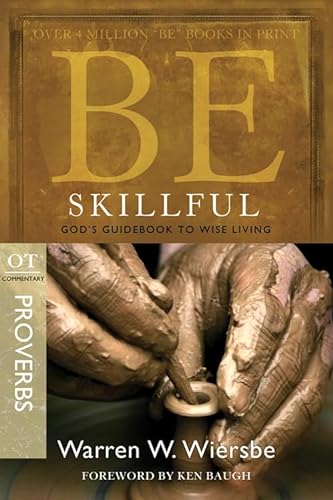
Synopsis
Beyond successful goal-setting and intelligent advice, acquiring and applying godly wisdom can guide the believer to a life of unbelievable fulfillment, as is shown in this powerful commentary on the book of Proverbs.
Les informations fournies dans la section « Synopsis » peuvent faire référence à une autre édition de ce titre.
À propos de l'auteur
Dr. Warren W. Wiersbe is an internationally known Bible teacher and the former pastor of three churches, including the Moody Church in Chicago. For ten years he served as general director and Bible teacher for the Back to the Bible radio broadcast. Dr. Wiersbe has written more than 150 books, including the popular "Be" series of expositional Bible studies, which has sold more than four million copies. In 2002, he was awarded the Jordon Lifetime Achievement Award by the Evangelical Christian Publishers Association. He and his wife, Betty, live in Lincoln, Nebraska.
Extrait. © Reproduit sur autorisation. Tous droits réservés.
BE SKILLFUL
GOD'S GUIDEBOOK TO WISE LIVING
By Warren W. WiersbeDavid C. Cook
Copyright © 1995 Warren W. Wiersbe
All rights reserved.
ISBN: 978-1-4347-6733-2All rights reserved.
Contents
The Big Idea: An Introduction to Be Skillful by Ken Baugh,
A Word from the Author,
1. Don't Just Make a Living, Make a Life! (Introduction to the Book of Proverbs),
2. Is Anybody Listening? (Proverbs 1:7–33; 8—9),
3. The Path of Wisdom and Life (Proverbs 2—4),
4. The Path of Folly and Death (Proverbs 5—7),
Interlude,
5. People, Wise and Otherwise—Part I (The Wise and the Wicked),
6. People, Wise and Otherwise—Part II (The Simple, Scorner, and Fool),
7. "Rich Man, Poor Man, Beggar Man, Thief",
8. Family, Friends, and Neighbors,
9. A Matter of Life or Death (Human Speech),
10. Make Way for the Righteous!,
11. Enjoying God's Guidance,
12. Popular Sins (Drunkenness, Disrespect, Illusion, Greed, Pride),
13. "This God Is Our God",
Notes,
CHAPTER 1
Don't Just Make a Living, Make a Life!
(Introduction to the Book of Proverbs)
My wife, Betty, is the navigator in our household. For more than forty years, I've depended on her to plan our ministry trips and our occasional holidays and to direct me when I'm driving. She knows that I don't have a good sense of direction and have even been known to get lost just a few miles from home. But the Lord gave her built-in radar, and I've learned to trust her, whether we're in the big city, the African bush, or the English countryside.
I need a similar "spiritual radar" to guide me when I'm embarking on a "study journey" through a book of the Bible. That radar is provided by the Holy Spirit, who guides us into God's truth (John 16:13) and, if we let Him, keeps us from going on unprofitable detours. But if I begin my journey by answering some basic questions about the book I'm studying, the Holy Spirit will find me better prepared for His teaching ministry. The questions I ask myself are ...
(1) What is the major theme of the book?
(2) Who wrote the book and how is it written?
(3) What is the key verse that helps "unlock" the message of the book?
(4) What does this book say about Jesus Christ?
(5) What must I do to get the most out of this book?
Let's get prepared for our pilgrimage through Proverbs by answering these five questions.
1. What Is the Major Theme of the Book of Proverbs?
One word answers the question: wisdom. In Proverbs, the words wise and wisdom are used at least 125 times, because the aim of the book is to help us acquire and apply God's wisdom to the decisions and activities of daily life.
The book of Proverbs belongs to what scholars call the "wisdom literature" of the Old Testament, which also includes Job and Ecclesiastes. The writers of these books wrestled with some of the most difficult questions of life as they sought to understand life's problems from God's point of view. After all, just because you're a believer and you walk by faith, it doesn't mean you put your mind on the shelf and stop thinking. The Lord expects us to apply ourselves intellectually and do some serious thinking as we study His Word. We should love the Lord with our minds as well as with our hearts and souls (Matt. 22:37).
Wisdom was an important commodity in the ancient Near East; every ruler had his council of "wise men" whom he consulted when making important decisions. Joseph was considered a wise man in Egypt, and Daniel and his friends were honored for their wisdom while serving in Babylon. God wants His children today to "walk circumspectly [carefully], not as fools but as wise" (Eph. 5:15 NKJV). Understanding the book of Proverbs can help us do that. It isn't enough simply to be educated and have knowledge, as important as education is. We also need wisdom, which is the ability to use knowledge. Wise men and women have the competence to grasp the meaning of a situation and understand what to do and how to do it in the right way at the right time.
To the ancient Jew, wisdom was much more than simply good advice or successful planning. I like Dr. Roy Zuck's definition: "Wisdom means being skillful and successful in one's relationships and responsibilities ... observing and following the Creator's principles of order in the moral universe." In that definition you find most of the important elements of biblical wisdom, the kind of wisdom we can learn from the book of Proverbs.
Biblical wisdom begins with a right relationship with the Lord. The wise person believes that there is a God, that He is the Creator and Ruler of all things, and that He has put within His creation a divine order that, if obeyed, leads ultimately to success. Wise people also assert that there is a moral law operating in this world, a principle of divine justice that makes sure that eventually the wicked are judged and the righteous are rewarded. Biblical wisdom has little if any relationship to a person's IQ or education, because it is a matter of moral and spiritual understanding. It has to do with character and values; it means looking at the world through the grid of God's truth.
In the Old Testament, the Hebrew word for "wise" (hakam) is used to describe people skillful in working with their hands, such as the artisans who helped build the tabernacle (Ex. 28:3; 35:30—36:2) and Solomon's temple (1 Chron. 22:15). Wisdom isn't something theoretical, it's something very practical that affects every area of life. It gives order and purpose to life; it gives discernment in making decisions; and it provides a sense of fulfillment in life to the glory of God.
Wisdom keeps us in harmony with the principles and purposes that the Lord has built into His world so that as we obey God, everything works for us and not against us. This doesn't mean we don't experience trials and difficulties, because trials and difficulties are a normal part of life. But it means we have the ability to deal with these adversities successfully so that we grow spiritually and the Lord is glorified.
People with wisdom have the skill to face life honestly and courageously, and to manage it successfully so that God's purposes are fulfilled in their lives. That's why I called the original "BE" series book on Proverbs Be Skillful, because we're seeking to learn from Proverbs the divine principles that can make us skillful, not in making a living, but in making a life. The pages of history are filled with the names of brilliant and gifted people who were smart enough to become rich and famous but not wise enough to make a successful and satisfying life. Before his death, one of the world's richest men said that he would have given all his wealth to make one of his six marriages succeed. It's one thing to make a living, but quite something else to make a life.
2. Who Wrote the Book of Proverbs and How Is It Written?
Author. In 1:1, 10:1, and 25:1, we're told that King Solomon is the author of the proverbs in this book. God gave Solomon great wisdom (1 Kings 3:5–15), so that people came from the ends of the earth to listen to him and returned home amazed (4:29–34; Matt. 12:42). He spoke three thousand proverbs, most of which are not included in this book. The Holy Spirit selected only those proverbs that the people of God should understand and obey in every age.
But other servants, guided by God's Spirit, were also involved in producing this book. "The men of Hezekiah" (Prov. 25:1) were a group of scholars in King Hezekiah's day (700 BC) who compiled the material recorded in chapters 25—29, and in Proverbs 30 and 31, you meet "Agur the son of Jakeh" and "King Lemuel," although many scholars think "Lemuel" was another name for Solomon. Most of the material in this book came from King Solomon, so it's rightly called "the proverbs of Solomon" (1:1).
As every Bible reader knows, Solomon began his reign as a man of wisdom but ended his life practicing the greatest folly (1 Kings 11; Deut. 17:14–20). In order to achieve his political goals and keep the kingdom in peace, Solomon allied himself to other nations by marrying hundreds of women, and these heathen princesses gradually turned his heart away from loyalty to the Lord. How tragic that Solomon didn't even obey the precepts he wrote in his own book!
Approach. "Always do right—this will gratify some and astonish the rest." Mark Twain said that, and President Harry S. Truman liked the quotation so much he had it framed and placed on the wall behind his desk in the Oval Office.
Whether or not they tell the whole truth, clever sayings like Twain's are like burrs that stick in your mind. You find yourself recalling them and quoting them. This is especially true of proverbs, some of which are now so ancient they've become clichés. I once had to tell a pastor that my schedule wouldn't allow me to accept his kind invitation to speak at his church. He replied, "Oh, well, nothing ventured, nothing gained." The proverb he quoted has been around a long time. Chaucer quoted a version of it in one of his poems—in 1385!
Almost every tribe and nation has its share of proverbs expressed in ways that make it easy to "hang" proverbial wisdom in the picture gallery of your memory. "Every invalid is a physician," says an Irish proverb, and a Serbian proverb reads, "If vinegar is free, it is sweeter than honey." A proverb from Crete is a favorite of mine: "When you want a drink of milk, you don't buy the whole cow." Centuries ago, the Romans smiled at timid politicians and soldiers and said to one another, "The cat would eat fish, but she doesn't want to get her feet wet."
As an intellectual exercise, I challenge you to expand those four proverbs into four paragraphs of explanation. If you do, you'll learn to appreciate the brevity and richness of good proverbs. Proverbs are pithy statements that summarize in a few choice words practical truths relating to some aspect of everyday life. The Spanish novelist Cervantes defined a proverb as "a short sentence based on long experience." From a literary point of view, that isn't a bad definition.
Some people think that our English word proverb comes from the Latin proverbium, which means "a set of words put forth," or "a saying supporting a point." Or it may come from the Latin pro ("instead of," "on behalf of") and verba ("words"); that is, a short statement that takes the place of many words. The proverb "Short reckonings make long friendships" comes across with more power than a lecture on forgiving your friends. One of my junior high school teachers, when she heard the low murmur of pupils talking in class, would say, "Empty barrels make the most noise," and that would take care of the problem.
The Hebrew word mashal is translated "proverb," "parable," and even "allegory," but its basic meaning is "a comparison." Many of Solomon's proverbs are comparisons or contrasts (see 11:22; 25:25; 26:6–9), and some of his proverbs present these comparisons by using the word better (see 15:16–17; 16:19, 32; 17:1; 19:1).
Throughout the centuries, familiar maxims and proverbial sayings have been compiled into books, but no collection is more important than the Old Testament book of Proverbs. For one thing, the book of Proverbs is a part of Scripture and therefore is inspired by the Spirit of God (2 Tim. 3:16–17). Proverbs contains much more than clever sayings based on man's investigation and interpretation of human experience. Because God inspired this book, it is a part of divine revelation and relates the concerns of human life to God and the eternal. The book of Proverbs is quoted in the New Testament and therefore has a practical application to the lives of believers today.
According to 2 Timothy 3:16–17, "All Scripture is ... profitable" in four ways: for doctrine—that's what's right; for reproof—that's what's not right; for correction—that's how to get right; and for instruction in righteousness—that's how to stay right. You will find all four of these purposes fulfilled in the book of Proverbs. These inspired sayings teach us about God, man, sin, creation, and a host of other doctrinal topics. These proverbs rebuke and reprove sinners for their lying, laziness, drunkenness, sexual sins, and other personal failures. But Proverbs doesn't stop with conviction; the book also administers correction, telling us how to turn from sin and mend our ways. It shows us how to stay on the path of wisdom and not stray again.
My friend Dr. Bob Cook, now home with the Lord, told me that he started reading Proverbs regularly when he was just a boy. There are thirty-one chapters in Proverbs, so if you read a chapter a day, you can read the book through once a month. Bob's father promised to give him a dollar every time he faithfully finished reading the book, so every year Bob gained spiritual treasure and earned twelve dollars just by reading Proverbs.
Traditional man-made proverbs don't always agree with one another and aren't always right, but you can trust the book of Proverbs. "Look before you leap" advises caution, while "He who hesitates is lost" warns you not to miss your golden opportunity. Which maxim do you follow? "Many hands make light work" is contradicted by "Too many cooks spoil the broth." However, the proverbs in Scripture are consistent with one another and with the total pattern of divine truth given in the Bible. Furthermore, the children of God have the Holy Spirit to guide them as they seek for God's wisdom in God's Word, because the Holy Spirit is "the Spirit of wisdom" (Isa. 11:2; Eph. 1:17).
But we still have to answer the important question, "Why did Solomon use proverbs and not some other kind of literary approach as he recorded these divine truths?" Keep in mind that, apart from kings, prophets, and priests, the average Jewish adult didn't own copies of their sacred books and had to depend on memory to be able to meditate on God's truth and discuss it (Deut. 6:1–9). If Solomon had written a lecture on pride, few people would remember it, so he wrote a proverb instead: "Pride goes before destruction, a haughty spirit before a fall" (Prov. 16:18 NIV). There are only seven words in the original Hebrew, and even a child could memorize seven words!
Because proverbs are brief and pictorial, they are easy to memorize, recall, and share. Edward Everett's two-hour oration at the Gettysburg battlefield is written in American history books, but Abraham Lincoln's two-minute Gettysburg Address is written on the hearts of millions of people. Believers who learn the key proverbs in this book will have at their disposal the wisdom they need for making right decisions day after day. The truths found in Proverbs touch upon every important area of human life, such as acquiring and using wealth, making and keeping friends, building a happy home, avoiding temptation and trouble, controlling our feelings, disciplining the tongue, and building godly character.
Analysis. But why didn't the Holy Spirit direct the authors to arrange these proverbs in topical fashion so we could quickly find what we need to know? Derek Kidner reminds us that the book of Proverbs "is no anthology, but a course of education in the life of wisdom." As we read Proverbs chapter by chapter, the Spirit of God has the freedom to teach us about many subjects, and we never know from day to day which topic we'll need the most. Just as the Bible itself isn't arranged like a systematic theology, neither is Proverbs. What Solomon wrote is more like a kaleidoscope than a stained-glass window: We never know what the next pattern will be.
The first nine chapters of Proverbs form a unit in which the emphasis is on "wisdom" and "folly," personified as two women. (The Hebrew word for wisdom is in the feminine gender.) In chapters 1, 8, and 9, Wisdom calls to men and women to follow her and enjoy salvation, wealth, and life. In chapters 5, 6, and 7, Folly calls to the same people and offers them immediate satisfaction but doesn't warn them of the tragic consequences of rejecting Wisdom: condemnation, poverty, and death. Chapters 10—15 form the next unit and present a series of contrasts between the life of wisdom and the life of folly. The closing chapters of the book (16—31) contain a variety of proverbs that give us counsel about many important areas of life.
As you survey Solomon's approach, you can see how wise God was in arranging the book this way. Wisdom isn't some abstract treasure that's so far away we can't grasp it. Through His Word and by His Spirit, God is every day calling us to the life of wisdom. If we want to live wisely, we must begin with commitment to Jesus Christ, who is "the wisdom from God" (1 Cor. 1:30 NASB). Wisdom and Folly each want to control our lives, and we must make the choice.
After we have committed ourselves to the Lord and His wisdom, we must recognize that there are consequences to the decisions we make. The proverbs in chapters 10—15 depict so vividly the contrasts that exist between the life of wisdom and the life of folly, between faith and unbelief, obedience and disobedience. We can't compromise and expect God to bless. The final section of the book (chapters 16—31) contains the further counsels we need for developing spiritual discernment and making wise decisions.
3. What Is the Key Verse That Helps "Unlock" the Book?
I suggest that 1:7 is the key verse we're looking for: "The fear of the LORD is the beginning [chief part] of knowledge: but fools despise wisdom and instruction." This statement is amplified in 9:10: "The fear of the LORD is the beginning of wisdom: and the knowledge of the holy [Holy One] is understanding." (See also Job 28:28; Psalm 111:10.)
(Continues...)
Excerpted from BE SKILLFUL by Warren W. Wiersbe. Copyright © 1995 Warren W. Wiersbe. Excerpted by permission of David C. Cook.
All rights reserved. No part of this excerpt may be reproduced or reprinted without permission in writing from the publisher.
Excerpts are provided by Dial-A-Book Inc. solely for the personal use of visitors to this web site.
Les informations fournies dans la section « A propos du livre » peuvent faire référence à une autre édition de ce titre.
Résultats de recherche pour Be Skillful: God's Guidebook to Wise Living : OT...

Image fournie par le vendeur
Be Skillful (Proverbs): God's Guidebook to Wise Living (The BE Series Commentary)
Edité par
David C Cook, 2009
ISBN 10 : 1434767337
ISBN 13 : 9781434767332
Ancien ou d'occasion
Couverture souple
Vendeur : Zoom Books Company, Lynden, WA, Etats-Unis
Évaluation du vendeur 5 sur 5 étoiles

Etat : very_good. Book is in very good condition and may include minimal underlining highlighting. The book can also include "From the library of" labels. May not contain miscellaneous items toys, dvds, etc. . We offer 100% money back guarantee and 24 7 customer service. N° de réf. du vendeur ZBV.1434767337.VG
Acheter D'occasion
EUR 4,50
Livraison gratuite
Expédition nationale : Etats-Unis
Expédition nationale : Etats-Unis
Quantité disponible : 1 disponible(s)
Image d'archives
Be Skillful (Proverbs): God's Guidebook to Wise Living (The BE Series Commentary)
Edité par
David C Cook (edition Revised), 2009
ISBN 10 : 1434767337
ISBN 13 : 9781434767332
Ancien ou d'occasion
Paperback
Vendeur : BooksRun, Philadelphia, PA, Etats-Unis
Évaluation du vendeur 5 sur 5 étoiles
Paperback. Etat : Very Good. Revised. It's a well-cared-for item that has seen limited use. The item may show minor signs of wear. All the text is legible, with all pages included. It may have slight markings and/or highlighting. Workbook. N° de réf. du vendeur 1434767337-11-1-42
Acheter D'occasion
EUR 4,81
Livraison gratuite
Expédition nationale : Etats-Unis
Expédition nationale : Etats-Unis
Quantité disponible : 1 disponible(s)
Image fournie par le vendeur
Be Skillful (Proverbs): God's Guidebook to Wise Living (The BE Series Commentary)
Edité par
David C Cook, 2009
ISBN 10 : 1434767337
ISBN 13 : 9781434767332
Ancien ou d'occasion
Couverture souple
Vendeur : ZBK Books, Carlstadt, NJ, Etats-Unis
Évaluation du vendeur 5 sur 5 étoiles
Etat : very_good. Fast & Free Shipping â" Very Good condition book with a firm cover and clean pages. Shows normal use and some light wear or limited notes markings. A solid, nice copy to enjoy. N° de réf. du vendeur ZWV.1434767337.VG
Acheter D'occasion
EUR 5,36
Livraison gratuite
Expédition nationale : Etats-Unis
Expédition nationale : Etats-Unis
Quantité disponible : 1 disponible(s)
Image fournie par le vendeur
Be Skillful (Proverbs): God's Guidebook to Wise Living (The BE Series Commentary)
Edité par
David C Cook, 2009
ISBN 10 : 1434767337
ISBN 13 : 9781434767332
Ancien ou d'occasion
Couverture souple
Vendeur : Greenworld Books, Arlington, TX, Etats-Unis
Évaluation du vendeur 5 sur 5 étoiles
Etat : good. Fast Free Shipping â" Good condition. It may show normal signs of use, such as light writing, highlighting, or library markings, but all pages are intact and the book is fully readable. A solid, complete copy that's ready to enjoy. N° de réf. du vendeur GWV.1434767337.G
Acheter D'occasion
EUR 5,82
Livraison gratuite
Expédition nationale : Etats-Unis
Expédition nationale : Etats-Unis
Quantité disponible : 1 disponible(s)
Image fournie par le vendeur
Be Skillful (Proverbs): God's Guidebook to Wise Living (The BE Series Commentary)
Edité par
David C Cook, 2009
ISBN 10 : 1434767337
ISBN 13 : 9781434767332
Ancien ou d'occasion
Couverture souple
Vendeur : Goodwill, Brooklyn Park, MN, Etats-Unis
Évaluation du vendeur 4 sur 5 étoiles

Etat : good. All pages and cover are intact including the dust cover, if applicable . Spine may show signs of wear. Pages may include limited notes and highlighting. May include "From the library of" labels. Shrink wrap, dust covers, or boxed set case may be missing. Item may be missing bundled media. N° de réf. du vendeur MINV.1434767337.G
Acheter D'occasion
EUR 2,38
Expédition à EUR 3,56
Expédition nationale : Etats-Unis
Expédition nationale : Etats-Unis
Quantité disponible : 1 disponible(s)
Image fournie par le vendeur
Be Skillful (Proverbs): God's Guidebook to Wise Living (The BE Series Commentary)
Edité par
David C Cook, 2009
ISBN 10 : 1434767337
ISBN 13 : 9781434767332
Ancien ou d'occasion
Couverture souple
Vendeur : Austin Goodwill 1101, Austin, TX, Etats-Unis
Évaluation du vendeur 5 sur 5 étoiles
Etat : good. Book shows general signs of use and handling. May have light wear on the cover or edges and minimal writing or highlighting. Binding remains tight, and pages are clean and readable. N° de réf. du vendeur CTXV.1434767337.G
Acheter D'occasion
EUR 3,01
Expédition à EUR 2,95
Expédition nationale : Etats-Unis
Expédition nationale : Etats-Unis
Quantité disponible : 1 disponible(s)
Image d'archives
Be Skillful (Proverbs): God's Guidebook to Wise Living
Edité par
David C Cook, 2009
ISBN 10 : 1434767337
ISBN 13 : 9781434767332
Ancien ou d'occasion
Paperback
Vendeur : ThriftBooks-Phoenix, Phoenix, AZ, Etats-Unis
Évaluation du vendeur 5 sur 5 étoiles
Paperback. Etat : Good. No Jacket. Pages can have notes/highlighting. Spine may show signs of wear. ~ ThriftBooks: Read More, Spend Less. N° de réf. du vendeur G1434767337I3N00
Acheter D'occasion
EUR 6,04
Livraison gratuite
Expédition nationale : Etats-Unis
Expédition nationale : Etats-Unis
Quantité disponible : 2 disponible(s)
Image d'archives
Be Skillful (Proverbs): God's Guidebook to Wise Living
Edité par
David C Cook, 2009
ISBN 10 : 1434767337
ISBN 13 : 9781434767332
Ancien ou d'occasion
Paperback
Vendeur : ThriftBooks-Reno, Reno, NV, Etats-Unis
Évaluation du vendeur 5 sur 5 étoiles
Paperback. Etat : Very Good. No Jacket. May have limited writing in cover pages. Pages are unmarked. ~ ThriftBooks: Read More, Spend Less. N° de réf. du vendeur G1434767337I4N00
Acheter D'occasion
EUR 6,04
Livraison gratuite
Expédition nationale : Etats-Unis
Expédition nationale : Etats-Unis
Quantité disponible : 1 disponible(s)
Image d'archives
Be Skillful (Proverbs): God's Guidebook to Wise Living
Edité par
David C Cook, 2009
ISBN 10 : 1434767337
ISBN 13 : 9781434767332
Ancien ou d'occasion
Paperback
Vendeur : ThriftBooks-Reno, Reno, NV, Etats-Unis
Évaluation du vendeur 5 sur 5 étoiles
Paperback. Etat : Good. No Jacket. Pages can have notes/highlighting. Spine may show signs of wear. ~ ThriftBooks: Read More, Spend Less. N° de réf. du vendeur G1434767337I3N00
Acheter D'occasion
EUR 6,04
Livraison gratuite
Expédition nationale : Etats-Unis
Expédition nationale : Etats-Unis
Quantité disponible : 2 disponible(s)
Image d'archives
Be Skillful (Proverbs): God's Guidebook to Wise Living
Edité par
David C Cook, 2009
ISBN 10 : 1434767337
ISBN 13 : 9781434767332
Ancien ou d'occasion
Paperback
Vendeur : ThriftBooks-Reno, Reno, NV, Etats-Unis
Évaluation du vendeur 5 sur 5 étoiles
Paperback. Etat : Fair. No Jacket. Readable copy. Pages may have considerable notes/highlighting. ~ ThriftBooks: Read More, Spend Less. N° de réf. du vendeur G1434767337I5N00
Acheter D'occasion
EUR 6,04
Livraison gratuite
Expédition nationale : Etats-Unis
Expédition nationale : Etats-Unis
Quantité disponible : 1 disponible(s)