
Articles liés à Gifts of the Crow: How Perception, Emotion, and Thought...
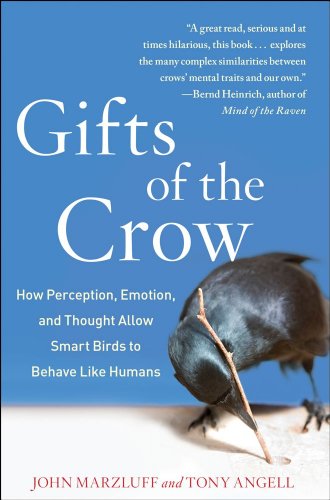
Gifts of the Crow: How Perception, Emotion, and Thought Allow Smart Birds to Behave Like Humans - Couverture rigide
Synopsis
Stan Coren’s groundbreaking The Intelligence of Dogs meets Bernd Heinrich’s classic Mind of the Raven in this astonishing, beautifully illustrated look at the uncanny intelligence and emotions of crows.
CROWS ARE MISCHIEVOUS, playful, social, and passionate. They have brains that are huge for their body size and exhibit an avian kind of eloquence. They mate for life and associate with relatives and neighbors for years. And because they often live near people—in our gardens, parks, and cities—they are also keenly aware of our peculiarities, staying away from and even scolding anyone who threatens or harms them and quickly learning to recognize and approach those who care for and feed them, even giving them numerous, oddly touching gifts in return.
With his extraordinary research on the intelligence and startling abilities of corvids—crows, ravens, and jays—scientist John Marzluff teams up with artist-naturalist Tony Angell to tell amazing stories of these brilliant birds in Gifts of the Crow. With narrative, diagrams, and gorgeous line drawings, they offer an in-depth look at these complex creatures and our shared behaviors. The ongoing connection between humans and crows—a cultural coevolution—has shaped both species for millions of years. And the characteristics of crows that allow this symbiotic relationship are language, delinquency, frolic, passion, wrath, risk-taking, and awareness—seven traits that humans find strangely familiar. Crows gather around their dead, warn of impending doom, recognize people, commit murder of other crows, lure fish and birds to their death, swill coffee, drink beer, turn on lights to stay warm, design and use tools, use cars as nutcrackers, windsurf and sled to play, and work in tandem to spray soft cheese out of a can. Their marvelous brains allow them to think, plan, and reconsider their actions.
With its abundance of funny, awe-inspiring, and poignant stories, Gifts of the Crow portrays creatures who are nothing short of amazing. A testament to years of painstaking research and careful observation, this fully illustrated, riveting work is a thrilling look at one of nature’s most wondrous creatures.
Les informations fournies dans la section « Synopsis » peuvent faire référence à une autre édition de ce titre.
À propos de l'auteur
John Marzluff, Ph.D., is Professor of Wildlife Science at the University of Washington. The author of four books and over one hundred scientific papers on various aspects of bird behavior, he is the recipient of the A. Brazier Howell, Board of Directors, and H.R. Painton awards from the Cooper Ornithological Society.
Tony Angell has authored and/or illustrated a dozen award-winning books related to natural history.
Extrait. © Reproduit sur autorisation. Tous droits réservés.
Preface
A BLUE-BLACK CROW PERCHES REGALLY on the cornice of a stone building on the University of Washington campus, where he is often found. Almost hourly, he delivers food to his mate and three fledglings, while also keeping watch for any threat to the nest. Suddenly he turns his head, caws softly, and glides away, landing on a lamppost directly above a blonde woman. The woman, Lijana Holmes, smiles and calls him “Bela” as she offers him a breakfast of eggs and meat, which she prepares daily. Bela, in turn, presents his special gift—recognizing Lijana and participating in this routine with her. His gift to Lijana is more abstract than what he provides his bird family, but it is powerful nonetheless—it is the ephemeral and profound connection to nature that many people crave.
Bela gives a slightly different gift this morning to my team as we walk through the same campus. For Bela knows us, and we know him. Five-and-a-half years ago we captured Bela and affixed light plastic rings to his legs for identification. So whenever he sees us, the old crow cocks his head, stares, takes flight and swoops low—right at us—screaming a harsh call that we immediately recognize as a bird scold. His family and neighbors hear the cry and join in, flying toward Bela to support his attack, and soon they, too, share his rage. The mobbing crows circle and scream above our heads just as they would do to a predator. Bela’s discriminating actions give us remarkable and invaluable information, proving that crows can recognize and remember human faces. We wonder when, or if, he will ever forget (or forgive) us.
The gifts of the crow are physical, metaphorical, and far-reaching. Some, like Bela, provide understanding and companionship. Others have delivered sparkling glass, plastic toys, and candy hearts to their human benefactors. Some have dropped from the sky and shocked strangers by saying, “Hello.” A raven, with its natural curiosity and conspicuous manner, can lead a hunter to game or alert a search party to the whereabouts of an injured person. A magpie or jay can brighten a cold day by pecking softly at a window to beg for its daily ration of food.
These birds are corvids, members of the avian family Corvidae, which includes nutcrackers, jays, ravens, magpies, and crows. We will consider many of the gifts with which corvids enrich the lives of people and the action of nature in the chapters ahead, and we will argue that a corvid’s ability to quickly and accurately infer causation is itself a natural gift. It has survival value. This and other demonstrations of its mental prowess are gifts that all birds—and most likely their dinosaur ancestors—gained through evolution.
Crows’ close association with humans has inspired art, language, legends, and myths. Corvids have their own form of eloquence as they exercise mischief, playfulness, and passion. They also lead us to reflect on their common behaviors with us and other sentient creatures and empower us with a deeper understanding of nature.
People from all walks of life eagerly recount the antics of their former pet crows or enthusiastically tell us authors about the fascinating, sometimes troubling behaviors perpetrated by their local jays, magpies, and ravens. In this book we celebrate their accounts along with others we have found in the scientific and popular literature, because these rare and exceptional behaviors cannot be limited to the few specialized researchers who study corvids.
Some scientists are dismissive of citizens’ reports, viewing them as unreliable or unexplainable, because of laypeople’s lack of formal training, lack of documentation, overinterpretation, and uncontrolled influences. To be sure, we have encountered descriptions of events laden with hyperbole and seasoned with more imagination than fact, but we were compelled to investigate them nonetheless and to interview the people who made the observations in order to verify the events. Taken individually, such stories are anecdotal, but collectively they provide a unique body of information that stimulates scientific exploration and becomes an assemblage of possibilities.
We draw from this cross-cultural collection to offer many intriguing stories about corvids’ fascinating behaviors as we explore the anatomy and physiology of the bird brain. We have tested these anecdotes, such as those of the crow that summoned dogs or the ravens that windsurfed. Putting them through the scientific process, we evaluated each report for believability, precedence in the scientific and cultural literature, and the mental ability a bird would need to act in such a manner. We came to know the bird and the citizen scientist behind the observation as we examined as completely as possible what causes people and birds to share such poignant moments.
We recognize the intelligence and adaptability of this unique group of birds and base every thesis about their humanlike behaviors on how the brain of a bird is known to function. Through brain-scanning technology, which allows us to see within the crow’s gray matter, we first glimpse how a crow’s brain works through a problem. To date, most of the understanding of the inner working of the crow brain was derived from what was known from a few mammals and detailed investigations of song-learning in birds. We hope you will find, as we have, that understanding some of the neurobiological processes of crows adds mightily to your appreciation of how these remarkable creatures operate so successfully in our dynamic world.
Les informations fournies dans la section « A propos du livre » peuvent faire référence à une autre édition de ce titre.
Résultats de recherche pour Gifts of the Crow: How Perception, Emotion, and Thought...

Image d'archives
Gifts of the Crow: How Perception, Emotion, and Thought Allow Smart Birds to Behave Like Humans
Edité par
Atria Books, 2012
ISBN 10 : 143919873X
ISBN 13 : 9781439198735
Ancien ou d'occasion
Couverture rigide
Vendeur : World of Books (was SecondSale), Montgomery, IL, Etats-Unis
Évaluation du vendeur 5 sur 5 étoiles

Hardback. Etat : Good. New research indicates that crows are among the brightest animals in the world. And professor of Wildlife Science at the University of Washington John Marzluff has done some of the most extraordinary research on crows, which has been featured in The New York Times, National Geographic, and the Chicago Tribune, as well as on NPR and PBS. Now he teams up with artist and fellow naturalist Tony Angell to offer an in-depth look at these incredible creatures--in a book that is brimming with surprises.Redefining the notion of bird brain, crows and ravens are often called feathered apes because of their clever tool-making and their ability to respond to environmental challenges, including those posed by humans. Indeed, their long lives, social habits, and large complex brains allow them to observe and learn from us and our social gatherings. Their marvelous brains allow crows to think, plan, and reconsider their actions. In these and other enthralling revelations, Marzluff and Angell portray creatures that are nothing short of amazing: they play, bestow gifts on people who help or feed them, use cars as nutcrackers, seek revenge on animals that harass them, are tricksters that lure birds to their deaths, and dream. The authors marvel at crows' behavior that we humans would find strangely familiar, from delinquency and risk taking to passion and frolic. A testament to years of painstaking research, this riveting work is a thrilling look at one of nature's most wondrous creatures. N° de réf. du vendeur 00109415666
Acheter D'occasion
EUR 11,48
Livraison gratuite
Expédition nationale : Etats-Unis
Expédition nationale : Etats-Unis
Quantité disponible : 5 disponible(s)
Image fournie par le vendeur
Gifts of the Crow: How Perception, Emotion, and Thought Allow Smart Birds to Behave Like Humans
Edité par
Atria Books, 2012
ISBN 10 : 143919873X
ISBN 13 : 9781439198735
Ancien ou d'occasion
Couverture rigide
Vendeur : Vive Liber Books, Somers, CT, Etats-Unis
Évaluation du vendeur 5 sur 5 étoiles
Etat : good. Good condition USED book. Pages are clean with normal wear. May have limited markings inside from previous owner. N° de réf. du vendeur VLM.1EVQ
Acheter D'occasion
EUR 11,49
Livraison gratuite
Expédition nationale : Etats-Unis
Expédition nationale : Etats-Unis
Quantité disponible : 1 disponible(s)
Image d'archives
Gifts of the Crow: How Perception, Emotion, and Thought Allow Smart Birds to Behave Like Humans
Edité par
Atria Books, 2012
ISBN 10 : 143919873X
ISBN 13 : 9781439198735
Ancien ou d'occasion
Couverture rigide
Vendeur : HPB-Emerald, Dallas, TX, Etats-Unis
Évaluation du vendeur 5 sur 5 étoiles
Hardcover. Etat : Very Good. Connecting readers with great books since 1972! Used books may not include companion materials, and may have some shelf wear or limited writing. We ship orders daily and Customer Service is our top priority! N° de réf. du vendeur S_483992314
Acheter D'occasion
EUR 9,16
Expédition à EUR 3,34
Expédition nationale : Etats-Unis
Expédition nationale : Etats-Unis
Quantité disponible : 1 disponible(s)
Image d'archives
Gifts of the Crow: How Perception, Emotion, and Thought Allow Smart Birds to Behave Like Humans
Edité par
Atria Books, 2012
ISBN 10 : 143919873X
ISBN 13 : 9781439198735
Ancien ou d'occasion
Couverture rigide
Vendeur : World of Books Inc, Montgomery, IL, Etats-Unis
Évaluation du vendeur 4 sur 5 étoiles

Hardback. Etat : Good. New research indicates that crows are among the brightest animals in the world. And professor of Wildlife Science at the University of Washington John Marzluff has done some of the most extraordinary research on crows, which has been featured in The New York Times, National Geographic, and the Chicago Tribune, as well as on NPR and PBS. Now he teams up with artist and fellow naturalist Tony Angell to offer an in-depth look at these incredible creatures--in a book that is brimming with surprises.Redefining the notion of bird brain, crows and ravens are often called feathered apes because of their clever tool-making and their ability to respond to environmental challenges, including those posed by humans. Indeed, their long lives, social habits, and large complex brains allow them to observe and learn from us and our social gatherings. Their marvelous brains allow crows to think, plan, and reconsider their actions. In these and other enthralling revelations, Marzluff and Angell portray creatures that are nothing short of amazing: they play, bestow gifts on people who help or feed them, use cars as nutcrackers, seek revenge on animals that harass them, are tricksters that lure birds to their deaths, and dream. The authors marvel at crows' behavior that we humans would find strangely familiar, from delinquency and risk taking to passion and frolic. A testament to years of painstaking research, this riveting work is a thrilling look at one of nature's most wondrous creatures. N° de réf. du vendeur CIN143919873XG
Acheter D'occasion
EUR 13,32
Livraison gratuite
Expédition nationale : Etats-Unis
Expédition nationale : Etats-Unis
Quantité disponible : 5 disponible(s)
Image d'archives
The Gift of the Crow : How Perception, Emotion, and Thought Allow Smart Birds to Behave Like Humans
Edité par
Simon & Schuster, 2013
ISBN 10 : 143919873X
ISBN 13 : 9781439198735
Ancien ou d'occasion
Couverture rigide
Vendeur : Better World Books: West, Reno, NV, Etats-Unis
Évaluation du vendeur 5 sur 5 étoiles
Etat : Very Good. Pages intact with possible writing/highlighting. Binding strong with minor wear. Dust jackets/supplements may not be included. Stock photo provided. Product includes identifying sticker. Better World Books: Buy Books. Do Good. N° de réf. du vendeur 4071422-75
Acheter D'occasion
EUR 13,66
Livraison gratuite
Expédition nationale : Etats-Unis
Expédition nationale : Etats-Unis
Quantité disponible : 2 disponible(s)
Image d'archives
The Gift of the Crow : How Perception, Emotion, and Thought Allow Smart Birds to Behave Like Humans
Edité par
Simon & Schuster, 2013
ISBN 10 : 143919873X
ISBN 13 : 9781439198735
Ancien ou d'occasion
Couverture rigide
Vendeur : Better World Books, Mishawaka, IN, Etats-Unis
Évaluation du vendeur 5 sur 5 étoiles
Etat : Good. Former library copy. Pages intact with minimal writing/highlighting. The binding may be loose and creased. Dust jackets/supplements are not included. Includes library markings. Stock photo provided. Product includes identifying sticker. Better World Books: Buy Books. Do Good. N° de réf. du vendeur 3972481-6
Acheter D'occasion
EUR 13,66
Livraison gratuite
Expédition nationale : Etats-Unis
Expédition nationale : Etats-Unis
Quantité disponible : 1 disponible(s)
Image d'archives
The Gift of the Crow : How Perception, Emotion, and Thought Allow Smart Birds to Behave Like Humans
Edité par
Simon & Schuster, 2013
ISBN 10 : 143919873X
ISBN 13 : 9781439198735
Ancien ou d'occasion
Couverture rigide
Vendeur : Better World Books: West, Reno, NV, Etats-Unis
Évaluation du vendeur 5 sur 5 étoiles
Etat : Very Good. Former library copy. Pages intact with possible writing/highlighting. Binding strong with minor wear. Dust jackets/supplements may not be included. Includes library markings. Stock photo provided. Product includes identifying sticker. Better World Books: Buy Books. Do Good. N° de réf. du vendeur 4189258-6
Acheter D'occasion
EUR 13,66
Livraison gratuite
Expédition nationale : Etats-Unis
Expédition nationale : Etats-Unis
Quantité disponible : 1 disponible(s)
Image d'archives
Gifts of the Crow: How Perception, Emotion, and Thought Allow Smart Birds to Behave Like Humans
Edité par
Pocket Books, 2012
ISBN 10 : 143919873X
ISBN 13 : 9781439198735
Ancien ou d'occasion
Couverture rigide
Vendeur : Magers and Quinn Booksellers, Minneapolis, MN, Etats-Unis
Évaluation du vendeur 5 sur 5 étoiles
hardcover. Etat : Acceptable. May have underlining, highlighting, margin notes, remainder marks, inscriptions, book plates, tears, significant wear, and/or a missing dust jacket, box, or discs. Damaged item. N° de réf. du vendeur 1558287
Acheter D'occasion
EUR 10,31
Expédition à EUR 3,55
Expédition nationale : Etats-Unis
Expédition nationale : Etats-Unis
Quantité disponible : 1 disponible(s)
Image fournie par le vendeur
Gifts of the Crow: How Perception, Emotion, and Thought Allow Smart Birds to Behave Like Humans
Edité par
Atria Books, 2012
ISBN 10 : 143919873X
ISBN 13 : 9781439198735
Ancien ou d'occasion
Couverture rigide
Vendeur : Goodwill of Central and Coastal Virginia, Richmond, VA, Etats-Unis
Évaluation du vendeur 4 sur 5 étoiles
Etat : acceptable. N° de réf. du vendeur CCVV.143919873X.A
Acheter D'occasion
EUR 8,76
Expédition à EUR 5,11
Expédition nationale : Etats-Unis
Expédition nationale : Etats-Unis
Quantité disponible : 1 disponible(s)
Image d'archives
Gifts of the Crow: How Perception, Emotion, and Thought Allow Smart Birds to Behave Like Humans
Edité par
Atria Books, 2012
ISBN 10 : 143919873X
ISBN 13 : 9781439198735
Ancien ou d'occasion
Couverture rigide
Vendeur : Friends of Pima County Public Library, Tucson, AZ, Etats-Unis
Évaluation du vendeur 4 sur 5 étoiles
hardcover. Etat : Good. Clean Pages. Ex-Library with usual markings, stamps and / or stickers. Mylar cover on dust jacket taped to book. Proceeds benefit the Pima County Public Library system, which serves Tucson and southern Arizona. Slight edge wear and bumping. N° de réf. du vendeur mon0000019382
Acheter D'occasion
EUR 9,18
Expédition à EUR 5,01
Expédition nationale : Etats-Unis
Expédition nationale : Etats-Unis
Quantité disponible : 1 disponible(s)