
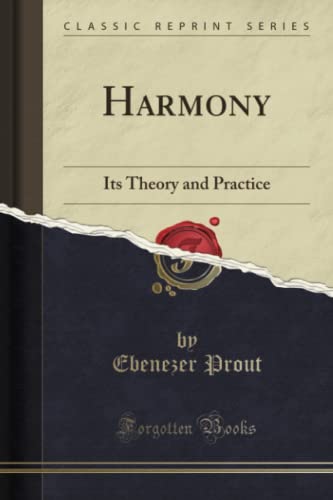
Synopsis
Discover the craft of harmony with practical guidance and real‑world examples.
This classic text walks you through the theory and practice of harmony, from writing in multiple voices to analyzing the work of great masters. You’ll find clear rules, illustrated passages, and thoughtful advice that helps you understand how chords move, how auxiliary and passing notes behave, and how to manage voice leading in four parts and beyond.
This edition presents concrete demonstrations of harmony in action, drawing on examples from Bach, Handel, Mendelssohn, Brahms, and Wagner. It explains how to approach five, six, seven, and even eight parts, while noting where the rules relax as the number of voices grows. The focus stays on usable skills for composing and analyzing, with emphasis on clean progression, proper handling of dissonance, and the aims of modern and past masters alike.- Learn how to construct and analyze chord progressions across multiple voices
- See how auxiliary notes, passing notes, and chromatic touches function in real music
- Explore the practical differences between two‑part, four‑part, and more elaborate polyphony
- Understand common pitfalls and the stylistic choices used by master composers
Les informations fournies dans la section « Synopsis » peuvent faire référence à une autre édition de ce titre.
Présentation de l'éditeur
Excerpt from Harmony Its Theory and Practice
So large a number of works on Harmony already exists that the publication of a new treatise on the subject seems to call for explanation, if not for apology. The present volume is the outcome of many years experience in teaching the theory of music, and the author hopes that it contains sufficient novelty both in plan and in matter to plead a justification for its appearance.
Most intelligent students of harmony have at times been perplexed by their inability to reconcile passages they have found in the works of the great masters with the rules given in the textbooks. If they ask the help of their teacher in their difficulty, they are probably told, "Bach is wrong," or "Beethoven is wrong," or, at best, "This is a licence." No doubt examples of very free part-writing may be found in the works of Bach and Beethoven, or even of Haydn and Mozart; several such are noted and explained in the present work. But the principle must surely be wrong which places the rules of an early stage of musical development above the inspirations of genius! Haydn, when asked according to what rule he had introduced a certain harmony, replied that the rules were all his very obedient humble servants; and when we find that in our own time Wagner, or Brahms, or Dvorak breaks some rule given in old text-books there is, to say the least, a very strong presumption, not that the composer is wrong, but that the rule needs modifying. In other words, practice must precede theory. The inspired composer goes first, and invents new effects; it is the business of the theorist not to cavil at every novelty, but to follow modestly behind, and make his rules conform to the practice of the master. It is a significant fact that, even in the most recent developments of the art, nothing has yet been written by any composer of eminence which a sound theoretical system cannot satisfactorily account for; and the objections made by musicians of the old...
Présentation de l'éditeur
Stack Annex KPRE FACE. So large a number of works on Harmony already exists that the publication of a new treatise on the subject seems to call for explanation, if not for apology. The present volume is the outcome of many years experience in teaching the theory of music, and the author hopes that it contains sufficient novelty both in plan and in matter to plead a justification for its appearance. Most intelligent students of harmony have at times been perplexed by their inability to reconcile passages they have found in the works of the great masters with the rules given in the textbooks. If they ask the help of their teacher in their difficulty, they are probably told, Bach is wrong, orB eethoven is wrong, or, at best, This is a licence. No doubt examples of very free part-writing may be found in the works of Bach and Beethoven, or even of Haydn and Mozart ;several such are noted and explained in the present work. But the principle must surely be wrong which places the rules of an early stage of musical development above the inspirations of genius !H aydn, when asked according to what rule he had introduced a certain harmony, replied that the rules were all his very obedient humble servants ;and when we find that in our own time Wagner, orB rahms, or Dvorak breaks some rule given in old text-books there is, to say the least, a very strong presumption, not that the composer is wrong, but that the rule needs modifying. In other words, practice must precede theory. The inspired composer goes first, and invents new effects ;it is the business of the theorist not to cavil at every novelty, but to follow modestly behind, and make his rules conform to the practice of the master. It is a significant fact that, even in the most recent developments of the art, nothing has yet been written by any composer of eminencewhich a sound theoretical system cannot satisfacto
(Typographical errors above are due to OCR software and don't occur in the book.)
Les informations fournies dans la section « A propos du livre » peuvent faire référence à une autre édition de ce titre.
Autres éditions populaires du même titre

Résultats de recherche pour Harmony (Classic Reprint): Its Theory and Practice

Image fournie par le vendeur
Harmony: Its Theory and Practice (Classic Reprint)
impression à la demandeVendeur : Forgotten Books, London, Royaume-Uni
Évaluation du vendeur 4 sur 5 étoiles

Paperback. Etat : New. Print on Demand. This book tackles the intricate world of harmony in music, a subject that has fascinated composers and theorists for centuries. Exploring the relationship between theory and practice, the author argues that while rules are important, they should not overshadow the creative instincts of talented composers. The book examines the harmonic series, a fundamental concept in understanding the relationships between notes, and how it influences the construction of chords and scales. It delves into the concept of key, and explains how the different notes within a key interact with each other, forming the foundation of musical composition. Through a detailed analysis of traditional and innovative harmonic progressions, the author sheds light on the evolution of musical language and provides a comprehensive framework for understanding the complex world of harmony. This book offers both a theoretical understanding and a practical guide, equipping students with the knowledge and tools to analyze and compose music with confidence. This book is a reproduction of an important historical work, digitally reconstructed using state-of-the-art technology to preserve the original format. In rare cases, an imperfection in the original, such as a blemish or missing page, may be replicated in the book. print-on-demand item. N° de réf. du vendeur 9781440071706_0
Acheter neuf
EUR 18,86
Livraison gratuite
Expédition depuis Royaume-Uni vers Etats-Unis
Expédition depuis Royaume-Uni vers Etats-Unis
Quantité disponible : Plus de 20 disponibles
Image d'archives
Harmony Its Theory and Practice (Classic Reprint)
Vendeur : PBShop.store US, Wood Dale, IL, Etats-Unis
Évaluation du vendeur 5 sur 5 étoiles

PAP. Etat : New. New Book. Shipped from UK. Established seller since 2000. N° de réf. du vendeur LW-9781440071706
Acheter neuf
EUR 29,52
Livraison gratuite
Expédition nationale : Etats-Unis
Expédition nationale : Etats-Unis
Quantité disponible : 15 disponible(s)
Image d'archives
Harmony Its Theory and Practice (Classic Reprint)
Vendeur : PBShop.store UK, Fairford, GLOS, Royaume-Uni
Évaluation du vendeur 5 sur 5 étoiles
PAP. Etat : New. New Book. Shipped from UK. Established seller since 2000. N° de réf. du vendeur LW-9781440071706
Acheter neuf
EUR 27,76
Expédition à EUR 4,87
Expédition depuis Royaume-Uni vers Etats-Unis
Expédition depuis Royaume-Uni vers Etats-Unis
Quantité disponible : 15 disponible(s)
Image d'archives
Harmony: Its Theory and Practice (Classic Reprint)
impression à la demandeVendeur : Revaluation Books, Exeter, Royaume-Uni
Évaluation du vendeur 5 sur 5 étoiles
Paperback. Etat : Brand New. 260 pages. 9.00x6.00x0.59 inches. This item is printed on demand. N° de réf. du vendeur zk1440071705
Acheter neuf
EUR 39,92
Expédition à EUR 11,71
Expédition depuis Royaume-Uni vers Etats-Unis
Expédition depuis Royaume-Uni vers Etats-Unis
Quantité disponible : 1 disponible(s)