
Articles liés à Mars as the Abode of Life (Classic Reprint)
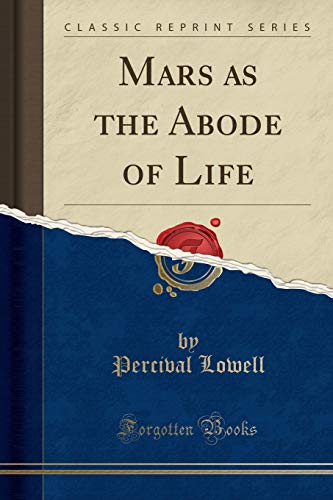
Synopsis
Exploring Mars as a changing world and the search for life.
This book presents a bold view of Mars as an aging planet, its history shaped by planetary evolution and the scarce water that still hints at life. It surveys how Mars compares with Earth, explains the idea of canals and oases, and connects planetary science to the possible future of our own world.
From a pioneering observatory perspective, the work traces how Mars reveals the steps of planetary development, the role of heat and mass, and the way landscapes form as planets cool. It also examines long-debated questions about life, its origins, and how signs of life might be detected on another world, without overpromising the outcomes.- Learn how planetary evolution shapes a world’s climate, seas, and land
- Understand the canal and oasis observations and what they might imply
- See how Mars is used as a lens to think about Earth’s future
- Discover the scientific method behind drawing conclusions from planetary data
Les informations fournies dans la section « Synopsis » peuvent faire référence à une autre édition de ce titre.
Présentation de l'éditeur
MARS AS THE ABODE OF LIFE FOREWORD UP to the middle of the nineteenth century, astronomy was busied with motions. The wanderings of the planets in their courses attracted attention, and held thought to the practical exclusion of all else concerning them. It was to problems of this character that the great names of the past - Newton, Huygens, Laplace - were linked. But when the century that has gone was halfway through its course, a change came over the spirit of the investigation; with the advance in physics celestial searchers began to concern themselves with matter, too. Gravitational astronomy had regarded the planets from the point of view of how they act; physical astronomy is intent upon what they are. One outcome of this more intimate acquaintance is the new study with which the present papers deal: the evolution of the planets regarded as worlds. Such research has to do not merely with the aggregation of material, but with its subsequent metamorphoses
Table of Contents
CONTENTS; Foreword; PAGE I; PART I; CHAPTER; I The Genesis of a World; Catastrophic origin Meteorites Meteorite worship; Meteoric constitution of solar system Analogy of cataclysm to new stars (Novae) The meteorites gravitate together, generating heat Amount of heat depends on the mass of the body Substances vary with heat and pressure Mass the fundamental factor Cooling Life-history depends on size Planetologic eras; Present aspects of the planets our guide Geologic part of planetology Landscape the result of cooling Mountains in proportion to mass Volcanic phenomena ; Relative roughness of Earth, Moon, and Mars Mountains absent on Mars Slant illumination Importance to astronomers Applied to Mars Not indicative of mountains Two or three thousand feet limit of elevation on Mars; xii; CONTENTS; CHAPTER PACE; Internal heat of the three bodies 23 Darwinian theory of lunar origin , , , ,26 Confirmed by lunar surface 26; Probable comparative
Les informations fournies dans la section « A propos du livre » peuvent faire référence à une autre édition de ce titre.
Résultats de recherche pour Mars as the Abode of Life (Classic Reprint)

Image fournie par le vendeur
Mars as the Abode of Life (Classic Reprint)
impression à la demandeVendeur : Forgotten Books, London, Royaume-Uni
Évaluation du vendeur 5 sur 5 étoiles

Paperback. Etat : New. Print on Demand. This book takes you on a journey through the life cycle of planets, from their fiery beginnings to their eventual demise. Using the Earth, Mars, and the Moon as case studies, the author explores how a planet's size shapes its destiny, influencing everything from its surface features to the potential for life. By comparing the geological features of these celestial bodies, the author unveils a fascinating story of how landscapes are sculpted by internal heat and the relentless process of cooling. The presence of water, a crucial ingredient for life, is examined in detail, revealing its profound impact on the evolution of organisms. This book delves into the intriguing possibility of life on Mars, presenting evidence that suggests the Red Planet may have once harbored oceans and potentially still supports life in a different form. By drawing parallels between Mars and Earth's future, the author paints a thought-provoking picture of our own planet's fate. Ultimately, this book challenges us to broaden our perspective and recognize the interconnectedness of life and the cosmos. It leaves us with a deeper understanding of our place in the universe and the remarkable forces that shape the worlds around us. This book is a reproduction of an important historical work, digitally reconstructed using state-of-the-art technology to preserve the original format. In rare cases, an imperfection in the original, such as a blemish or missing page, may be replicated in the book. print-on-demand item. N° de réf. du vendeur 9781440082467_0
Acheter neuf
EUR 19,80
Livraison gratuite
Expédition depuis Royaume-Uni vers Etats-Unis
Expédition depuis Royaume-Uni vers Etats-Unis
Quantité disponible : Plus de 20 disponibles
Image d'archives
Mars as the Abode of Life (Classic Reprint)
Vendeur : PBShop.store US, Wood Dale, IL, Etats-Unis
Évaluation du vendeur 5 sur 5 étoiles
PAP. Etat : New. New Book. Shipped from UK. Established seller since 2000. N° de réf. du vendeur LW-9781440082467
Acheter neuf
EUR 30,80
Livraison gratuite
Expédition nationale : Etats-Unis
Expédition nationale : Etats-Unis
Quantité disponible : 15 disponible(s)
Image d'archives
Mars as the Abode of Life (Classic Reprint)
Vendeur : PBShop.store UK, Fairford, GLOS, Royaume-Uni
Évaluation du vendeur 5 sur 5 étoiles
PAP. Etat : New. New Book. Shipped from UK. Established seller since 2000. N° de réf. du vendeur LW-9781440082467
Acheter neuf
EUR 28,68
Expédition à EUR 4,85
Expédition depuis Royaume-Uni vers Etats-Unis
Expédition depuis Royaume-Uni vers Etats-Unis
Quantité disponible : 15 disponible(s)
Image d'archives
Mars as the Abode of Life (Classic Reprint)
impression à la demandeVendeur : Revaluation Books, Exeter, Royaume-Uni
Évaluation du vendeur 5 sur 5 étoiles
Paperback. Etat : Brand New. 330 pages. 9.00x6.00x0.75 inches. This item is printed on demand. N° de réf. du vendeur zk1440082464
Acheter neuf
EUR 30,80
Expédition à EUR 14,58
Expédition depuis Royaume-Uni vers Etats-Unis
Expédition depuis Royaume-Uni vers Etats-Unis
Quantité disponible : 1 disponible(s)