
Articles liés à All In: How the Best Managers Create a Culture of Belief...
Synopsis
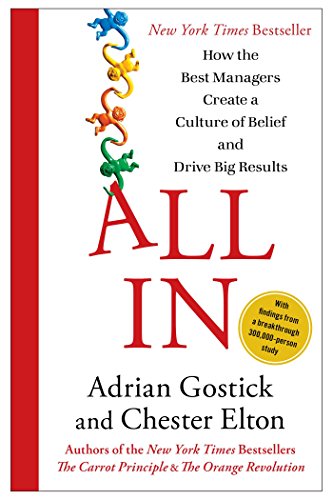
The authors of the bestsellers The Carrot Principle and The Orange Revolution present groundbreaking new findings: In the highest-performing teams and companies, managers create a “culture of belief,” following seven essential steps of leadership.
To have any hope of succeeding as a manager, you need to get your people all in.
Whether you manage the smallest of teams or a multi-continent organization, you are the owner of a work culture—congratulations—and few things will have a bigger impact on your performance than getting your people to buy into your ideas and your cause and to believe what they do matters.
Bestselling authors of The Carrot Principle and The Orange Revolution, Adrian Gostick and Chester Elton return to answer the most overlooked leadership questions of our day: Why are some managers able to get their employees to commit wholeheartedly to their culture and give that extra push that leads to outstanding results? And how can managers at any level build and sustain a profitable, vibrant work-group culture of their own?
These leading workplace experts teamed up with research giant Towers Watson to analyze an unprecedented 300,000-person study, and they made a groundbreaking finding: managers of the highest-performing work groups create a “culture of belief.” In these distinctive workplaces, people believe in their leaders and in the company’s vision, values, and goals. Employees are not only engaged but also enabled and energized (termed the three Es), which leads to astonishing results—average annual revenues three times higher than for organizations lacking such a positive culture. And this was true during a period that included this most recent recession.
Based on their extensive consulting experience and in-depth interviews with leaders and employees at exceptional companies such as American Express, Cigna, Avis Budget, Pepsi Bottling, and Hard Rock, the authors present a simple seven-step road map for creating a culture of belief: define a burning platform; create a customer focus; develop agility; share everything; partner with your talent; root for each other; and establish clear accountability. Delving into specific how-tos for each step, they share eye-opening stories of exceptional leaders in action, vividly depicting just how these powerful methods can be implemented by any manager.
All In draws on cutting-edge psychology and all of the creative genius that have made Gostick and Elton a must-read for leaders worldwide. This vital resource will empower managers everywhere to inspire a new level of commitment and performance.
Les informations fournies dans la section « Synopsis » peuvent faire référence à une autre édition de ce titre.
À propos des auteurs
Adrian Gostick is the New York Times bestselling coauthor of The Best Team Wins, The Carrot Principle, and All In, which are sold in more than fifty countries around the world. He is a founder of the global training firm The Culture Works, with a focus in culture, teamwork, and employee motivation. Learn more at TheCultureWorks.com or CarrotGuys.com.
Chester Elton is coauthor of The Best Team Wins, The Carrot Principle, and All In, a popular lecturer, and an influential voice in global workplace trends. He is a founder of The Culture Works and advises the leadership teams of numerous Fortune 500 firms on cultural and teamwork issues. Learn more at TheCultureWorks.com or CarrotGuys.com.
Extrait. © Reproduit sur autorisation. Tous droits réservés.
All In
1
Get in the Wheelbarrow
Why Aren’t They Giving Their All?
Some twenty-five thousand onlookers had turned out on June 30, 1859, as a flamboyant, mustached Frenchman known as the Great Blondin stepped out onto a three-inch cord that stretched across roaring Niagara Falls. They were in high spirits, curious to see if the daredevil would become the first person to cross the chasm on a tightrope or if he would plummet to his death. Either way it would be a day to remember.
Blondin had been born as Jean-François Gravelet and had been an acrobat since childhood, raised in the circus tents of Europe. He knew his craft, and the showman had no doubt he would be successful. It was not bravado; it was merely something he took to be a fact—as true as the sky being blue. And, as history shows, he not only crossed the fifteen-hundred-foot-wide falls without a stumble but even paused to perform a back somersault on his return trip. The breathless crowd erupted into wild cheers when he set his feet on firm ground.
The Great Blondin would cross the gorge eight times over the next decade, all with theatrical variations—blindfolded, on stilts, but most often trundling a small wheelbarrow. As you can imagine, crowds flocked to see him and he began to draw loyal devotees. According to accounts, the mob on one summer day was especially boisterous, and they gave him a chorus of hurrahs as he approached pushing his familiar barrow.
“Do you believe I can cross the falls with this wheelbarrow?” he called out.
“Yes!” they yelled as one.
“Wonderful,” he said. “Then who will get in?”
Many in the crowd laughed but then fell silent as they realized he wasn’t joking. Blondin waited as the seconds ticked by; a haze of gray cigar smoke hung just above their heads. They stood awkward and immobile. There were no takers. Blondin had hoped his fans would believe, as he did, in his infallible prowess on the high wire. They said they did, but they really didn’t.
Then someone did. Blondin’s agent, Harry Colcord, took off his silk top hat and waved it high above his head. He was volunteering.
Blondin was greatly moved by the gesture. Despite the drama of the day, he actually hadn’t intended to wheel anyone across the falls, but Colcord’s offer sparked an idea. Instead of pushing his agent then, he returned a few months later and carried Colcord across the falls on his shoulders, an amazing feat considering the man was only a few pounds lighter than the showman.
Let’s stop there. This book is clearly not about daredevils or tightrope walkers, but about a related drama that is taking place in organizations every day, all around the world. While most managers by now understand that their most reliable competitive advantage comes from their people, few of them actually know how to get people “all in”—convincing employees to truly buy into their ideas and the strategy they’ve put forward, to give that extra push that leads to outstanding results.
It’s not for lack of effort. Most leaders we meet seem to be bending over backward for their people. They walk the floor, listen respectfully to their employees’ ideas, and try to be accommodating. They’ve been taught they need to be people managers, not slaves to process, and as a result they’re focusing more, one-on-one, on the needs of each person in their care.
And yet overall performance isn’t improving, or not nearly enough.
This is backed up by the data we see. Employee engagement scores haven’t improved much at most organizations after many years of effort, and companies aren’t seeing markedly greater amounts of innovation or employee initiative. As hard as managers have been working, something’s missing: It’s culture.
Whether you manage the smallest of teams or a multicontinent organization, you are the proud owner of a culture—congratulations—and it’s important to understand that the effectiveness of that culture will have a big impact on your performance. If your culture is clear, positive, and strong, then your people will buy into your ideas and cause and, most important, will believe what they do matters and that they can make a difference. That pervasive enthusiasm and energy will spread like perfume in the atmosphere. On the other hand, if your culture is dysfunctional—chaotic, combative, or indifferent—employees will most likely spend more time thinking about why the people sitting next to them should be fired than getting fired up themselves.
Now, a reader might ask why the carrot guys are writing a book on culture. The answer is simple: We’ve worked with clients on leadership issues for almost twenty years now, and hardly a week has gone by that we haven’t excitedly called each other to talk about a fascinating corporate culture we’ve just stumbled upon. For a long time we’ve believed that culture is what makes teams and organizations great, and yet no one was talking about it in popular business literature and it seemed that no one really wanted to. Perhaps culture seemed the sole purview of CEOs and human resource departments. Unquestionably the boss of a small IT department or regional call center wouldn’t have the audacity to claim he had a culture, right?
But over the last few years something has changed. As we meet with new clients, expecting them to want us to work with them on the more focused ideas of employee recognition or teamwork, the subjects of our two last books, they keep steering the conversation back to culture. And not just their overall corporate culture; they have awoken to the fact that if the culture in their Cincinnati office isn’t working, then no amount of thank-yous or esprit de corps will help.
They have learned that if a culture works, then everything works better.
Take the case of Andrew Heath, who when we met him was the newly appointed president of the energy business of Rolls-Royce, one of the four sectors of the iconic British firm. Heath’s face lit up as he described a business improvement team of seventy people he had led years before in the company’s aerospace business. With more work than the team could reasonably achieve, he knew he needed to create a “special environment” where people would truly care about the success of the venture. He needed more than discretionary effort; he needed to create a culture “where employees would see the problem before them as a challenge rather than as something to drag them down.”
Heath realized he couldn’t achieve the assigned goals by force of character alone. He needed to change his leadership style and engage the whole team by asking them what they thought would increase their commitment to the job, what help they needed, and what would give them greater satisfaction. They came up with ideas to pair new employees with senior people, identify training needs, present above-and-beyond awards for great work (a favorite became bottles of champagne), hold regular update luncheons, and so on. Unassuming things, really, but the outcome was not only increased employee ownership and dramatic business results but also a level of camaraderie that is rare.
“We achieved more than we thought possible. The team and I had never worked so hard in our lives. It was a tough assignment, but we had such fun in the process,” Heath said. “I knew we had created a special culture together, but it only really struck me how much impact it had on the individual team members when we got together for a reunion a few years later. Everyone spoke of the profound effect it had had on their subsequent leadership styles.”
Savvy leaders like Heath realize it is culture that will differentiate your team or organization and drive real business results.
John F. W. Rogers, distinguished partner of the investment banking firm Goldman Sachs, put his finger on the crucial role of culture when he said, “Our bankers travel on the same planes as our competitors. We stay at the same hotels. In a lot of cases, we have the same clients as our competition. So when it comes down to it, it is a combination of the execution and culture that makes the difference between us and other firms. That’s why our culture is necessary—it’s the glue that binds us together.”
Those words stuck with us and bear repeating: Culture is the difference; it is the glue that binds us together.
Over the years we’ve been asked to work with some pretty impressive organizations all over the globe, including American Express, the National Football League, Cigna, the U.S. Army, Rolls-Royce, and Johnson & Johnson, to drop a few names. It’s probably no surprise we found great cultures in those places. And yet we have found similarly amazing places to work in every industry we’ve studied—even in workplaces where you might not expect culture to thrive or make a difference.
Consider this example. A few years ago we were asked to conduct a workshop at Crothall Healthcare. With thirty thousand employees, this is one of the largest and fastest-growing companies you’ve probably never heard of. They clean hospitals and offices, maintain facilities, transport patients, process linens, and so on. It’s not sexy stuff, but stick with us on this. Every five years Crothall doubles in size. At less than twenty years old, the company has annual revenues in excess of a billion dollars—which is a heck of a lot more than we were making when we were twenty!
We were halfway through our presentation to the senior leadership team, and just about to reach the crux of our argument, when the chief executive officer, Bobby Kutteh, made a mad dash for the door. It was disappointing but not unexpected; CEOs are, after all, in demand. But less than thirty seconds elapsed before he returned, reached up to the stage, and handed us bottles of water. He’d heard our voices were getting dry after talking for so long in the hot auditorium, so he’d raced to the lobby to find us a drink.
We’ve been doing this for a long time. Let us count for you the number of times this has happened before… zero.
We appreciated the gesture and it made us think well of Kutteh, but we also realized that the moment was bigger than that. He was exemplifying the culture of Crothall. His act reinforced what didn’t need to be spoken: Crothall is a caring place. Indeed, we found the act was utterly symbolic of the kind of overall corporate culture that Kutteh and his leadership team have created. It is a humble, sincere, service-oriented environment. And as you could rightly infer from that simple action of running to get us a drink, Kutteh is a servant to his people. It’s one reason he’s loved. Yes, loved. Just about everyone who was in the audience that day would do just about anything for this guy.
Before we spoke, Kutteh had talked for forty-five minutes. He addressed the audience without notes, with just a lavalier microphone affixed to his button-down shirt, sleeves rolled up. As he paced back and forth he outlined the strategy for the future, cracked jokes, thanked his leaders, and asked everyone to walk a little taller by taking better care of their employees.
“My dad used to say people will always remember how you make them feel,” he said. “A little stroke of kindness to your employees can go a long way.” And when he was done, every one of the two hundred and thirty leaders stood—no, they jumped to their feet and gave him a standing ovation that lasted and lasted. It was a fantastic moment.
You don’t have to look any farther than this very unassuming, very successful hospital-cleaning company to see that culture works.
But the fact is there is still nowhere near enough emphasis on culture. Business schools and leadership books teach us the mechanics of processes—strategy, marketing and product development, supply-chain management, playing to our strengths, even choosing the right employees. All are important, without a doubt. But as counterintuitive as it may sound to some, the thing that sets you apart from your peers is rarely what you sell or how you package or promote it. You all look pretty similar to us consumers. No, unless you’ve just invented the iPod of your industry, it’s likely that your competitors offer, more or less, the same things you do at about the same prices. The secret of moving a business forward is in getting your working population to differentiate you.
As Stephen Sadove, chairman and chief executive officer of department store giant Saks Incorporated, said, “When I talk to Wall Street, people really want to know your results, what are your strategies, what are the issues, and what is it that you’re doing to drive your business. Never do you get people asking about the culture.” But, he concluded, it is culture that drives “whatever you are trying to accomplish within a company—innovation, execution, whatever it’s going to be. And that then drives results.”
Sadove knows that if a culture works, then everything else works better. And we’ve discovered that it works a whole lot better, with the help of some powerful research we’ll unveil in this book.
And yet if you’ve worked in enough jobs, you’ll know that cultures can vary dramatically. There are workplaces of outright dysfunction, of contention, of coasting, and even of backstabbing. There are some cultures that produce impressive financial results but also high employee turnover and burnout. As a professional told us in a consumer products company, “Around here they put a gun in your back on day one. The trigger is pulled, and if you stop running the bullet is going to get you.” We could go on, of course, describing the varieties, but you get the point. What we will show in this book is that the most profitable, productive, enduring cultures are places where people lock into a vision with conviction, where they maintain excitement not out of fear but out of passion. They are cultures where people believe.
A number of compelling studies, going back many years, have shown that such a positive culture is a key driver of results. Exhibit A is a study done in the mid-1990s by Harvard Business School professors John Kotter and James Heskett. They followed two hundred companies to learn if a positive culture—one that facilitated adaptation to a changing world and that highly valued employees—really affected a firm’s long-term economic performance. The results were staggering. They found that those strong cultures “encourage leadership from everyone in the firm. So if customer needs change, a firm’s culture almost forces people to change their practices to meet the new needs. And anyone, not just a few people, is empowered to do just that.”
The financial impact of such a culture? Over the eleven-year period studied by the professors, revenue growth in the companies with “positive” cultures grew an average of 682 percent compared with 166 percent in the firms with “weak” cultures, and the difference between stock appreciation was 901 percent to 74 percent. Astounding.
But, you might ask, can a strong culture make a measurable difference in a team or division? Enter Exhibit B, a field study conducted in 2001 by the University of California at Los Angeles’s Eric Flamholtz. The UCLA professor studied a midsize industrial firm with twenty divisions all doing fairly similar work. He found the departments that behaved in ways most consistent with the company’s desired culture had markedly better financial performance—whereas the lower-performing divisions did not have cultural buy-in. The findings for this $800 million firm were so striking that “effective culture management” was immediately added to every manager’s performance management system and bonus calculation.
Okay, so we see team buy-in to culture makes a difference, but can a single manager really influence a culture to that great a degree? Absolutely. In fact, the level of impact might shock you. As we’ll demonstrate through both research and stories of exceptional managers we’ve observed closely, you as the manager are the core influencer of the kind of culture at play in your team, division, or whole company.
If you’re incredulous about your influence, you are not the only one. In our consulting work we are often faced with quantifying how much sway managers really have over performance. Sometimes leaders doubt if it is in their power to influence morale, productivity, and profitability. They know some work groups perform better than others, but it is difficult to pinpoint the exact reasons why and even a little uncomfortable to wonder if it is within their power to shape success.
So consider this. Recently, we worked with a health care system in the San Francisco area that had embarked on an experiment to investigate this long-standing business dilemma of the effect of a manager on performance. The organization started by classifying each department within their hospitals as green, yellow, or red. Green departments were terrific places to work. They had not only higher-than-normal team productivity and profitability but also great employee engagement scores and better-than-average employee retention. They were the kind of work groups we all want to be a part of, so workers came and stayed.
In contrast, yellow departments had average employee survey scores. They weren’t bad teams but they weren’t great.
As you might imagine, red departments were poor on every metric, especially employee turnover. It seemed workers couldn’t get out of the red work groups fast enough.
Then the organization conducted an interesting experiment. They moved quite a number of managers of green departments to red departments, and managers of red work groups were asked to lead green workplaces. They imagined that this shuffle would show whether leadership really mattered. What happened? The head of HR shook her head and said, “In every single case—every case—no matter the background or expertise of the manager, within a year the red departments were green and green departments had turned red. It was the manager who made the difference.”
Our decision to focus in this book on how managers can make a difference in a culture was inspired by yet another piece of powerful research, which we worked on with Towers Watson, one of the most respected names in global research and professional services. Together we created the parameters of how to communicate the results of a major new study that showed the way the most profitable companies work—on the inside. This break-through information became a vital part of this book. From its eight-million-person global database collected during 2009 and 2010 alone from 700 companies, Towers Watson identified 25 companies with a total of 303,000 employees that enjoyed high-performance business results—organizations that outperformed their competitors in financial measures by as much as two and three times. This Global High-Performance list includes a thin slice of the best of the best—companies from around the world and in every industry: health care, financial services, manufacturing, high tech, services, transportation, and so on.
The task in the study was to determine what levers managers of these organizations pulled to bring about such dramatically better financial results than their peers and how they did it during the abysmal market conditions we experienced during the last few years. We will introduce the discoveries from this study more fully in chapter 3, but the core finding was that in the highest-performing cultures, leaders not only create high levels of engagement—manifest in strong employee attachment to the company and a willingness to give extra effort—but they also create environments that support productivity and performance, in which employees feel enabled. And finally, they help employees feel a greater sense of well-being and drive at work; in other words, people feel energized.
This triumvirate of engaged, enabled, and energized (E + E + E for short)—integrated into a single measurement and approach by Towers Watson—was found in every highly profitable culture studied. It’s a unique combination that can boost any company, division, or small team to new heights.
To grasp the substantial impact of the three Es on pecuniary results, take a glance at the chart on the next page. The financial results of the Global High-Performance companies (the ones that enjoy high levels of each E + E + E) are compared with a group of companies with only high employee engagement as well as a group with low engagement scores. The research shows the cumulative effect of the three Es at work. The engaged, enabled, and energized cultures saw average annual operating margins of 27.4 percent during a period that included a recession/economic downturn—twice as high as organizations with just high employee engagement and three times higher than those with low engagement scores.
As a primer, operating margin is the percentage of a company’s sales left over after it pays for wages, raw materials, and other costs; it essentially gives investors an idea of how much profit you really make on each dollar of sales, before interest and taxes. For instance, an operating margin of 9.9 percent means that a company makes just under ten cents—before interest and taxes—on every buck it earns; pretty slim. The higher the margin, the more profitable the company. Operating margins above 27 percent are rare and worthy of exploration. They indicate efficiently run organizations, but also ones where customers are willing to pay a premium for their services.
Towers Watson study of 50 global companies.
Over the past twenty years we had met some pretty cool managers in some cool companies, but that wasn’t enough to make a case. This data on E + E + E was, and we began sharing it. It seemed to resonate with people. Heads were nodding. However, we quickly met resistance. As the manager of a bank in New York said to us, “Okay, your research is solid. Your models make sense.” We smiled gratefully, and then he continued. “I get it, culture is important, and I see what it looks like from your findings. What I want to know is how to do it. I do… what, exactly?”
I do what? It was a superbly well-placed question. Of course he had every right to know not only what makes a culture great but also the steps he must take to get there—to bond people to his ideas and his cause and make his culture really work. As Alice might say, his straightforward question made us “curiouser and curiouser,” and our curiosity became an obsession—how do regular managers build amazing cultures where people buy enthusiastically into goals and visions, where they deliver top-shelf service and ingenuity?
The fact is most managers have little notion how to create a culture in their team—or even how to put into words what they are looking for. As we ask managers about their specific team cultures, we are often told that they have a strong one, but that it’s hard to define. Sorry for being blunt, but that’s rubbish. If it’s so excruciatingly hard to describe your culture, then you don’t have a great one. Culture isn’t invisible, indefinable. When you walk into a great culture, it smacks you in the face with its concreteness. We’ve all experienced this firsthand. There is a tangible feeling about spending time in an Apple store where employees are truly enabled to meet your needs, or phoning Zappos and sharing a laugh with an energized customer service agent, or having a cup of coffee at a really hip Starbucks. It is an atmosphere that engulfs you immediately and lingers with you after you leave.
In this book we will answer the two most overlooked business questions of our day: Why is it that some work cultures get their people to buy in wholeheartedly and others don’t? And what can managers of any level do to build and sustain profitable, vibrant cultures of their own?
≈ ALL IN ≈
THE SEVEN-STEP ROAD MAP
On a Monday not long ago a friend left us a voice mail. He is one of the most talented marketing professionals we know, but after years of feeling dissed by his boss he had become disengaged at work. What follows is the transcript of the message:
It’s ten twenty-four and I’m driving in to work. [pause] That’s right, ten twenty-four. Business as usual. And it just… doesn’t… matter. [sarcastically] But I’m committed. You can call me a workaholic, you can call me a chocoholic, but doggone it I will be there at the crack of eleven every day, making sure that the three point five hours I put in drumming on my desk with my pencils like George Costanza working on the Penske account… remember that episode?…
He trailed off without finishing the thought. It would have been funny if it weren’t so haunting. Talent wasted.
Our friend may be an extreme case, but almost every manager today is dealing with a good deal of disillusionment and disengagement of some kind or other. Despite all the hard work bosses have invested in recent years to seem caring and attentive, statistics show that workers aren’t buying it. The average employee spends about fifteen hours a month complaining about his or her manager. That’s basically twenty-four days a year, a full month of workdays, grumbling and getting nothing done. Right now employee teams and entire organizational cultures around the world are crumbling from misunderstanding and neglect. It is a crippling crisis of belief, and the symptom is what many we’ve spoken to in the military refer to as “retired on active duty.” Consider these sobering statistics: As of 2010, according to the Gallup Organization, 52 percent of employees were not engaged at work and 18 percent were so disengaged that they were regularly working against their organization’s goals. Indeed, most leaders we speak with feel like their employees are losing their drive, energy, and focus on results.
It takes a concerted effort to reengage people. We wish we could tell you it will be easy, but of course, it takes work. The process we will introduce you to will require that you take some time away from your clients, from your deliverables. It will force you to become a coach and no longer a player. But the results are exponential as you learn to harness the full power of all the people in your care.
What we introduce in this book is a manager’s practical guide to developing a robust culture where people buy in. The road map we will present is based on in-depth research and long experience working with executives and managers at leading companies. You’ll see that the tactical tools a leader uses to build a strong culture include some timeless principles of management but also new ideas that emerged from our studies.
Here, in capsule form, is an overview of the steps we’ve found have the most powerful effect:
Define your burning platform. Employees typically don’t buy into a way of doing business without clear and compelling reasons, and yet most leaders provide little or no justification as they introduce their ideas and strategies and ask their people for improved results. In the best workplaces, though, leaders define the mission with great clarity and instill a sense of urgency, making it clear that if they don’t all do their utmost to carry it through, before long they will find themselves on the precipice of calamities. We introduce the best methods for creating this clarity of mission and developing the resolve to achieve it.
Create a customer focus. In the highest-performing cultures, managers convey that employees must focus like lasers on customers, and they mandate a vigorous pro-customer orientation. This not only leads to exceptionally high client satisfaction and loyalty, but it provides moment-to-moment direction for all employees in making the right decisions and taking initiative on their own.
Develop agility. When we initiated this research, it shocked us to find the concept of agility arising as one of the top handful of management skills in high-performance cultures. This hadn’t shown up on leadership studies we had conducted even a few years ago, but we’re in a world of increasingly rapid change and uncertainty, and this recent research has shown that the top-performing companies are seen by both their employees and their customers as much more able to deal with change. Employees are more insistent than ever that their managers see into the future and do a decent job of addressing the coming challenges and capitalizing on new opportunities.
Share everything. The best cultures are places of truth, of constant communication, and of marked transparency. Managers in these cultures share even the hard truths with their employees as soon as they can, and they encourage debate even if it rattles harmony. They leave the “pillows” at home; in other words, they don’t soften the blows. Employees know that their managers will be truthful and direct, and that builds trust and a larger culture of openness.
Partner with your talent. Great managers think differently about their employees. They believe their success is a direct result of their peoples’ unique ingenuity and talent, not their own brilliance. As a result, they treat people like true partners and have a sincere desire to create opportunities for them to grow and develop—thereby retaining the best. This notion for some leaders is akin to fingernails on a chalkboard, but before employees will buy into a culture, they must be able to answer the WIIFM question: “What’s in it for me?”
Root for each other. “In the most innovative companies, there is a significantly higher volume of thank-yous than in companies of low innovation,” says Rosabeth Moss Kanter of Harvard Business School. Given our background in recognition, we were thrilled to find higher levels of appreciation and camaraderie in not only the innovative places we studied, but in cultures of great customer service, operational excellence, compassion, and ownership. In the best workplaces, teammates had much higher levels of goodwill and they spent much more time thanking each other peer-to-peer. These seemingly warm and fuzzy skills created tangible esprit de corps and a single-mindedness about living the right behaviors.
Establish clear accountability. As a capstone to this process, managers must learn how to hold employees accountable—and yet they must turn this idea from a negative into a positive. Employees want to be held accountable for hitting their goals, but they must be given the responsibility and tools to ensure their success, and then rewarded when they see a goal through to completion.
As we’ll show in part 2 of this book, each of these components builds upon the others, and each is a necessary element of a successful culture. We hope our presentation of how each can be enhanced will help you identify core changes you can make that will result in dramatic improvements. As you’ll see, small adjustments in direction now can lead to big improvements.
Take this case of how one talented leader made remarkable headway by establishing more accountability. Soon after Margie Lynch took over as divisional vice president of talent and human capital services at Kmart, the number three discount retailer in the United States, she went on a yearlong tour of the entire format teaching district mangers how to set goals and then hold themselves and their associates accountable.
“I kept hearing people describe others in our culture with terms like ‘She’s so nice.’ That was fine, but I wanted to hear things like ‘She’s so nice, and wow, she gets a lot done.’”
Kmart had a friendly culture, but what they needed was a culture of friendliness combined with healthy levels of follow-up. Managers needed to learn that accountability wasn’t a negative, it was part of the vital process of being open with each other, of building trust. And the result of many cultural-improvement efforts in this 100,000-person organization? Kmart is not only gaining some serious buzz as a great place to work in retail but is beating its largest competitor, Walmart, in same-store sales. A pretty remarkable turnaround considering the very public challenges Kmart has faced in its history.
As you’ll see in the chapters to come this is a book about culture, but more so it is the story of how great leaders create unique, inviting, and profitable places to work. Today’s successful business leaders are less the tyrannical symphony conductor or decisive military genius of yesteryear, but they also haven’t bent over so far backward in their sensitivity that they’ve lost their focus. They are more Dr. Martin Luther King Jr. than George Patton, more Mother Teresa than Karl Marx. The modern leader provides the why, keeps an ear close to those they serve, is agile and open, treats their people with deference, and creates a place where every step forward is noted and applauded.
The questions will we answer are these: How do you create an emotional connection with your employees that can transform their passive curiosity into Harry Colcord–like faith? How do you influence others to “get in the wheelbarrow”?
Right now you may be facing indifference or resistance. Your particular situation may seem impossible, inexorable. It is not. There is a path to a hidden reservoir of drive and dedication in your people. There is a process by which seeds of a strong culture can begin to grow.
As you’ll see, the era of survival is over; the age of belief is upon us.
Les informations fournies dans la section « A propos du livre » peuvent faire référence à une autre édition de ce titre.
Résultats de recherche pour All In: How the Best Managers Create a Culture of Belief...

Image d'archives
All In: How the Best Managers
Edité par
Free Press, 2012
ISBN 10 : 1451659822
ISBN 13 : 9781451659825
Ancien ou d'occasion
Couverture rigide
Vendeur : World of Books (was SecondSale), Montgomery, IL, Etats-Unis
Évaluation du vendeur 5 sur 5 étoiles

Etat : Very Good. Item in very good condition! Textbooks may not include supplemental items i.e. CDs, access codes etc. N° de réf. du vendeur 00100548424
Acheter D'occasion
EUR 3,43
Livraison gratuite
Expédition nationale : Etats-Unis
Expédition nationale : Etats-Unis
Quantité disponible : 17 disponible(s)
Image d'archives
All In: How the Best Managers
Edité par
Free Press, 2012
ISBN 10 : 1451659822
ISBN 13 : 9781451659825
Ancien ou d'occasion
Couverture rigide
Vendeur : World of Books (was SecondSale), Montgomery, IL, Etats-Unis
Évaluation du vendeur 5 sur 5 étoiles
Etat : Good. Item in good condition. Textbooks may not include supplemental items i.e. CDs, access codes etc. N° de réf. du vendeur 00063010796
Acheter D'occasion
EUR 3,43
Livraison gratuite
Expédition nationale : Etats-Unis
Expédition nationale : Etats-Unis
Quantité disponible : Plus de 20 disponibles
Image d'archives
All In: How the Best managers Create a Culture of Belief and Drive Big Results
Edité par
Free Press, 2012
ISBN 10 : 1451659822
ISBN 13 : 9781451659825
Ancien ou d'occasion
Couverture rigide
Vendeur : Your Online Bookstore, Houston, TX, Etats-Unis
Évaluation du vendeur 5 sur 5 étoiles
Hardcover. Etat : Good. N° de réf. du vendeur 1451659822-3-21111270
Acheter D'occasion
EUR 3,57
Livraison gratuite
Expédition nationale : Etats-Unis
Expédition nationale : Etats-Unis
Quantité disponible : 1 disponible(s)
Image d'archives
All In: How the Best managers Create a Culture of Belief and Drive Big Results
Edité par
Free Press, 2012
ISBN 10 : 1451659822
ISBN 13 : 9781451659825
Ancien ou d'occasion
Couverture rigide
Vendeur : Gulf Coast Books, Cypress, TX, Etats-Unis
Évaluation du vendeur 5 sur 5 étoiles
Hardcover. Etat : Good. N° de réf. du vendeur 1451659822-3-25080456
Acheter D'occasion
EUR 3,57
Livraison gratuite
Expédition nationale : Etats-Unis
Expédition nationale : Etats-Unis
Quantité disponible : 1 disponible(s)
Image fournie par le vendeur
All In: How the Best Managers Create a Culture of Belief and Drive Big Results
Edité par
Free Press, 2012
ISBN 10 : 1451659822
ISBN 13 : 9781451659825
Ancien ou d'occasion
Couverture rigide
Vendeur : 3Brothers Bookstore, Egg harbor township, NJ, Etats-Unis
Évaluation du vendeur 5 sur 5 étoiles
Etat : like_new. Book is in like new condition with only potential shelf wear. No marking or highlighting. N° de réf. du vendeur EVV.1451659822.LN
Acheter D'occasion
EUR 3,87
Livraison gratuite
Expédition nationale : Etats-Unis
Expédition nationale : Etats-Unis
Quantité disponible : 1 disponible(s)
Image fournie par le vendeur
All In: How the Best Managers Create a Culture of Belief and Drive Big Results
Edité par
Free Press, 2012
ISBN 10 : 1451659822
ISBN 13 : 9781451659825
Ancien ou d'occasion
Couverture rigide
Vendeur : Zoom Books East, Glendale Heights, IL, Etats-Unis
Évaluation du vendeur 5 sur 5 étoiles
Etat : good. Book is in good condition and may include underlining highlighting and minimal wear. The book can also include "From the library of" labels. May not contain miscellaneous items toys, dvds, etc. . We offer 100% money back guarantee and 24 7 customer service. N° de réf. du vendeur ZEV.1451659822.G
Acheter D'occasion
EUR 3,90
Livraison gratuite
Expédition nationale : Etats-Unis
Expédition nationale : Etats-Unis
Quantité disponible : 1 disponible(s)
Image fournie par le vendeur
All In: How the Best Managers Create a Culture of Belief and Drive Big Results
Edité par
Free Press, 2012
ISBN 10 : 1451659822
ISBN 13 : 9781451659825
Ancien ou d'occasion
Couverture rigide
Vendeur : Reliant Bookstore, El Dorado, KS, Etats-Unis
Évaluation du vendeur 5 sur 5 étoiles
Etat : good. This book is in good condition with very minimal damage. Pages may have minimal notes or highlighting. Cover image on the book may vary from photo. Ships out quickly in a secure plastic mailer. N° de réf. du vendeur RDV.1451659822.G
Acheter D'occasion
EUR 4,33
Livraison gratuite
Expédition nationale : Etats-Unis
Expédition nationale : Etats-Unis
Quantité disponible : 1 disponible(s)
Image fournie par le vendeur
All In: How the Best Managers Create a Culture of Belief and Drive Big Results
Edité par
Free Press, 2012
ISBN 10 : 1451659822
ISBN 13 : 9781451659825
Ancien ou d'occasion
Couverture rigide
Vendeur : Reliant Bookstore, El Dorado, KS, Etats-Unis
Évaluation du vendeur 5 sur 5 étoiles
Etat : very_good. This book is in excellent condition. There may be minimal writing on the inside cover or cover page. Cover image on the book may vary from photo. Ships out quickly in a secure plastic mailer. N° de réf. du vendeur RDV.1451659822.VG
Acheter D'occasion
EUR 4,33
Livraison gratuite
Expédition nationale : Etats-Unis
Expédition nationale : Etats-Unis
Quantité disponible : 1 disponible(s)
Image fournie par le vendeur
All In: How the Best Managers Create a Culture of Belief and Drive Big Results
Edité par
Free Press, 2012
ISBN 10 : 1451659822
ISBN 13 : 9781451659825
Ancien ou d'occasion
Couverture rigide
Vendeur : Greenworld Books, Arlington, TX, Etats-Unis
Évaluation du vendeur 5 sur 5 étoiles
Etat : like_new. Fast Free Shipping â" Excellent condition book with clean cover and pages. Barely handled, with minimal wear. An outstanding copy, close to enjoy! N° de réf. du vendeur GWV.1451659822.LN
Acheter D'occasion
EUR 4,35
Livraison gratuite
Expédition nationale : Etats-Unis
Expédition nationale : Etats-Unis
Quantité disponible : 1 disponible(s)
Image fournie par le vendeur
All In: How the Best Managers Create a Culture of Belief and Drive Big Results
Edité par
Free Press, 2012
ISBN 10 : 1451659822
ISBN 13 : 9781451659825
Ancien ou d'occasion
Couverture rigide
Vendeur : ZBK Books, Carlstadt, NJ, Etats-Unis
Évaluation du vendeur 5 sur 5 étoiles
Etat : good. Fast & Free Shipping â" Good condition. It may show normal signs of use, such as light writing, highlighting, or library markings, but all pages are intact and the book is fully readable. A solid, complete copy that's ready to enjoy. N° de réf. du vendeur ZWV.1451659822.G
Acheter D'occasion
EUR 4,35
Livraison gratuite
Expédition nationale : Etats-Unis
Expédition nationale : Etats-Unis
Quantité disponible : 3 disponible(s)