
Articles liés à Pensees
Synopsis
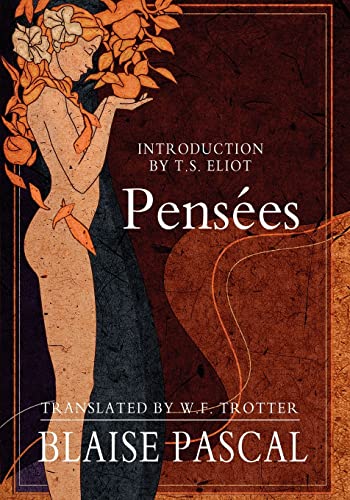
For much of his life, Pascal (1623-62) worked on a magnum opus which was never published in the form the philosopher intended. Instead, Pascal left a mass of fragments, some of them meant as notes for the Apologie. These became known as the Pensées, and they occupy a crucial place in Western philosophy and religious writing. --(Text refers to a previous edition)
Les informations fournies dans la section « Synopsis » peuvent faire référence à une autre édition de ce titre.
Biographie de l'auteur
Blaise Pascal (19 June 1623 – 19 August 1662) was a French mathematician, physicist, inventor, writer and Christian philosopher. He was a child prodigy who was educated by his father, a tax collector in Rouen. Pascal's earliest work was in the natural and applied sciences where he made important contributions to the study of fluids, and clarified the concepts of pressure and vacuum by generalizing the work of Evangelista Torricelli. Pascal also wrote in defense of the scientific method. In 1642, while still a teenager, he started some pioneering work on calculating machines. After three years of effort and fifty prototypes, he was one of the first two inventors of the mechanical calculator. He built 20 of these machines (called Pascal's calculators and later Pascalines) in the following ten years. Pascal was an important mathematician, helping create two major new areas of research: he wrote a significant treatise on the subject of projective geometry at the age of 16, and later corresponded with Pierre de Fermat on probability theory, strongly influencing the development of modern economics and social science. Following Galileo and Torricelli, in 1646, he refuted Aristotle's followers who insisted that nature abhors a vacuum. Pascal's results caused many disputes before being accepted.
Présentation de l'éditeur
For much of his life, Pascal (1623-62) worked on a magnum opus which was never published in the form the philosopher intended. Instead, Pascal left a mass of fragments, some of them meant as notes for the Apologie. These became known as the Pensées, and they occupy a crucial place in Western philosophy and religious writing. --(Text refers to a previous edition)
Les informations fournies dans la section « A propos du livre » peuvent faire référence à une autre édition de ce titre.
Résultats de recherche pour Pensees

Image d'archives
Pensees
Edité par
CreateSpace Independent Publishi, 2011
ISBN 10 : 1461048656
ISBN 13 : 9781461048657
Ancien ou d'occasion
paperback
Vendeur : Books From California, Simi Valley, CA, Etats-Unis
Évaluation du vendeur 4 sur 5 étoiles

paperback. Etat : Very Good. N° de réf. du vendeur mon0004081782
Acheter D'occasion
EUR 4,58
Expédition à EUR 4,44
Expédition nationale : Etats-Unis
Expédition nationale : Etats-Unis
Quantité disponible : 1 disponible(s)
Image d'archives
Pensees
Edité par
CreateSpace Independent Publishing Platform, 2011
ISBN 10 : 1461048656
ISBN 13 : 9781461048657
Ancien ou d'occasion
Paperback
Vendeur : WorldofBooks, Goring-By-Sea, WS, Royaume-Uni
Évaluation du vendeur 5 sur 5 étoiles

Paperback. Etat : Very Good. The book has been read, but is in excellent condition. Pages are intact and not marred by notes or highlighting. The spine remains undamaged. N° de réf. du vendeur GOR009647845
Acheter D'occasion
EUR 3,38
Expédition à EUR 6,57
Expédition depuis Royaume-Uni vers Etats-Unis
Expédition depuis Royaume-Uni vers Etats-Unis
Quantité disponible : 1 disponible(s)
Image d'archives
Pensees
Edité par
CreateSpace Independent Publishing Platform, 2011
ISBN 10 : 1461048656
ISBN 13 : 9781461048657
Ancien ou d'occasion
Couverture souple
Vendeur : Better World Books, Mishawaka, IN, Etats-Unis
Évaluation du vendeur 5 sur 5 étoiles
Etat : Very Good. Pages intact with possible writing/highlighting. Binding strong with minor wear. Dust jackets/supplements may not be included. Stock photo provided. Product includes identifying sticker. Better World Books: Buy Books. Do Good. N° de réf. du vendeur 19247518-20
Acheter D'occasion
EUR 11,15
Livraison gratuite
Expédition nationale : Etats-Unis
Expédition nationale : Etats-Unis
Quantité disponible : 1 disponible(s)
Image fournie par le vendeur
Pensees
Edité par
CreateSpace Independent Publishing Platform, 2011
ISBN 10 : 1461048656
ISBN 13 : 9781461048657
Ancien ou d'occasion
Couverture souple
Vendeur : GreatBookPrices, Columbia, MD, Etats-Unis
Évaluation du vendeur 5 sur 5 étoiles
Etat : As New. Unread book in perfect condition. N° de réf. du vendeur 14390615
Acheter D'occasion
EUR 9,59
Expédition à EUR 2,35
Expédition nationale : Etats-Unis
Expédition nationale : Etats-Unis
Quantité disponible : Plus de 20 disponibles
Image fournie par le vendeur
Pensees
Edité par
CreateSpace Independent Publishing Platform, 2011
ISBN 10 : 1461048656
ISBN 13 : 9781461048657
Neuf
Couverture souple
Vendeur : GreatBookPrices, Columbia, MD, Etats-Unis
Évaluation du vendeur 5 sur 5 étoiles
Etat : New. N° de réf. du vendeur 14390615-n
Acheter neuf
EUR 10,39
Expédition à EUR 2,35
Expédition nationale : Etats-Unis
Expédition nationale : Etats-Unis
Quantité disponible : Plus de 20 disponibles
Image d'archives
Pensees
Edité par
CreateSpace Independent Publishing Platform, 2011
ISBN 10 : 1461048656
ISBN 13 : 9781461048657
Neuf
Couverture souple
Vendeur : California Books, Miami, FL, Etats-Unis
Évaluation du vendeur 5 sur 5 étoiles
Etat : New. Print on Demand. N° de réf. du vendeur I-9781461048657
Acheter neuf
EUR 12,82
Livraison gratuite
Expédition nationale : Etats-Unis
Expédition nationale : Etats-Unis
Quantité disponible : Plus de 20 disponibles
Image fournie par le vendeur
Pensees
Vendeur : Rarewaves.com USA, London, LONDO, Royaume-Uni
Évaluation du vendeur 5 sur 5 étoiles
Paperback. Etat : New. N° de réf. du vendeur LU-9781461048657
Acheter neuf
EUR 15,22
Livraison gratuite
Expédition depuis Royaume-Uni vers Etats-Unis
Expédition depuis Royaume-Uni vers Etats-Unis
Quantité disponible : Plus de 20 disponibles
Image fournie par le vendeur
Pensees
Edité par
CreateSpace Independent Publishing Platform, 2011
ISBN 10 : 1461048656
ISBN 13 : 9781461048657
Neuf
Couverture souple
Vendeur : GreatBookPricesUK, Woodford Green, Royaume-Uni
Évaluation du vendeur 5 sur 5 étoiles
Etat : New. N° de réf. du vendeur 14390615-n
Acheter neuf
EUR 13,08
Expédition à EUR 17,60
Expédition depuis Royaume-Uni vers Etats-Unis
Expédition depuis Royaume-Uni vers Etats-Unis
Quantité disponible : Plus de 20 disponibles
Image fournie par le vendeur
Pensees
Edité par
CreateSpace Independent Publishing Platform, 2011
ISBN 10 : 1461048656
ISBN 13 : 9781461048657
Ancien ou d'occasion
Couverture souple
Vendeur : GreatBookPricesUK, Woodford Green, Royaume-Uni
Évaluation du vendeur 5 sur 5 étoiles
Etat : As New. Unread book in perfect condition. N° de réf. du vendeur 14390615
Acheter D'occasion
EUR 15,71
Expédition à EUR 17,60
Expédition depuis Royaume-Uni vers Etats-Unis
Expédition depuis Royaume-Uni vers Etats-Unis
Quantité disponible : Plus de 20 disponibles
Image d'archives
Pensees
Edité par
CreateSpace Independent Publishing Platform, 2011
ISBN 10 : 1461048656
ISBN 13 : 9781461048657
Neuf
paperback
Vendeur : BennettBooksLtd, Los Angeles, CA, Etats-Unis
Évaluation du vendeur 5 sur 5 étoiles
paperback. Etat : New. In shrink wrap. Looks like an interesting title! N° de réf. du vendeur Q-1461048656
Acheter neuf
EUR 70,53
Expédition à EUR 6,18
Expédition nationale : Etats-Unis
Expédition nationale : Etats-Unis
Quantité disponible : 1 disponible(s)