
Articles liés à Linear Algebraic Groups
Synopsis
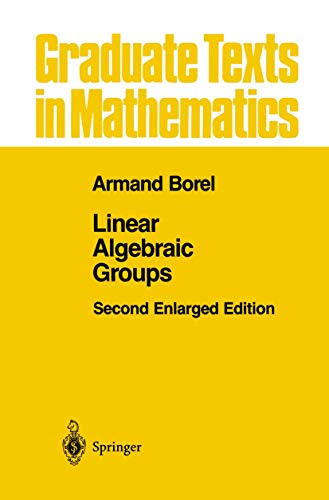
<p>This revised, enlarged edition of Linear Algebraic Groups (1969) starts by presenting foundational material on algebraic groups, Lie algebras, transformation spaces, and quotient spaces. It then turns to solvable groups, general properties of linear algebraic groups, and Chevally’s structure theory of reductive groups over algebraically closed groundfields. It closes with a focus on rationality questions over non-algebraically closed fields.</p>
Les informations fournies dans la section « Synopsis » peuvent faire référence à une autre édition de ce titre.
À propos de l'auteur
Armand Borel (21 May 1923 -11 August 2003) was a Swiss mathematician, born in La Chaux-de-Fonds, and served as a professor at the Institute for Advanced Study in Princeton, New Jersey, United States from 1957 to 1993. From 1983 to 1986 he also served as a professor at the ETH Zurich. He primarily worked on algebraic topology and on the theory of Lie groups, and was one of the founders of the contemporary theory of linear algebraic groups. In 1992 he was awarded the Balzan Prize in recognition of his contributions to the field.
À propos de la quatrième de couverture
This book is a revised and enlarged edition of "Linear Algebraic Groups", published by W.A. Benjamin in 1969. The text of the first edition has been corrected and revised. Accordingly, this book presents foundational material on algebraic groups, Lie algebras, transformation spaces, and quotient spaces. After establishing these basic topics, the text then turns to solvable groups, general properties of linear algebraic groups and Chevally's structure theory of reductive groups over algebraically closed groundfields. The remainder of the book is devoted to rationality questions over non-algebraically closed fields. This second edition has been expanded to include material on central isogenies and the structure of the group of rational points of an isotropic reductive group. The main prerequisite is some familiarity with algebraic geometry. The main notions and results needed are summarized in a chapter with references and brief proofs.
Les informations fournies dans la section « A propos du livre » peuvent faire référence à une autre édition de ce titre.
Résultats de recherche pour Linear Algebraic Groups

Image d'archives
Linear Algebraic Groups (eng)
impression à la demandeVendeur : Brook Bookstore On Demand, Napoli, NA, Italie
Évaluation du vendeur 5 sur 5 étoiles

Etat : new. Questo è un articolo print on demand. N° de réf. du vendeur VVVZP6V0OZ
Acheter neuf
EUR 54,23
Expédition à EUR 6,80
Expédition depuis Italie vers Etats-Unis
Expédition depuis Italie vers Etats-Unis
Quantité disponible : Plus de 20 disponibles
Image d'archives
Linear Algebraic Groups
Vendeur : GreatBookPrices, Columbia, MD, Etats-Unis
Évaluation du vendeur 5 sur 5 étoiles
Etat : New. N° de réf. du vendeur 19199751-n
Acheter neuf
EUR 62,27
Expédition à EUR 2,36
Expédition nationale : Etats-Unis
Expédition nationale : Etats-Unis
Quantité disponible : Plus de 20 disponibles
Image d'archives
Linear Algebraic Groups
Edité par
Springer, 2012
ISBN 10 : 1461269547
ISBN 13 : 9781461269540
Ancien ou d'occasion
Couverture souple
Vendeur : GreatBookPrices, Columbia, MD, Etats-Unis
Évaluation du vendeur 5 sur 5 étoiles
Etat : As New. Unread book in perfect condition. N° de réf. du vendeur 19199751
Acheter D'occasion
EUR 73,80
Expédition à EUR 2,36
Expédition nationale : Etats-Unis
Expédition nationale : Etats-Unis
Quantité disponible : Plus de 20 disponibles
Image d'archives
Linear Algebraic Groups (Graduate Texts in Mathematics, 126)
Vendeur : California Books, Miami, FL, Etats-Unis
Évaluation du vendeur 5 sur 5 étoiles
Etat : New. N° de réf. du vendeur I-9781461269540
Acheter neuf
EUR 83,89
Expédition à EUR 2,68
Expédition nationale : Etats-Unis
Expédition nationale : Etats-Unis
Quantité disponible : Plus de 20 disponibles
Image fournie par le vendeur
Linear Algebraic Groups
Edité par
Springer, Springer Sep 2012, 2012
ISBN 10 : 1461269547
ISBN 13 : 9781461269540
Neuf
Taschenbuch
Vendeur : BuchWeltWeit Ludwig Meier e.K., Bergisch Gladbach, Allemagne
Évaluation du vendeur 5 sur 5 étoiles
Taschenbuch. Etat : Neu. This item is printed on demand - it takes 3-4 days longer - Neuware -This book is a revised and enlarged edition of 'Linear Algebraic Groups', published by W.A. Benjamin in 1969. The text of the first edition has been corrected and revised. Accordingly, this book presents foundational material on algebraic groups, Lie algebras, transformation spaces, and quotient spaces. After establishing these basic topics, the text then turns to solvable groups, general properties of linear algebraic groups and Chevally's structure theory of reductive groups over algebraically closed groundfields. The remainder of the book is devoted to rationality questions over non-algebraically closed fields. This second edition has been expanded to include material on central isogenies and the structure of the group of rational points of an isotropic reductive group. The main prerequisite is some familiarity with algebraic geometry. The main notions and results needed are summarized in a chapter with references and brief proofs. 308 pp. Englisch. N° de réf. du vendeur 9781461269540
Acheter neuf
EUR 64,19
Expédition à EUR 23
Expédition depuis Allemagne vers Etats-Unis
Expédition depuis Allemagne vers Etats-Unis
Quantité disponible : 2 disponible(s)
Image d'archives
Linear Algebraic Groups (Graduate Texts in Mathematics, 126)
Vendeur : Ria Christie Collections, Uxbridge, Royaume-Uni
Évaluation du vendeur 5 sur 5 étoiles
Etat : New. In English. N° de réf. du vendeur ria9781461269540_new
Acheter neuf
EUR 75,77
Expédition à EUR 13,48
Expédition depuis Royaume-Uni vers Etats-Unis
Expédition depuis Royaume-Uni vers Etats-Unis
Quantité disponible : Plus de 20 disponibles
Image fournie par le vendeur
Linear Algebraic Groups
Edité par
Springer, 2012
ISBN 10 : 1461269547
ISBN 13 : 9781461269540
Ancien ou d'occasion
Couverture souple
Vendeur : GreatBookPricesUK, Woodford Green, Royaume-Uni
Évaluation du vendeur 5 sur 5 étoiles
Etat : As New. Unread book in perfect condition. N° de réf. du vendeur 19199751
Acheter D'occasion
EUR 75,62
Expédition à EUR 17,91
Expédition depuis Royaume-Uni vers Etats-Unis
Expédition depuis Royaume-Uni vers Etats-Unis
Quantité disponible : Plus de 20 disponibles
Image fournie par le vendeur
Linear Algebraic Groups
Vendeur : GreatBookPricesUK, Woodford Green, Royaume-Uni
Évaluation du vendeur 5 sur 5 étoiles
Etat : New. N° de réf. du vendeur 19199751-n
Acheter neuf
EUR 75,75
Expédition à EUR 17,91
Expédition depuis Royaume-Uni vers Etats-Unis
Expédition depuis Royaume-Uni vers Etats-Unis
Quantité disponible : Plus de 20 disponibles
Image d'archives
Linear Algebraic Groups
Edité par
Springer-Verlag New York Inc., 2012
ISBN 10 : 1461269547
ISBN 13 : 9781461269540
Neuf
Paperback / softback
Vendeur : THE SAINT BOOKSTORE, Southport, Royaume-Uni
Évaluation du vendeur 5 sur 5 étoiles
Paperback / softback. Etat : New. This item is printed on demand. New copy - Usually dispatched within 5-9 working days. N° de réf. du vendeur C9781461269540
Acheter neuf
EUR 79,99
Expédition à EUR 18,86
Expédition depuis Royaume-Uni vers Etats-Unis
Expédition depuis Royaume-Uni vers Etats-Unis
Quantité disponible : Plus de 20 disponibles
Image d'archives
Linear Algebraic Groups
Vendeur : Books Puddle, Woodside, NY, Etats-Unis
Évaluation du vendeur 4 sur 5 étoiles

Etat : New. pp. 308. N° de réf. du vendeur 2658588857
Acheter neuf
EUR 100,34
Expédition à EUR 3,57
Expédition nationale : Etats-Unis
Expédition nationale : Etats-Unis
Quantité disponible : 4 disponible(s)