
Articles liés à Conscience of a Conservative
Synopsis
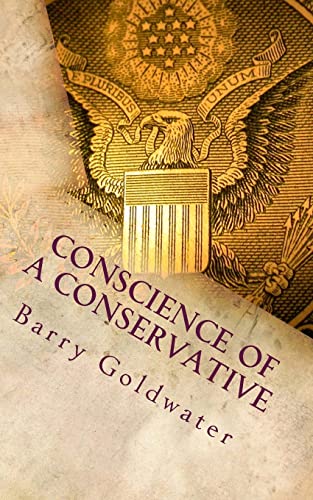
Bold, unapologetic, and decades ahead of its time, Conscience of a Conservative is the landmark manifesto that reshaped American politics and sparked a movement that continues to influence the nation today. In this powerful and deeply principled work, Barry Goldwater argues for a vision of individual freedom, limited government, and personal responsibility—ideas that would help ignite the modern conservative resurgence and pave the way for the Reagan Revolution.
Far more than a campaign tract, this slim volume delivers a sharply reasoned philosophy that remains startlingly relevant. Goldwater tackles education, labor unions, civil rights, agricultural subsidies, social welfare programs, and federal taxation with clarity and conviction, challenging readers to question the expanding power of government and consider what true liberty demands.
What makes this book timeless is its heart as much as its logic. Goldwater writes not as a distant politician but as a man fiercely committed to the moral and civic duty of maintaining freedom. His conservatism is neither isolationist nor elitist—it is a passionate call for self-determination, courage, and integrity. With each page, he pushes readers to confront uncomfortable truths about power, responsibility, and the future of the country.
Whether you are a student of political philosophy, a lover of American history, or a reader searching for the roots of today’s political climate, this book offers a riveting glimpse into the ideas that shaped a movement. Clear, bold, and surprisingly fresh, Conscience of a Conservative remains one of the most influential—and provocative—political works ever written.
Les informations fournies dans la section « Synopsis » peuvent faire référence à une autre édition de ce titre.
À propos de l'auteur
Barry Goldwater (1909–1998) was a five-term United States Senator from Arizona and the Republican Party's nominee for President in the 1964 election. An articulate and charismatic figure during the first half of the 1960s, he was known as "Mr. Conservative". Goldwater is the politician most often credited for sparking the resurgence of the American conservative political movement in the 1960s. He also had a substantial impact on the libertarian movement. Goldwater rejected the legacy of the New Deal and fought through the conservative coalition to defeat the New Deal coalition. He mobilized a large conservative constituency to win the hard-fought Republican primaries. Goldwater's right-wing campaign platform ultimately failed to gain the support of the electorate and he lost the 1964 presidential election to incumbent Democrat Lyndon B. Johnson by one of the largest landslides in history, bringing down many Republican candidates as well. The Johnson campaign and other critics painted him as a reactionary, while supporters praised his crusades against the Soviet Union, labor unions, and the welfare state. His defeat allowed Johnson and the Democrats in Congress to pass the Great Society programs, but the defeat of so many older Republicans in 1964 also cleared the way for a younger generation of American conservatives to mobilize. Goldwater was much less active as a national leader of conservatives after 1964; his supporters mostly rallied behind Ronald Reagan, who became governor of California in 1967 and the 40th President of the United States in 1981. Goldwater returned to the Senate in 1969, and specialized in defense policy, bringing to the table his experience as a senior officer in the Air Force Reserve. His greatest accomplishment was arguably the passage of the Goldwater-Nichols Act of 1986, which restructured the higher levels of the Pentagon by increasing the power of the Chairman of the Joint Chiefs of Staff to direct military action. In 1974, as an elder statesman of the party, Goldwater successfully urged President Richard Nixon to resign when evidence of a cover-up in the Watergate scandal became overwhelming and impeachment was imminent. By the 1980s, the increasing influence of the Christian right on the Republican Party so conflicted with Goldwater's libertarian views that he became a vocal opponent of the religious right on issues such as abortion, gay rights and the role of religion in public life.
Les informations fournies dans la section « A propos du livre » peuvent faire référence à une autre édition de ce titre.
Résultats de recherche pour Conscience of a Conservative

Image d'archives
Conscience of a Conservative
Edité par
CreateSpace Independent Publishing Platform, 2012
ISBN 10 : 1477510354
ISBN 13 : 9781477510353
Ancien ou d'occasion
Couverture souple
Vendeur : World of Books (was SecondSale), Montgomery, IL, Etats-Unis
Évaluation du vendeur 5 sur 5 étoiles

Etat : Good. Item in good condition and has highlighting/writing on text. Used texts may not contain supplemental items such as CDs, info-trac etc. N° de réf. du vendeur 00099709778
Acheter D'occasion
EUR 7,03
Livraison gratuite
Expédition nationale : Etats-Unis
Expédition nationale : Etats-Unis
Quantité disponible : 1 disponible(s)
Image d'archives
Conscience of a Conservative
Edité par
CreateSpace Independent Publishing Platform, 2012
ISBN 10 : 1477510354
ISBN 13 : 9781477510353
Ancien ou d'occasion
Couverture souple
Vendeur : Better World Books, Mishawaka, IN, Etats-Unis
Évaluation du vendeur 5 sur 5 étoiles
Etat : Good. Pages intact with minimal writing/highlighting. The binding may be loose and creased. Dust jackets/supplements are not included. Stock photo provided. Product includes identifying sticker. Better World Books: Buy Books. Do Good. N° de réf. du vendeur 55437586-6
Acheter D'occasion
EUR 7,05
Livraison gratuite
Expédition nationale : Etats-Unis
Expédition nationale : Etats-Unis
Quantité disponible : 1 disponible(s)
Image d'archives
Conscience of a Conservative
impression à la demandeVendeur : Revaluation Books, Exeter, Royaume-Uni
Évaluation du vendeur 5 sur 5 étoiles
Paperback. Etat : Brand New. 100 pages. 8.00x5.00x0.23 inches. This item is printed on demand. N° de réf. du vendeur zk1477510354
Acheter neuf
EUR 19,78
Expédition à EUR 11,66
Expédition depuis Royaume-Uni vers Etats-Unis
Expédition depuis Royaume-Uni vers Etats-Unis
Quantité disponible : 1 disponible(s)