
Articles liés à Are Racists Crazy?: How Prejudice, Racism, and Antisemitism...
Are Racists Crazy?: How Prejudice, Racism, and Antisemitism Became Markers of Insanity - Couverture rigide
Livre 11 sur 22: Biopolitics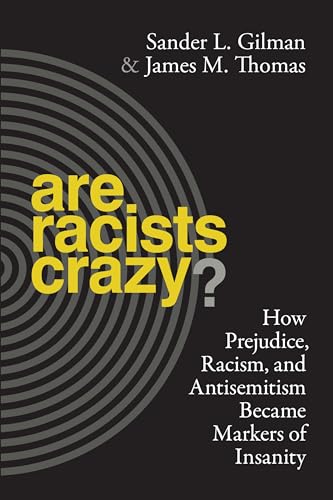
Synopsis
The connection and science behind race, racism, and mental illness
In 2012, an interdisciplinary team of scientists at the University of Oxford reported that - based on their clinical experiment - the beta-blocker drug, Propranolol, could reduce implicit racial bias among its users. Shortly after the experiment, an article in Time Magazine cited the study, posing the question: Is racism becoming a mental illness? In Are Racists Crazy? Sander Gilman and James Thomas trace the idea of race and racism as psychopathological categories., from mid-19th century Europe, to contemporary America, up to the aforementioned clinical experiment at the University of Oxford, and ask a slightly different question than that posed by Time: How did racism become a mental illness? Using historical, archival, and content analysis, the authors provide a rich account of how the 19th century 'Sciences of Man' - including anthropology, medicine, and biology - used race as a means of defining psychopathology and how assertions about race and madness became embedded within disciplines that deal with mental health and illness.
Les informations fournies dans la section « Synopsis » peuvent faire référence à une autre édition de ce titre.
À propos des auteurs
Sander L. Gilman is Distinguished Professor of the Liberal Arts and Sciences, as well as Professor of Psychiatry, at Emory University. He is the author or editor of more than ninety books, including the basic study of the visual stereotyping of the mentally ill, Seeing the Insane.
James Thomas is Associate Professor of Sociology, University of Mississippi. He is the author of
Diversity Regimes: Why Talk Is Not Enough to Fix Racial Inequality at Universities (Rutgers, 2020) and co-author of Are Racists Crazy?: How Prejudice, Racism, and Antisemitism Became Markers of Insanity (NYU, 2016).
Les informations fournies dans la section « A propos du livre » peuvent faire référence à une autre édition de ce titre.
Résultats de recherche pour Are Racists Crazy?: How Prejudice, Racism, and Antisemitism...

Image d'archives
Are Racists Crazy?: How Prejudice, Racism, and Antisemitism Became Markers of Insanity (Biopolitics, 11)
Edité par
NYU Press, 2016
ISBN 10 : 1479856126
ISBN 13 : 9781479856121
Ancien ou d'occasion
Couverture rigide
Vendeur : World of Books (was SecondSale), Montgomery, IL, Etats-Unis
Évaluation du vendeur 5 sur 5 étoiles

Etat : Good. Item in good condition. Textbooks may not include supplemental items i.e. CDs, access codes etc. N° de réf. du vendeur 00053983818
Acheter D'occasion
EUR 5,35
Livraison gratuite
Expédition nationale : Etats-Unis
Expédition nationale : Etats-Unis
Quantité disponible : 1 disponible(s)
Image d'archives
Are Racists Crazy?: How Prejudice, Racism, and Antisemitism Became Markers of Insanity (Biopolitics, 11)
Edité par
NYU Press (edition ), 2016
ISBN 10 : 1479856126
ISBN 13 : 9781479856121
Ancien ou d'occasion
Couverture rigide
Vendeur : BooksRun, Philadelphia, PA, Etats-Unis
Évaluation du vendeur 5 sur 5 étoiles
Hardcover. Etat : Very Good. With dust jacket. It's a well-cared-for item that has seen limited use. The item may show minor signs of wear. All the text is legible, with all pages included. It may have slight markings and/or highlighting. N° de réf. du vendeur 1479856126-8-1-29
Acheter D'occasion
EUR 5,36
Livraison gratuite
Expédition nationale : Etats-Unis
Expédition nationale : Etats-Unis
Quantité disponible : 3 disponible(s)
Image d'archives
Are Racists Crazy?: How Prejudice, Racism, and Antisemitism Became Markers of Insanity
Edité par
New York University Press, 2016
ISBN 10 : 1479856126
ISBN 13 : 9781479856121
Ancien ou d'occasion
Couverture rigide
Vendeur : ThriftBooks-Dallas, Dallas, TX, Etats-Unis
Évaluation du vendeur 5 sur 5 étoiles
Hardcover. Etat : Very Good. No Jacket. Former library book; May have limited writing in cover pages. Pages are unmarked. ~ ThriftBooks: Read More, Spend Less. N° de réf. du vendeur G1479856126I4N10
Acheter D'occasion
EUR 6,37
Livraison gratuite
Expédition nationale : Etats-Unis
Expédition nationale : Etats-Unis
Quantité disponible : 1 disponible(s)
Image d'archives
Are Racists Crazy? : How Prejudice, Racism, and Antisemitism Became Markers of Insanity
Edité par
New York University Press, 2016
ISBN 10 : 1479856126
ISBN 13 : 9781479856121
Ancien ou d'occasion
Couverture rigide
Vendeur : Better World Books, Mishawaka, IN, Etats-Unis
Évaluation du vendeur 5 sur 5 étoiles
Etat : Good. Former library copy. Pages intact with minimal writing/highlighting. The binding may be loose and creased. Dust jackets/supplements are not included. Includes library markings. Stock photo provided. Product includes identifying sticker. Better World Books: Buy Books. Do Good. N° de réf. du vendeur 17559528-6
Acheter D'occasion
EUR 6,75
Livraison gratuite
Expédition nationale : Etats-Unis
Expédition nationale : Etats-Unis
Quantité disponible : 1 disponible(s)
Image d'archives
Are Racists Crazy? : How Prejudice, Racism, and Antisemitism Became Markers of Insanity
Edité par
New York University Press, 2016
ISBN 10 : 1479856126
ISBN 13 : 9781479856121
Ancien ou d'occasion
Couverture rigide
Vendeur : Better World Books, Mishawaka, IN, Etats-Unis
Évaluation du vendeur 5 sur 5 étoiles
Etat : Very Good. Former library copy. Pages intact with possible writing/highlighting. Binding strong with minor wear. Dust jackets/supplements may not be included. Includes library markings. Stock photo provided. Product includes identifying sticker. Better World Books: Buy Books. Do Good. N° de réf. du vendeur 18021871-6
Acheter D'occasion
EUR 6,75
Livraison gratuite
Expédition nationale : Etats-Unis
Expédition nationale : Etats-Unis
Quantité disponible : 1 disponible(s)
Image d'archives
Are Racists Crazy?: How Prejudice, Racism, and Antisemitism Became Markers of Insanity
Edité par
New York University Press, 2016
ISBN 10 : 1479856126
ISBN 13 : 9781479856121
Ancien ou d'occasion
Couverture rigide
Vendeur : World of Books Inc, Montgomery, IL, Etats-Unis
Évaluation du vendeur 4 sur 5 étoiles

Hardback. Etat : Good. The connection and science behind race, racism, and mental illness In 2012, an interdisciplinary team of scientists at the University of Oxford reported that - based on their clinical experiment - the beta-blocker drug, Propranolol, could reduce implicit racial bias among its users. Shortly after the experiment, an article in Time Magazine cited the study, posing the question: Is racism becoming a mental illness? In Are Racists Crazy? Sander Gilman and James Thomas trace the idea of race and racism as psychopathological categories., from mid-19th century Europe, to contemporary America, up to the aforementioned clinical experiment at the University of Oxford, and ask a slightly different question than that posed by Time: How did racism become a mental illness? Using historical, archival, and content analysis, the authors provide a rich account of how the 19th century 'Sciences of Man' - including anthropology, medicine, and biology - used race as a means of defining psychopathology and how assertions about race and madness became embedded within disciplines that deal with mental health and illness. An illuminating and riveting history of the discourse on racism, antisemitism, and psychopathology, Are Racists Crazy? connects past and present claims about race and racism, showing the dangerous implications of this specious line of thought for today. N° de réf. du vendeur CIN1479856126G
Acheter D'occasion
EUR 7,19
Livraison gratuite
Expédition nationale : Etats-Unis
Expédition nationale : Etats-Unis
Quantité disponible : 1 disponible(s)
Image d'archives
Are Racists Crazy?: How Prejudice, Racism, and Antisemitism Became Markers of Insanity (Biopolitics, 11)
Edité par
NYU Press, 2016
ISBN 10 : 1479856126
ISBN 13 : 9781479856121
Ancien ou d'occasion
Couverture rigide
Vendeur : HPB-Red, Dallas, TX, Etats-Unis
Évaluation du vendeur 5 sur 5 étoiles
hardcover. Etat : Good. Connecting readers with great books since 1972! Used textbooks may not include companion materials such as access codes, etc. May have some wear or writing/highlighting. We ship orders daily and Customer Service is our top priority! N° de réf. du vendeur S_453784938
Acheter D'occasion
EUR 4,60
Expédition à EUR 3,35
Expédition nationale : Etats-Unis
Expédition nationale : Etats-Unis
Quantité disponible : 1 disponible(s)
Image d'archives
Are Racists Crazy?: How Prejudice, Racism, and Antisemitism Became Markers of Insanity
Edité par
NYU Press, New York, NY, 2016
ISBN 10 : 1479856126
ISBN 13 : 9781479856121
Ancien ou d'occasion
Couverture rigide
Edition originale
Vendeur : Montana Book Company, Fond du Lac, WI, Etats-Unis
Évaluation du vendeur 5 sur 5 étoiles
Hardcover. Etat : Good. 1st Edition. 385 pp. Tightly bound. Text is free of markings. No ownership markings. Good dust jacket. First Edition / First Printing. 10,9,8,7,6,5,4,3,2,1. Please Note the reasons for the lower "good" rating. (1) The tips of the four corners are lightly bumped. (2) There are some small dings along pages of the side fore-edge. A good reading copy that has no markings in the text. N° de réf. du vendeur 093957
Acheter D'occasion
EUR 8,28
Expédition à EUR 3,55
Expédition nationale : Etats-Unis
Expédition nationale : Etats-Unis
Quantité disponible : 1 disponible(s)
Image d'archives
Are Racists Crazy?: How Prejudice, Racism, and Antisemitism Became Markers of Insanity (Biopolitics, 11)
Vendeur : GoldBooks, Denver, CO, Etats-Unis
Évaluation du vendeur 5 sur 5 étoiles
Hardcover. Etat : new. New Copy. Customer Service Guaranteed. N° de réf. du vendeur 45C39_49_1479856126
Acheter neuf
EUR 35,23
Expédition à EUR 4,91
Expédition nationale : Etats-Unis
Expédition nationale : Etats-Unis
Quantité disponible : 1 disponible(s)
Image fournie par le vendeur
Are Racists Crazy?
Edité par
New York University Press, US, 2016
ISBN 10 : 1479856126
ISBN 13 : 9781479856121
Neuf
Couverture rigide
Vendeur : Rarewaves USA, HEBRON, KY, Etats-Unis
Évaluation du vendeur 5 sur 5 étoiles
Hardback. Etat : New. The connection and science behind race, racism, and mental illness In 2012, an interdisciplinary team of scientists at the University of Oxford reported that - based on their clinical experiment - the beta-blocker drug, Propranolol, could reduce implicit racial bias among its users. Shortly after the experiment, an article in Time Magazine cited the study, posing the question: Is racism becoming a mental illness? In Are Racists Crazy? Sander Gilman and James Thomas trace the idea of race and racism as psychopathological categories., from mid-19th century Europe, to contemporary America, up to the aforementioned clinical experiment at the University of Oxford, and ask a slightly different question than that posed by Time: How did racism become a mental illness? Using historical, archival, and content analysis, the authors provide a rich account of how the 19th century 'Sciences of Man' - including anthropology, medicine, and biology - used race as a means of defining psychopathology and how assertions about race and madness became embedded within disciplines that deal with mental health and illness. An illuminating and riveting history of the discourse on racism, antisemitism, and psychopathology, Are Racists Crazy? connects past and present claims about race and racism, showing the dangerous implications of this specious line of thought for today. N° de réf. du vendeur LU-9781479856121
Acheter neuf
EUR 108,38
Livraison gratuite
Expédition nationale : Etats-Unis
Expédition nationale : Etats-Unis
Quantité disponible : Plus de 20 disponibles