
Articles liés à No More Nice Girls: Gender, Power, and Why It's...
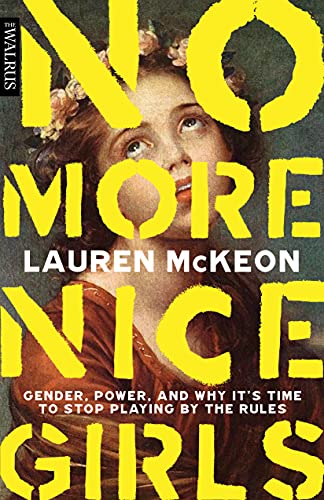
No More Nice Girls: Gender, Power, and Why It's Time to Stop Playing by the Rules - Couverture souple
Synopsis
A groundbreaking, insightful book about women and power from award-winning journalist Lauren McKeon, which shows how women are disrupting the standard (very male) vision of power, ditching convention, and building a more equitable world for everyone.
In the age of girl bosses, Beyoncé, and Black Widow, we like to tell our little girls they can be anything they want when they grow up, except they’ll have to work twice as hard, be told to “play nice,” and face countless double standards that curb their personal, political, and economic power. Women today remain a surprisingly, depressingly long way from gender and racial equality. It’s worth asking: Why do we keep playing a game we were never meant to win?
Award-winning journalist and author of F-Bomb: Dispatches from the War on Feminism, Lauren McKeon examines the many ways in which our institutions are designed to keep women and other marginalized genders at a disadvantage. In doing so, she reveals why we need more than parity, visible diversity, and lone female CEOs to change this power game. She talks to people doing power differently in a variety of sectors and uncovers new models of power. And as the toxic, divisive, and hyper-masculine style of leadership gains ground, she underscores why it’s time to stop playing by the rules of a rigged game.
Les informations fournies dans la section « Synopsis » peuvent faire référence à une autre édition de ce titre.
À propos de l'auteur
LAUREN MCKEON'S critically acclaimed first book, F-Bomb: Dispatches from the War on Feminism, was a finalist for the Kobo Emerging Writer Prize and was selected by the Hill Times as a book of the year and by the Feminist Book Club as one of their top five feminist books ever. McKeon is the winner of several National Magazine Awards, including a Gold in the Personal Journalism category. Her writing has appeared in Hazlitt, Flare, Chatelaine, and Best Canadian Essays, on TVO.org, and in the book Whatever Gets You Through: Twelve Survivors on Life After Sexual Assault. McKeon has taught long-form writing at Humber College and holds an M.F.A. in Creative Nonfiction from the University of King's College. She was the editor of This Magazine from 2011 to 2016 and the digital editor at The Walrus from 2017 to 2020, and she is currently a contributing editor at Toronto Life and the deputy editor of Reader's Digest.
Extrait. © Reproduit sur autorisation. Tous droits réservés.
On November 8, 2016, I tried to pretend the TVs at my gym did not exist. I’d shown up that night to my weekly class expecting to walk out sweaty and exalted. If America elected a woman as its leader (as all the pundits and polls suggested the country would) then, surely, Canada would follow. Anything felt possible. I imagined a cascade of broken status quos — belligerent white men in crisp suits falling like dominos. But over the next hour disbelief replaced excitement. At one point, our class melted away from our workout stations to pool, lost, around the TV. Women muttered shit, what, no, over and over again. That night, I couldn’t sleep. I stayed seated on my bed, cross-legged, stunned. It didn’t matter that I wasn’t American, or that one of the wokest men on Earth supposedly ran my own country. Electing a blatant misogynist to one of the world’s most powerful positions symbolized something: we were fucked.
Since then, the question of women and power has undergone something of a renaissance — largely because we’ve been forced to confront, once again, how much of it women still don’t have. Quite literally overnight, many of us went from believing, with good reason, that we’d never been closer to equality — and power — to reckoning with just how far away from both women truly were. In response, women woke up, gathered, and demanded change. All around the world, they protested. The momentum from the Women’s March on Washington built into #MeToo and a very public reckoning with the everyday ways in which women’s power and autonomy are constantly undermined.
Watching it all, I was galvanized. But I also felt as though I was stuck in a not-so-fun house of magic mirrors. Come one, come all! Watch as the road to equality shrinks, stretches, distorts! Sometimes it seemed as if our fury, powerful in its own right, could propel us anywhere we wanted to go: into public office, into the C-suite, into a world in which we had bodily autonomy. Other times, as the anti-feminist backlash grew louder, bolder, and more expansive, it seemed as though women were in our most precarious spot yet. I began to think of feminist power as a paradox: from some vantages, we seemed closer than ever to achieving it; from others, we’d never been farther away.
I have spent the bulk of my journalism career investigating the ways in which women navigate, and in many cases push back against, the expectations of the world around them. In doing this, I now realize, what I’ve really been asking, consciously or not, is how women disrupt and reimagine power structures, how they gain power both in and over their lives. Many of the women I’ve interviewed are pioneers in their fields, often ones dominated by men, and you could say they are subverting from within. Others are pushing at established power structures from the outside, rallying from the grassroots. They are all inspiring and amazing. But is what they’re doing working? These past few years have illuminated some stark, and seemingly contradictory, truths. Despite immense progress, no amount of success can immunize women against the toxic, sexist environments around them, and it is not uncommon for women to be utterly alone: one of few in their field, the only woman in management at their company, or the only one breaking a certain convention.
The more I heard their stories, the more I wondered: Even if a woman won the next American or Canadian federal election, what would that victory gain us? Or, put another way: Do we have the very concept of women and power all wrong? I’m not saying I want all the feminists to give up the fight, retreat to their kitchens, and let one pucker-mouthed man and his acolytes burn the planet. I want women to attain the same powerful positions afforded to men, in equal numbers. But it’s also dangerous to see that status, in and of itself, as a panacea to centuries of Western civilization, all built on foundational histories of sexism, misogyny, and violence against women. A woman prime minister certainly wouldn’t “cancel out” this seemingly new brand of misogyny, dredged up for all the world to see. In fact, the past few years have revealed that any woman, or member of another equity-seeking group, who stands where white, straight, cisgender men usually do is certain to face violent backlash. Or, as University of Cambridge classics professor Mary Beard argues in her short manifesto Women and Power, throughout time women have been placed in, or near to, positions of power simply to fail. To illustrate her point, Beard borrows from Greek mythology, referring to Clytemnestra, who rules over her city while her husband fights in the Trojan War, only to be murdered by her own children after she refuses to cede her new leadership upon his return (well, okay, she also killed her husband rather than go back down the patriarchal chain). Or more recently, Beard suggests, consider Theresa May or Hillary Clinton. For women, power is messy from every angle.
Perhaps, then, it’s finally time to start rethinking feminism’s one-time end goals, to ditch our old checklists for equality. Yes, let’s not abandon our strategizing toward getting more women to the top, but let’s also examine a deeper, less considered problem: that is, what the view from “the top” looks like for women once they’re there. What if we could redefine not just women’s path to power but the very concept of power itself? Or more radical yet: What if we stopped focusing on playing the game better, ditched the rulebook, and refused to play their game at all? What would power even look like to us if we weren’t always visualizing it within the context of men?
Les informations fournies dans la section « A propos du livre » peuvent faire référence à une autre édition de ce titre.
Résultats de recherche pour No More Nice Girls: Gender, Power, and Why It's...

Image fournie par le vendeur
No More Nice Girls: Gender, Power, and Why Itâs Time to Stop Playing by the Rules
Edité par
The Walrus Books, 2020
ISBN 10 : 1487006446
ISBN 13 : 9781487006440
Ancien ou d'occasion
Couverture souple
Vendeur : Bay State Book Company, North Smithfield, RI, Etats-Unis
Évaluation du vendeur 5 sur 5 étoiles

Etat : good. The book is in good condition with all pages and cover intact, including the dust jacket if originally issued. The spine may show light wear. Pages may contain some notes or highlighting, and there might be a "From the library of" label. Boxed set packaging, shrink wrap, or included media like CDs may be missing. N° de réf. du vendeur BSM.1C7JA
Acheter D'occasion
EUR 5,62
Livraison gratuite
Expédition nationale : Etats-Unis
Expédition nationale : Etats-Unis
Quantité disponible : 1 disponible(s)
Image d'archives
No More Nice Girls: Gender, Power, and Why It?s Time to Stop Playing by the Rules
Edité par
The Walrus Books, 2020
ISBN 10 : 1487006446
ISBN 13 : 9781487006440
Ancien ou d'occasion
paperback
Vendeur : Your Online Bookstore, Houston, TX, Etats-Unis
Évaluation du vendeur 5 sur 5 étoiles
paperback. Etat : Fair. N° de réf. du vendeur 1487006446-4-36609587
Acheter D'occasion
EUR 6,32
Livraison gratuite
Expédition nationale : Etats-Unis
Expédition nationale : Etats-Unis
Quantité disponible : 1 disponible(s)
Image d'archives
No More Nice Girls : Gender, Power, and Why It's Time to Stop Playing by the Rules
Edité par
House of Anansi Press, 2020
ISBN 10 : 1487006446
ISBN 13 : 9781487006440
Ancien ou d'occasion
Couverture souple
Vendeur : Better World Books: West, Reno, NV, Etats-Unis
Évaluation du vendeur 5 sur 5 étoiles
Etat : Good. Pages intact with minimal writing/highlighting. The binding may be loose and creased. Dust jackets/supplements are not included. Stock photo provided. Product includes identifying sticker. Better World Books: Buy Books. Do Good. N° de réf. du vendeur 55372541-75
Acheter D'occasion
EUR 6,34
Livraison gratuite
Expédition nationale : Etats-Unis
Expédition nationale : Etats-Unis
Quantité disponible : 1 disponible(s)
Image d'archives
No More Nice Girls : Gender, Power, and Why It's Time to Stop Playing by the Rules
Edité par
House of Anansi Press, 2020
ISBN 10 : 1487006446
ISBN 13 : 9781487006440
Ancien ou d'occasion
Couverture souple
Vendeur : Better World Books, Mishawaka, IN, Etats-Unis
Évaluation du vendeur 5 sur 5 étoiles
Etat : Very Good. Former library copy. Pages intact with possible writing/highlighting. Binding strong with minor wear. Dust jackets/supplements may not be included. Includes library markings. Stock photo provided. Product includes identifying sticker. Better World Books: Buy Books. Do Good. N° de réf. du vendeur 42744382-6
Acheter D'occasion
EUR 6,34
Livraison gratuite
Expédition nationale : Etats-Unis
Expédition nationale : Etats-Unis
Quantité disponible : 1 disponible(s)
Image d'archives
No More Nice Girls : Gender, Power, and Why It's Time to Stop Playing by the Rules
Edité par
House of Anansi Press, 2020
ISBN 10 : 1487006446
ISBN 13 : 9781487006440
Ancien ou d'occasion
Couverture souple
Vendeur : Better World Books, Mishawaka, IN, Etats-Unis
Évaluation du vendeur 5 sur 5 étoiles
Etat : Good. Former library copy. Pages intact with minimal writing/highlighting. The binding may be loose and creased. Dust jackets/supplements are not included. Includes library markings. Stock photo provided. Product includes identifying sticker. Better World Books: Buy Books. Do Good. N° de réf. du vendeur 42744839-6
Acheter D'occasion
EUR 6,34
Livraison gratuite
Expédition nationale : Etats-Unis
Expédition nationale : Etats-Unis
Quantité disponible : 1 disponible(s)
Image d'archives
No More Nice Girls: Gender, Power, and Why It's Time to Stop Playing by the Rules
Edité par
Walrus Books, 2020
ISBN 10 : 1487006446
ISBN 13 : 9781487006440
Ancien ou d'occasion
Paperback
Vendeur : ThriftBooks-Dallas, Dallas, TX, Etats-Unis
Évaluation du vendeur 5 sur 5 étoiles
Paperback. Etat : Very Good. No Jacket. Former library book; May have limited writing in cover pages. Pages are unmarked. ~ ThriftBooks: Read More, Spend Less. N° de réf. du vendeur G1487006446I4N10
Acheter D'occasion
EUR 7,27
Livraison gratuite
Expédition nationale : Etats-Unis
Expédition nationale : Etats-Unis
Quantité disponible : 1 disponible(s)
Image d'archives
No More Nice Girls: Gender, Power, and Why It's Time to Stop Playing by the Rules
Edité par
Walrus Books, 2020
ISBN 10 : 1487006446
ISBN 13 : 9781487006440
Ancien ou d'occasion
Paperback
Vendeur : ThriftBooks-Atlanta, AUSTELL, GA, Etats-Unis
Évaluation du vendeur 5 sur 5 étoiles
Paperback. Etat : Very Good. No Jacket. Former library book; May have limited writing in cover pages. Pages are unmarked. ~ ThriftBooks: Read More, Spend Less. N° de réf. du vendeur G1487006446I4N10
Acheter D'occasion
EUR 7,27
Livraison gratuite
Expédition nationale : Etats-Unis
Expédition nationale : Etats-Unis
Quantité disponible : 1 disponible(s)
Image d'archives
No More Nice Girls: Gender, Power, and Why Itâs Time to Stop Playing by the Rules
Edité par
The Walrus Books, 2020
ISBN 10 : 1487006446
ISBN 13 : 9781487006440
Ancien ou d'occasion
paperback
Vendeur : HPB-Diamond, Dallas, TX, Etats-Unis
Évaluation du vendeur 5 sur 5 étoiles
paperback. Etat : Very Good. Connecting readers with great books since 1972! Used books may not include companion materials, and may have some shelf wear or limited writing. We ship orders daily and Customer Service is our top priority! N° de réf. du vendeur S_481779047
Acheter D'occasion
EUR 5,66
Expédition à EUR 3,34
Expédition nationale : Etats-Unis
Expédition nationale : Etats-Unis
Quantité disponible : 1 disponible(s)
Image d'archives
No More Nice Girls: Gender, Power, and Why It's Time to Stop Playing by the Rules
Edité par
The Walrus Books, 2020
ISBN 10 : 1487006446
ISBN 13 : 9781487006440
Ancien ou d'occasion
Couverture souple
Vendeur : SustainableBooks.com, Amherst, NY, Etats-Unis
Évaluation du vendeur 5 sur 5 étoiles
Etat : Very Good. Book is in Used-VeryGood condition. Pages and cover are clean and intact. Used items may not include supplementary materials such as CDs or access codes. May show signs of minor shelf wear and contain very limited notes and highlighting. N° de réf. du vendeur 1487006446-2-3
Acheter D'occasion
EUR 9,27
Livraison gratuite
Expédition nationale : Etats-Unis
Expédition nationale : Etats-Unis
Quantité disponible : 1 disponible(s)
Image d'archives
No More Nice Girls: Gender, Power, and Why Itâs Time to Stop Playing by the Rules
Edité par
The Walrus Books, 2020
ISBN 10 : 1487006446
ISBN 13 : 9781487006440
Ancien ou d'occasion
paperback
Vendeur : Half Price Books Inc., Dallas, TX, Etats-Unis
Évaluation du vendeur 5 sur 5 étoiles
paperback. Etat : Very Good. Connecting readers with great books since 1972! Used books may not include companion materials, and may have some shelf wear or limited writing. We ship orders daily and Customer Service is our top priority! N° de réf. du vendeur S_488874246
Acheter D'occasion
EUR 8,70
Expédition à EUR 3,34
Expédition nationale : Etats-Unis
Expédition nationale : Etats-Unis
Quantité disponible : 1 disponible(s)