
Articles liés à Errors, Blunders, and Lies: How to Tell the Difference
Errors, Blunders, and Lies: How to Tell the Difference - Couverture souple
Livre 1 sur 15: ASA-CRC Series on Statistical Reasoning in Science and Society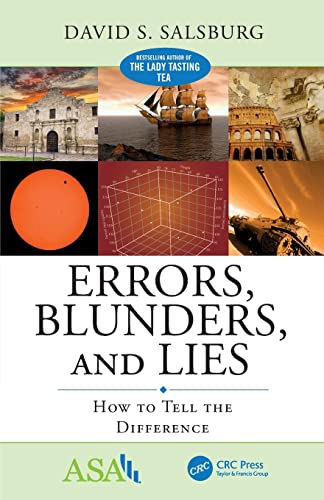
Synopsis
We live in a world that is not quite "right." The central tenet of statistical inquiry is that Observation = Truth + Error because even the most careful of scientific investigations have always been bedeviled by uncertainty. Our attempts to measure things are plagued with small errors. Our attempts to understand our world are blocked by blunders. And, unfortunately, in some cases, people have been known to lie.
In this long-awaited follow-up to his well-regarded bestseller, The Lady Tasting Tea, David Salsburg opens a door to the amazing widespread use of statistical methods by looking at historical examples of errors, blunders and lies from areas as diverse as archeology, law, economics, medicine, psychology, sociology, Biblical studies, history, and war-time espionage. In doing so, he shows how, upon closer statistical investigation, errors and blunders often lead to useful information. And how statistical methods have been used to uncover falsified data.
Beginning with Edmund Halley’s examination of the Transit of Venus and ending with a discussion of how many tanks Rommel had during the Second World War, the author invites the reader to come along on this easily accessible and fascinating journey of how to identify the nature of errors, minimize the effects of blunders, and figure out who the liars are.
Les informations fournies dans la section « Synopsis » peuvent faire référence à une autre édition de ce titre.
À propos de l'auteur
David Salsburg is the author of The Lady Tasting Tea: How Statistics Revolutionized Science in the Twentieth Century, a popular science book he wrote in retirement. It has appeared in hardcover and paperback, in Chinese, Korean, Japanese, and Portuguese editions. The paperback version is now in its eleventh printing. Since retiring in 1995, Salsburg has also taught at the Harvard School of Public Health and currently teaches one course a year at Yale University. He continues to publish academic articles.
Salsburg was the first statistician hired by Pfizer Central Research, Pfizer Inc. in 1968. During his years at Pfizer, he worked on 15 successful products and hundreds of unsuccessful ones, and rose to the top of the company’s scientific ladder. Salsburg occasionally taught courses at the University of Connecticut and at Connecticut College. His publication record includes more than 50 articles in refereed journals and three academic books. He was honored by being named a Fellow of the American Statistical Association, given a Lifetime Achievement Award from the Pharmaceutical Manufacturing and Research Association, and declared an outstanding alumnus from the University of Connecticut.
He graduated from the University of Pennsylvania with honors in 1952, and served as an officer in the U.S. Navy 1952-1955. In the five years after serving in the Navy, he tried his hand at business. Salsburg married his wife, Fran, in 1959 and, with her encouragement, went back to school for graduate studies. He received a Master of Science in mathematics from Trinity College, Hartford, and a PhD in mathematical statistics from the University of Connecticut in 1966. Degree in hand, he accepted a position as an assistant professor in the Statistics and Operations Research Department of the Wharton School, University of Pennsylvania.
À propos de la quatrième de couverture
In this follow-up to the author's bestselling classic, "The Lady Tasting Tea," David Salsburg takes a fresh and insightful look at the history of statistical development by examing errors, blunders and outright lies in many different models taken from a variety of fields including economics, biology, physics and sports.
Les informations fournies dans la section « A propos du livre » peuvent faire référence à une autre édition de ce titre.
Résultats de recherche pour Errors, Blunders, and Lies: How to Tell the Difference

Image d'archives
Errors, Blunders, and Lies: How to Tell the Difference (ASA-CRC Series on Statistical Reasoning in Science and Society)
Edité par
Chapman and Hall/CRC, 2017
ISBN 10 : 1498795781
ISBN 13 : 9781498795784
Ancien ou d'occasion
Couverture souple
Vendeur : Wonder Book, Frederick, MD, Etats-Unis
Évaluation du vendeur 5 sur 5 étoiles

Etat : As New. Like New condition. A near perfect copy that may have very minor cosmetic defects. N° de réf. du vendeur L01E-00041
Acheter D'occasion
EUR 6,27
Livraison gratuite
Expédition nationale : Etats-Unis
Expédition nationale : Etats-Unis
Quantité disponible : 1 disponible(s)
Image d'archives
Errors, Blunders, and Lies: How to Tell the Difference (ASA-CRC Series on Statistical Reasoning in Science and Society)
Edité par
Chapman and Hall/CRC (edition 1), 2017
ISBN 10 : 1498795781
ISBN 13 : 9781498795784
Ancien ou d'occasion
Paperback
Vendeur : BooksRun, Philadelphia, PA, Etats-Unis
Évaluation du vendeur 5 sur 5 étoiles
Paperback. Etat : Very Good. 1. It's a well-cared-for item that has seen limited use. The item may show minor signs of wear. All the text is legible, with all pages included. It may have slight markings and/or highlighting. N° de réf. du vendeur 1498795781-11-1
Acheter D'occasion
EUR 6,88
Livraison gratuite
Expédition nationale : Etats-Unis
Expédition nationale : Etats-Unis
Quantité disponible : 1 disponible(s)
Image d'archives
Errors, Blunders, and Lies : How to Tell the Difference
Edité par
CRC Press LLC, 2017
ISBN 10 : 1498795781
ISBN 13 : 9781498795784
Ancien ou d'occasion
Couverture souple
Vendeur : Better World Books: West, Reno, NV, Etats-Unis
Évaluation du vendeur 5 sur 5 étoiles
Etat : Very Good. Pages intact with possible writing/highlighting. Binding strong with minor wear. Dust jackets/supplements may not be included. Stock photo provided. Product includes identifying sticker. Better World Books: Buy Books. Do Good. N° de réf. du vendeur 50035636-6
Acheter D'occasion
EUR 8,58
Livraison gratuite
Expédition nationale : Etats-Unis
Expédition nationale : Etats-Unis
Quantité disponible : 1 disponible(s)
Image fournie par le vendeur
Errors, Blunders, and Lies: How to Tell the Difference (ASA-CRC Series on Statistical Reasoning in Science and Society)
Edité par
Chapman and Hall/CRC, 2017
ISBN 10 : 1498795781
ISBN 13 : 9781498795784
Ancien ou d'occasion
Couverture souple
Vendeur : Big River Books, Powder Springs, GA, Etats-Unis
Évaluation du vendeur 5 sur 5 étoiles
Etat : good. This book is in good condition. The cover has minor creases or bends. The binding is tight and pages are intact. Some pages may have writing or highlighting. N° de réf. du vendeur BRV.1498795781.G
Acheter D'occasion
EUR 7,15
Expédition à EUR 3,48
Expédition nationale : Etats-Unis
Expédition nationale : Etats-Unis
Quantité disponible : 1 disponible(s)
Image d'archives
Errors, Blunders, and Lies: How to Tell the Difference (ASA-CRC Series on Statistical Reasoning in Science and Society)
Edité par
Chapman and Hall/CRC, 2017
ISBN 10 : 1498795781
ISBN 13 : 9781498795784
Ancien ou d'occasion
paperback
Vendeur : Half Price Books Inc., Dallas, TX, Etats-Unis
Évaluation du vendeur 5 sur 5 étoiles
paperback. Etat : Very Good. Connecting readers with great books since 1972! Used books may not include companion materials, and may have some shelf wear or limited writing. We ship orders daily and Customer Service is our top priority! N° de réf. du vendeur S_467793988
Acheter D'occasion
EUR 7,40
Expédition à EUR 3,27
Expédition nationale : Etats-Unis
Expédition nationale : Etats-Unis
Quantité disponible : 1 disponible(s)
Image d'archives
Errors, Blunders, and Lies: How to Tell the Difference (ASA-CRC Series on Statistical Reasoning in Science and Society)
Edité par
Chapman and Hall/CRC, 2017
ISBN 10 : 1498795781
ISBN 13 : 9781498795784
Ancien ou d'occasion
paperback
Vendeur : HPB Inc., Dallas, TX, Etats-Unis
Évaluation du vendeur 5 sur 5 étoiles
paperback. Etat : Very Good. Connecting readers with great books since 1972! Used books may not include companion materials, and may have some shelf wear or limited writing. We ship orders daily and Customer Service is our top priority! N° de réf. du vendeur S_433349660
Acheter D'occasion
EUR 7,40
Expédition à EUR 3,27
Expédition nationale : Etats-Unis
Expédition nationale : Etats-Unis
Quantité disponible : 1 disponible(s)
Image d'archives
Errors, Blunders, and Lies: How to Tell the Difference (ASA-CRC Series on Statistical Reasoning in Science and Society)
Edité par
Chapman and Hall/CRC, 2017
ISBN 10 : 1498795781
ISBN 13 : 9781498795784
Ancien ou d'occasion
Paperback
Vendeur : WorldofBooks, Goring-By-Sea, WS, Royaume-Uni
Évaluation du vendeur 5 sur 5 étoiles
Paperback. Etat : Very Good. The book has been read, but is in excellent condition. Pages are intact and not marred by notes or highlighting. The spine remains undamaged. N° de réf. du vendeur GOR012823076
Acheter D'occasion
EUR 18,61
Expédition à EUR 6,52
Expédition depuis Royaume-Uni vers Etats-Unis
Expédition depuis Royaume-Uni vers Etats-Unis
Quantité disponible : 1 disponible(s)
Image d'archives
Errors, Blunders, and Lies: How to Tell the Difference (ASA-CRC Series on Statistical Reasoning in Science and Society)
Edité par
Chapman and Hall/CRC, 2017
ISBN 10 : 1498795781
ISBN 13 : 9781498795784
Ancien ou d'occasion
Paperback
Vendeur : Reuseabook, Gloucester, GLOS, Royaume-Uni
Évaluation du vendeur 5 sur 5 étoiles
Paperback. Etat : Used; Very Good. Dispatched, from the UK, within 48 hours of ordering. Though second-hand, the book is still in very good shape. Minimal signs of usage may include very minor creasing on the cover or on the spine. N° de réf. du vendeur CHL10825994
Acheter D'occasion
EUR 22,30
Expédition à EUR 11,64
Expédition depuis Royaume-Uni vers Etats-Unis
Expédition depuis Royaume-Uni vers Etats-Unis
Quantité disponible : 1 disponible(s)
Image fournie par le vendeur
Errors, Blunders, and Lies: How to Tell the Difference (Paperback or Softback)
Edité par
CRC Press 4/19/2017, 2017
ISBN 10 : 1498795781
ISBN 13 : 9781498795784
Neuf
Paperback or Softback
Vendeur : BargainBookStores, Grand Rapids, MI, Etats-Unis
Évaluation du vendeur 5 sur 5 étoiles
Paperback or Softback. Etat : New. Errors, Blunders, and Lies: How to Tell the Difference. Book. N° de réf. du vendeur BBS-9781498795784
Acheter neuf
EUR 34,36
Livraison gratuite
Expédition nationale : Etats-Unis
Expédition nationale : Etats-Unis
Quantité disponible : 5 disponible(s)
Image d'archives
Errors, Blunders, and Lies: How to Tell the Difference (ASA-CRC Series on Statistical Reasoning in Science and Society)
Edité par
Chapman and Hall/CRC, 2017
ISBN 10 : 1498795781
ISBN 13 : 9781498795784
Neuf
Couverture souple
Vendeur : California Books, Miami, FL, Etats-Unis
Évaluation du vendeur 5 sur 5 étoiles
Etat : New. N° de réf. du vendeur I-9781498795784
Acheter neuf
EUR 35,90
Livraison gratuite
Expédition nationale : Etats-Unis
Expédition nationale : Etats-Unis
Quantité disponible : Plus de 20 disponibles