
Articles liés à Losing Earth: The Decade We Could Have Stopped Climate...
Synopsis
'The excellent and appalling Losing Earth by Nathaniel Rich describes how close we came in the 70s to dealing with the causes of global warming and how US big business and Reaganite politicians in the 80s ensured it didn’t happen. Read it.' John Simpson
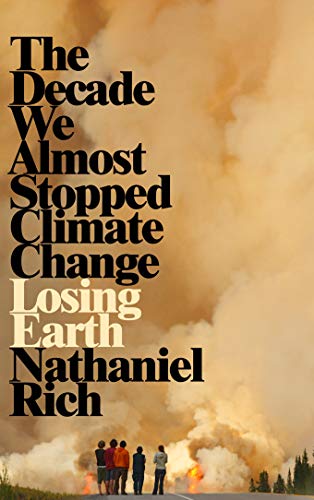
By 1979, we knew all that we know now about the science of climate change – what was happening, why it was happening, and how to stop it. Over the next ten years, we had the very real opportunity to stop it. Obviously, we failed.
Nathaniel Rich’s groundbreaking account of that failure – and how tantalizingly close we came to signing binding treaties that would have saved us all before the fossil fuels industry and politicians committed to anti-scientific denialism – is already a journalistic blockbuster, a full issue of the New York Times Magazine that has earned favorable comparisons to Rachel Carson’s Silent Spring and John Hersey’s Hiroshima. Rich has become an instant, in-demand expert and speaker. A major movie deal is already in place. It is the story, perhaps, that can shift the conversation.
In the book Losing Earth, Rich is able to provide more of the context for what did – and didn’t – happen in the 1980s and, more important, is able to carry the story fully into the present day and wrestle with what those past failures mean for us at the beginning of the twenty-first century. It is not just an agonizing revelation of historical missed opportunities, but a clear-eyed and eloquent assessment of how we got to now, and what we can and must do before it's truly too late.
Les informations fournies dans la section « Synopsis » peuvent faire référence à une autre édition de ce titre.
À propos de l'auteur
Nathaniel Rich is the author of the novels Odds Against Tomorrow and The Mayor’s Tongue. His short fiction has appeared in McSweeney’s, The Virginia Quarterly Review, and VICE, among other publications. He is a writer at large for The New York Times Magazine and a regular contributor to The New York Review of Books and The Atlantic. Rich lives with his wife and son in New Orleans.
Les informations fournies dans la section « A propos du livre » peuvent faire référence à une autre édition de ce titre.
Résultats de recherche pour Losing Earth: The Decade We Could Have Stopped Climate...

Image d'archives
Losing Earth: The Decade We Could Have Stopped Climate Change
Vendeur : WorldofBooks, Goring-By-Sea, WS, Royaume-Uni
Évaluation du vendeur 5 sur 5 étoiles

Paperback. Etat : Very Good. The book has been read, but is in excellent condition. Pages are intact and not marred by notes or highlighting. The spine remains undamaged. N° de réf. du vendeur GOR010128581
Acheter D'occasion
EUR 2,56
Expédition à EUR 6,65
Expédition depuis Royaume-Uni vers Etats-Unis
Expédition depuis Royaume-Uni vers Etats-Unis
Quantité disponible : 2 disponible(s)
Image d'archives
Losing Earth: The Decade We Could Have Stopped Climate Change
Edité par
Picador, 2019
ISBN 10 : 1529015839
ISBN 13 : 9781529015836
Ancien ou d'occasion
Couverture souple
Vendeur : medimops, Berlin, Allemagne
Évaluation du vendeur 5 sur 5 étoiles
Etat : good. Befriedigend/Good: Durchschnittlich erhaltenes Buch bzw. Schutzumschlag mit Gebrauchsspuren, aber vollständigen Seiten. / Describes the average WORN book or dust jacket that has all the pages present. N° de réf. du vendeur M01529015839-G
Acheter D'occasion
EUR 12,48
Expédition à EUR 10
Expédition depuis Allemagne vers Etats-Unis
Expédition depuis Allemagne vers Etats-Unis
Quantité disponible : 1 disponible(s)
Image d'archives
Losing Earth: The Decade We Could Have Stopped Climate Change
Vendeur : Brit Books, Milton Keynes, Royaume-Uni
Évaluation du vendeur 4 sur 5 étoiles

Paperback. Etat : Used; Very Good. ***Simply Brit*** Welcome to our online used book store, where affordability meets great quality. Dive into a world of captivating reads without breaking the bank. We take pride in offering a wide selection of used books, from classics to hidden gems, ensuring there is something for every literary palate. All orders are shipped within 24 hours and our lightning fast-delivery within 48 hours coupled with our prompt customer service ensures a smooth journey from ordering to delivery. Discover the joy of reading with us, your trusted source for affordable books that do not compromise on quality. N° de réf. du vendeur 4464106
Acheter D'occasion
EUR 4,80
Expédition à EUR 18,98
Expédition depuis Royaume-Uni vers Etats-Unis
Expédition depuis Royaume-Uni vers Etats-Unis
Quantité disponible : 1 disponible(s)
Image d'archives
Losing Earth: The Decade We Could Have Stopped Climate Change
Vendeur : Greener Books, London, Royaume-Uni
Évaluation du vendeur 4 sur 5 étoiles
Paperback. Etat : Used; Very Good. **SHIPPED FROM UK** We believe you will be completely satisfied with our quick and reliable service. All orders are dispatched as swiftly as possible! Buy with confidence! Greener Books. N° de réf. du vendeur 4427513
Acheter D'occasion
EUR 4,80
Expédition à EUR 23,74
Expédition depuis Royaume-Uni vers Etats-Unis
Expédition depuis Royaume-Uni vers Etats-Unis
Quantité disponible : 1 disponible(s)
Image fournie par le vendeur
Losing Earth
Vendeur : Book Express (NZ), Shannon, Nouvelle-Zélande
Évaluation du vendeur 3 sur 5 étoiles

Paperback. Etat : Good. 206 pages. mark from sticker on coverAn instant classic: The most urgent story of our times, brilliantly reframed, beautifully toldBy 1979, we knew all that we know now about the science of climate change--what was happening, why it was happening, and how to stop it. Over the next ten years, we had the very real opportunity to stop it. Obviously , we failed.Nathaniel Rich's groundbreaking account of that failure--and how tantalizingly close we came to signing binding treaties that would have save d us all before the fossil fuels industry and the Republican Party full committe d to anti-scientific denialism--is already a journalistic blockbuster, a full is sue of The New York Times Magazine that has earned favorable comparisons to Rach el Carson's Silent Spring and John Hersey's Hiroshima. Rich has become an instan t, in-demand expert and speaker. A major movie deal is already in place. Publish ers around the world are clamoring for the rights. It is the story, perhaps, tha t can shift the conversation.In the book Losing Earth, Rich is able to pr ovide more of the context for what did--and didn't--happen in the 1980s and, mor e important, is able to carry the story fully into the present day and wrestle w ith what those past failures mean for us in 2019. It is not just an agonizing re velation of historical missed opportunities, but a clear-eyed and eloquent asses sment of how we got to now, and what we can and must do before it's truly too la te. N° de réf. du vendeur 3976l
Acheter D'occasion
EUR 5,72
Expédition à EUR 40,13
Expédition depuis Nouvelle-Zélande vers Etats-Unis
Expédition depuis Nouvelle-Zélande vers Etats-Unis
Quantité disponible : 1 disponible(s)
Image fournie par le vendeur
Losing Earth: The Decade We Could Have Stopped Climate Change
Edité par
Pan Macmillan, 2019
ISBN 10 : 1529015839
ISBN 13 : 9781529015836
Ancien ou d'occasion
Paperback
Vendeur : Optimon Books, Gravesend, KENT, Royaume-Uni
Évaluation du vendeur 5 sur 5 étoiles
Paperback. Etat : Good. The very good and appalling Losing Earth by Nathaniel Rich describes how close we came in the 70s to dealing with the causes of global warming and how US big business and Reaganite politicians in the 80s ensured it didn't happen. Read it.' John SimpsonBy 1979, we knew all that we know now about the science of climate change - what was happening, why it was happening, and how to stop it. Over the next ten years, we had the very real opportunity to stop it. Obviously, we failed.Nathaniel Rich's groundbreaking account of that failure - and how tantalizingly close we came to signing binding treaties that would have saved us all before the fossil fuels industry and politicians committed to anti-scientific denialism - is already a journalistic blockbuster, a full issue of the New York Times Magazine that has earned favorable comparisons to Rachel Carson's Silent Spring and John Hersey's Hiroshima. Rich has become an instant, in-demand expert and speaker. A major movie deal is already in place. It is the story, perhaps, that can shift the conversation. In the book Losing Earth, Rich is able to provide more of the context for what did - and didn't - happen in the 1980s and, more important, is able to carry the story fully into the present day and wrestle with what those past failures mean for us at the beginning of the twenty-first century. It is not just an agonizing revelation of historical missed opportunities, but a clear-eyed and eloquent assessment of how we got to now, and what we can and must do before it's truly too late. Copyright © Pan Macmillan. N° de réf. du vendeur 461349
Acheter D'occasion
EUR 30,55
Expédition à EUR 21,36
Expédition depuis Royaume-Uni vers Etats-Unis
Expédition depuis Royaume-Uni vers Etats-Unis
Quantité disponible : 1 disponible(s)