
Articles liés à Staging Growth: Modernization, Development, and the...
Staging Growth: Modernization, Development, and the Global Cold War - Couverture souple
Livre 5 sur 50: Culture and Politics in the Cold War and Beyond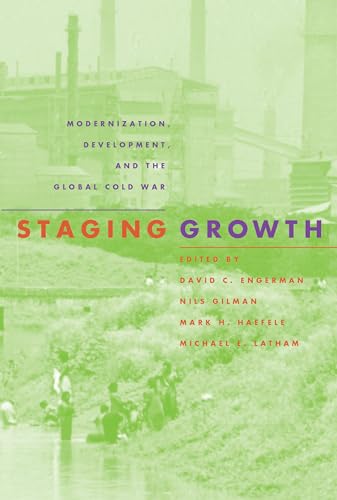
Synopsis
Beginning in the 1950s, the theory of modernization emerged as the dominant paradigm of economic, social, and political development within the American foreign policy establishment. Purporting to explain the stages through which all nations pass on the road to industrial modernity, it provided a rationale for a broad range of cultural and political projects aimed at fostering Third World growth while simultaneously combating communism.
But modernization theory was more than simply an expression of Cold War ideology. As the essays in this volume show, the ideal of modernization proliferated throughout the postcolonial world and across ideological lines in places as diverse as East Asia, Southern Africa, and South Asia. Indeed, it was embraced by all who shared the American enthusiasm for the increased production and higher standards of living promised by industrialization -enemies and allies alike. Situating modernization theory historically, Staging Growth avoids conventional chronologies and categories of analysis, particularly the traditional focus on conflicts between major powers. The contributors employ a variety of approaches-from economic and intellectual history to cultural criticism and biography-to shed fresh light on the global forces that shaped the Cold War and its legacies. Most of the pieces are comparative, exploring how different countries and cultures have grappled with the implications of modern development. At the same time, all of the essays address similar fundamental questions. Is modernization the same thing as Westernization? Is the idea of modernization universally valid? Do countries follow similar trajectories as they undertake development? Does modernization bring about globalization? In addition to the editors and Akira Iriye, contributors include Michael Adas, Laura Belmonte, Gregg Andrew Brazinsky, Christina Klein, J. Victor Koschmann, and Michael R. Mahoney.Les informations fournies dans la section « Synopsis » peuvent faire référence à une autre édition de ce titre.
À propos de l'auteur
David C. Engerman is assistant professor of history at Brandeis University. Nils Gilman is a postgraduate fellow at the University of California, Berkeley. Mark H. Haefele is a lecturer at Harvard University. Michael E. Latham is associate professor of history at Fordham University.
Les informations fournies dans la section « A propos du livre » peuvent faire référence à une autre édition de ce titre.
Résultats de recherche pour Staging Growth: Modernization, Development, and the...

Image d'archives
Staging Growth
Edité par
University of Massachusetts Press, 2003
ISBN 10 : 1558493700
ISBN 13 : 9781558493704
Ancien ou d'occasion
Paperback
Vendeur : ThriftBooks-Dallas, Dallas, TX, Etats-Unis
Évaluation du vendeur 5 sur 5 étoiles

Paperback. Etat : Good. No Jacket. Pages can have notes/highlighting. Spine may show signs of wear. ~ ThriftBooks: Read More, Spend Less. N° de réf. du vendeur G1558493700I3N00
Acheter D'occasion
EUR 7,31
Livraison gratuite
Expédition nationale : Etats-Unis
Expédition nationale : Etats-Unis
Quantité disponible : 1 disponible(s)
Image d'archives
Staging Growth : Modernization, Development, and the Global Cold War
Edité par
University of Massachusetts Press, 2003
ISBN 10 : 1558493700
ISBN 13 : 9781558493704
Ancien ou d'occasion
Couverture souple
Vendeur : Better World Books, Mishawaka, IN, Etats-Unis
Évaluation du vendeur 5 sur 5 étoiles
Etat : Good. Pages intact with minimal writing/highlighting. The binding may be loose and creased. Dust jackets/supplements are not included. Stock photo provided. Product includes identifying sticker. Better World Books: Buy Books. Do Good. N° de réf. du vendeur 9961076-6
Acheter D'occasion
EUR 10,08
Livraison gratuite
Expédition nationale : Etats-Unis
Expédition nationale : Etats-Unis
Quantité disponible : 1 disponible(s)
Image d'archives
Staging Growth: Modernization, Development, and the Global Cold War (Culture, Politics, and the Cold War)
Edité par
University of Massachusetts Press, 2003
ISBN 10 : 1558493700
ISBN 13 : 9781558493704
Ancien ou d'occasion
Paperback
Vendeur : Textbooks_Source, Columbia, MO, Etats-Unis
Évaluation du vendeur 5 sur 5 étoiles
Paperback. Etat : Good. Ships in a BOX from Central Missouri! May not include working access code. Will not include dust jacket. Has used sticker(s) and some writing or highlighting. UPS shipping for most packages, (Priority Mail for AK/HI/APO/PO Boxes). N° de réf. du vendeur 000633314U
Acheter D'occasion
EUR 15,52
Expédition à EUR 3,55
Expédition nationale : Etats-Unis
Expédition nationale : Etats-Unis
Quantité disponible : 8 disponible(s)
Image d'archives
Staging Growth: Modernization, Development, and the Global Cold War (Culture, Politics, and the Cold War)
Edité par
University of Massachusetts Pres, 2003
ISBN 10 : 1558493700
ISBN 13 : 9781558493704
Ancien ou d'occasion
paperback
Vendeur : HPB Inc., Dallas, TX, Etats-Unis
Évaluation du vendeur 5 sur 5 étoiles
paperback. Etat : Very Good. Connecting readers with great books since 1972! Used books may not include companion materials, and may have some shelf wear or limited writing. We ship orders daily and Customer Service is our top priority! N° de réf. du vendeur S_484356760
Acheter D'occasion
EUR 16,03
Expédition à EUR 3,34
Expédition nationale : Etats-Unis
Expédition nationale : Etats-Unis
Quantité disponible : 1 disponible(s)
Image d'archives
Staging Growth: Modernization, Development, and the Global Cold War (Culture, Politics, and the Cold War)
Edité par
University of Massachusetts Pres, 2003
ISBN 10 : 1558493700
ISBN 13 : 9781558493704
Ancien ou d'occasion
paperback
Vendeur : HPB-Ruby, Dallas, TX, Etats-Unis
Évaluation du vendeur 5 sur 5 étoiles
paperback. Etat : Very Good. Connecting readers with great books since 1972! Used books may not include companion materials, and may have some shelf wear or limited writing. We ship orders daily and Customer Service is our top priority! N° de réf. du vendeur S_486826366
Acheter D'occasion
EUR 16,03
Expédition à EUR 3,34
Expédition nationale : Etats-Unis
Expédition nationale : Etats-Unis
Quantité disponible : 1 disponible(s)
Image fournie par le vendeur
Staging Growth : Modernization, Development, and the Global Cold War
Edité par
University of Massachusetts Press, 2003
ISBN 10 : 1558493700
ISBN 13 : 9781558493704
Ancien ou d'occasion
Couverture souple
Vendeur : GreatBookPrices, Columbia, MD, Etats-Unis
Évaluation du vendeur 5 sur 5 étoiles
Etat : good. May show signs of wear, highlighting, writing, and previous use. This item may be a former library book with typical markings. No guarantee on products that contain supplements Your satisfaction is 100% guaranteed. Twenty-five year bookseller with shipments to over fifty million happy customers. N° de réf. du vendeur 800310-5
Acheter D'occasion
EUR 24,92
Expédition à EUR 2,35
Expédition nationale : Etats-Unis
Expédition nationale : Etats-Unis
Quantité disponible : 5 disponible(s)
Image fournie par le vendeur
Staging Growth: Modernization, Development and the Global Cold War (Culture, Politics & the Cold War)
Edité par
University Massachusetts Press, 2003
ISBN 10 : 1558493700
ISBN 13 : 9781558493704
Ancien ou d'occasion
paperback
Vendeur : WeBuyBooks, Rossendale, LANCS, Royaume-Uni
Évaluation du vendeur 5 sur 5 étoiles
paperback. Etat : Like New. Most items will be dispatched the same or the next working day. An apparently unread copy in perfect condition. Dust cover is intact with no nicks or tears. Spine has no signs of creasing. Pages are clean and not marred by notes or folds of any kind. N° de réf. du vendeur rev2524644301
Acheter D'occasion
EUR 19,57
Expédition à EUR 7,99
Expédition depuis Royaume-Uni vers Etats-Unis
Expédition depuis Royaume-Uni vers Etats-Unis
Quantité disponible : 1 disponible(s)
Image fournie par le vendeur
Staging Growth : Modernization, Development, and the Global Cold War
Edité par
University of Massachusetts Press, 2003
ISBN 10 : 1558493700
ISBN 13 : 9781558493704
Neuf
Couverture souple
Vendeur : GreatBookPrices, Columbia, MD, Etats-Unis
Évaluation du vendeur 5 sur 5 étoiles
Etat : New. N° de réf. du vendeur 800310-n
Acheter neuf
EUR 35,34
Expédition à EUR 2,35
Expédition nationale : Etats-Unis
Expédition nationale : Etats-Unis
Quantité disponible : 5 disponible(s)
Image fournie par le vendeur
Staging Growth
Edité par
University of Massachusetts Press, US, 2003
ISBN 10 : 1558493700
ISBN 13 : 9781558493704
Neuf
Paperback
Vendeur : Rarewaves.com USA, London, LONDO, Royaume-Uni
Évaluation du vendeur 5 sur 5 étoiles
Paperback. Etat : New. A timely reassessment of modernization theory and its international impact; Beginning in the 1950s, the theory of modernization emerged as the dominant paradigm of economic, social, and political develoment within the American foreign policy establishment. Purporting to explain the stages through which all nations pass on the road to industrial modernity, it provided a rationale for a broad range of cultural and political projects aimed at fostering Third World growth while simultaneously combating communism. But modernization theory was more than simply an expression of Cold War ideology. As the essays in this volume show, the ideal of modernization proliferated throughout the postcolonial world and across ideological lines in places as diverse as East Asia, Southern Africa, and South Asia. Indeed, it was embraced by all who shared the American enthusiasm for the increased production and higher standards of living promised by industrialization - enemies and allies alike. Situating modernization theory historically, Staging Growth avoids conventional chronologies and categories of analysis, particularly the traditional focus on conflicts between major powers. The contributors employ a variety of approaches - from economic and intellectual history to cultural criticism and biography - to shed fresh light on the global forces that shaped the Cold War and its legacies. Most of the pieces are comparative, exploring how different countries and cultures have grappled with the implications of modern development. At the same time, all of the essays address similar fundamental questions. Is modernization the same thing as Westernization? Is the idea of modernization universally valid? Do countries follow similar trajectories as they undertake development? Does modernization bring about globalization? In addition to the editors and Akira Iriye, contributors include Michael Adas, Laura Belmonte, Gregg Andrew Brazinsky, Christina Klein, J. Victor Koschmann, and Michael R. Mahoney. N° de réf. du vendeur LU-9781558493704
Acheter neuf
EUR 37,77
Livraison gratuite
Expédition depuis Royaume-Uni vers Etats-Unis
Expédition depuis Royaume-Uni vers Etats-Unis
Quantité disponible : 3 disponible(s)
Image d'archives
Staging Growth: Modernization, Development, and the Global Cold War Format: Paperback
Edité par
University of Chicago press, 2003
ISBN 10 : 1558493700
ISBN 13 : 9781558493704
Neuf
Couverture souple
Vendeur : INDOO, Avenel, NJ, Etats-Unis
Évaluation du vendeur 5 sur 5 étoiles
Etat : New. Brand New. N° de réf. du vendeur 9781558493704
Acheter neuf
EUR 37,98
Livraison gratuite
Expédition nationale : Etats-Unis
Expédition nationale : Etats-Unis
Quantité disponible : Plus de 20 disponibles