
Articles liés à Main Street
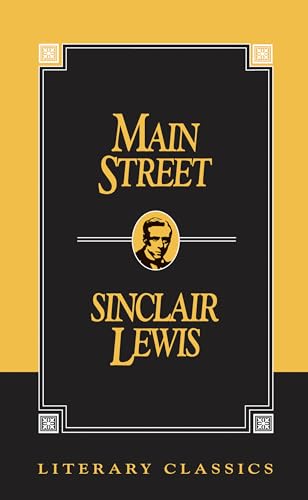
Synopsis
The first of his major novels of the 1920s, Sinclair Lewis's Main Street satirizes the manners of the American Midwest. Here is the story of Carol Kennicott, who, to be accepted, must adapt to the ways of Gopher Prairie, Minnesota. This ground-breaking novel attacks conformism, commercialism, moneygrubbing, and the decline in what Lewis saw as the American ideals of freedom and respect for individuality.
Les informations fournies dans la section « Synopsis » peuvent faire référence à une autre édition de ce titre.
À propos de l'auteur
HARRY SINCLAIR LEWIS was born, the son of a physician, in Sauk Centre, Minnesota, on February 7, 1885. Unattractive and unpopular as a youth, Lewis, at the age of seventeen, escaped his small town to enroll at Oberlin Academy in Ohio, in preparation for entrance to Yale University. It was at Yale that Lewis realized his ambition to be a writer. Dropping his first name, he began to contribute poetry and stories to the campus magazines. Lewis left Yale in his senior year to try his hand at freelance writing and to live and work at Helicon Hall, Upton Sinclair's experiment in community living in New Jersey. Following his failure at these ventures, Lewis returned to Yale, taking his degree in 1908.
For the next two years Lewis worked as a journalist, and from 1910 to 1915, as an editor at various New York publishing houses. Following the publication of his first serious novel, Our Mr. Wrenn (1914), Lewis married Grace Livingstone Hegger, who worked at Vogue magazine. With the gradual success of his short stories, which began appearing in the Saturday Evening Post and other periodicals, Lewis could give up work as an editor and devote his full time to writing.
Main Street, Lewis's sixth novel and his first major success, was published in 1920. The first of Lewis's great novels of the 1920s, it drew on his experience in Sauk Centre. Set in Gopher Prairie, Minnesota, it satirized the conformity and narrow-mindedness of Middle America. Lewis would broaden his attacks on American provincialism, commercialism, racial bigotry, religious fundamentalism, and fascism with his novels Babbitt (1922), Arrowsmith (1925), Elmer Gantry (1927), Dodsworth (1929), and later, It Can't Happen Here (1935) and Kingsblood Royal (1947).
Despite the success of his novels (he won the Nobel Prize for literature in 1930) and the great wealth they earned, enabling him to live in both the United States and Europe, Lewis's personal life was dogged by unhappiness. After divorcing Grace Hegger in 1928, he married the newspaperwoman Dorothy Thompson, but that marriage soon fell apart. His son by his first wife was killed in World War II. Lewis's last years were plagued by alcoholism and loneliness. He died, alone, in Rome on January 10, 1951.
Les informations fournies dans la section « A propos du livre » peuvent faire référence à une autre édition de ce titre.
Résultats de recherche pour Main Street

Image d'archives
Main Street (Literary Classics)
Edité par
Prometheus, 1996
ISBN 10 : 1573920487
ISBN 13 : 9781573920483
Ancien ou d'occasion
paperback
Vendeur : Bookmonger.Ltd, HILLSIDE, NJ, Etats-Unis
Évaluation du vendeur 5 sur 5 étoiles

paperback. Etat : Good. Crease on cover and a few pages*. N° de réf. du vendeur mon0000689470
Acheter D'occasion
EUR 3,45
Expédition à EUR 3,45
Expédition nationale : Etats-Unis
Expédition nationale : Etats-Unis
Quantité disponible : 1 disponible(s)
Image d'archives
Main Street
Edité par
Prometheus Books, Publishers, 1996
ISBN 10 : 1573920487
ISBN 13 : 9781573920483
Ancien ou d'occasion
Couverture souple
Vendeur : Better World Books, Mishawaka, IN, Etats-Unis
Évaluation du vendeur 5 sur 5 étoiles
Etat : Good. New Ed. Pages intact with minimal writing/highlighting. The binding may be loose and creased. Dust jackets/supplements are not included. Stock photo provided. Product includes identifying sticker. Better World Books: Buy Books. Do Good. N° de réf. du vendeur 3753288-6
Acheter D'occasion
EUR 7,01
Livraison gratuite
Expédition nationale : Etats-Unis
Expédition nationale : Etats-Unis
Quantité disponible : 1 disponible(s)
Image d'archives
Main Street: Easyread Super Large 20pt Edition
Edité par
Prometheus Books, Amherst, New York, U.S.A., 1996
ISBN 10 : 1573920487
ISBN 13 : 9781573920483
Ancien ou d'occasion
Soft cover
Vendeur : Mountain Books, Kent, CT, Etats-Unis
Évaluation du vendeur 4 sur 5 étoiles

Soft cover. Etat : Good. A good reading copy. Some signs of use. We ship fast. N° de réf. du vendeur 009276
Acheter D'occasion
EUR 4,44
Expédition à EUR 4,64
Expédition nationale : Etats-Unis
Expédition nationale : Etats-Unis
Quantité disponible : 1 disponible(s)
Image d'archives
Main Street (Literary Classics)
Edité par
Prometheus, 1996
ISBN 10 : 1573920487
ISBN 13 : 9781573920483
Ancien ou d'occasion
paperback
Vendeur : HR1 Books, Hereford, Royaume-Uni
Évaluation du vendeur 5 sur 5 étoiles
paperback. Etat : Very Good. Same / next day dispatch (Monday - Friday), N° de réf. du vendeur mon0000133684
Acheter D'occasion
EUR 11,61
Expédition à EUR 18,04
Expédition depuis Royaume-Uni vers Etats-Unis
Expédition depuis Royaume-Uni vers Etats-Unis
Quantité disponible : 1 disponible(s)
Image d'archives
Main Street (Literary Classics)
Vendeur : SHIMEDIA, Brooklyn, NY, Etats-Unis
Évaluation du vendeur 4 sur 5 étoiles
Etat : New. Satisfaction Guaranteed or your money back. N° de réf. du vendeur 1573920487
Acheter neuf
EUR 88,90
Livraison gratuite
Expédition nationale : Etats-Unis
Expédition nationale : Etats-Unis
Quantité disponible : 1 disponible(s)