
Articles liés à Drift Station: Arctic Outposts of Superpower Science
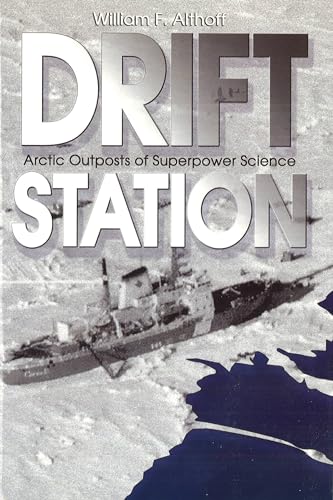
Synopsis
Closed to conventional passage, the Arctic Ocean and peripheral seas have nevertheless known European explorers since the sixteenth century. Systematic observation, however, dates only from the last years of the nineteenth century, with the epic drift of Fridtjof Nansen's ice ship Fram (1893-1896), the first scientific expedition of the modern era. Twentieth-century technology--the icebreaker, radio transmission, nuclear power, and aircraft--opened the Arctic for survey, basic research, and observation. World War II saw the inhospitable circumpolar Arctic transformed into a theater of military operations.
The Cold War and the missile age saw governments staking further claims, because only a relatively short arc of maritime boreal waste separated North America and Eurasia. The complex interactions of air, ice, and water that drive circumpolar systems also serve as engines of oceanic and atmospheric circulation. As a result, meteorology, oceanography, geophysics, and many other areas of scientific research in the region soon became acutely linked to the economic, political, and particularly the politico-military interests of the Soviet Union, the United States, Canada, and the other Arctic nations. In response, both superpowers established "drift stations"--that is, isolated camps based on nomadic ice floes--to conduct crucial scientific research. During the Cold War, they were the objects of suspicion, particularly the Soviet stations, which often stood accused as bases for espionage. Today, with the world's climate system and global warming under study, Russian expertise, data, geography, and stewardship are crucial to the world community.Les informations fournies dans la section « Synopsis » peuvent faire référence à une autre édition de ce titre.
À propos de l'auteur
William F. Althoff, an environmental geologist by profession, has published extensively in technical and in history-related journals. During 1999-2000, he was Ramsey Fellow in Naval Aviation History at the National Air and Space Museum, Smithsonian Institution. The author several books on airships, including Forgotten Weapon: U.S. Navy Airships and the U-Boat War
Les informations fournies dans la section « A propos du livre » peuvent faire référence à une autre édition de ce titre.
Résultats de recherche pour Drift Station: Arctic Outposts of Superpower Science

Image d'archives
Drift Station: Arctic Outposts of Superpower Science
Edité par
Potomac Books, 2007
ISBN 10 : 1574887718
ISBN 13 : 9781574887716
Ancien ou d'occasion
Couverture rigide
Vendeur : ThriftBooks-Dallas, Dallas, TX, Etats-Unis
Évaluation du vendeur 5 sur 5 étoiles

Hardcover. Etat : Very Good. No Jacket. May have limited writing in cover pages. Pages are unmarked. ~ ThriftBooks: Read More, Spend Less. N° de réf. du vendeur G1574887718I4N00
Acheter D'occasion
EUR 5,72
Livraison gratuite
Expédition nationale : Etats-Unis
Expédition nationale : Etats-Unis
Quantité disponible : 1 disponible(s)
Image d'archives
Drift Station: Arctic Outposts of Superpower Science
Edité par
Potomac Books, 2007
ISBN 10 : 1574887718
ISBN 13 : 9781574887716
Ancien ou d'occasion
Couverture rigide
Vendeur : ThriftBooks-Atlanta, AUSTELL, GA, Etats-Unis
Évaluation du vendeur 5 sur 5 étoiles
Hardcover. Etat : Very Good. No Jacket. May have limited writing in cover pages. Pages are unmarked. ~ ThriftBooks: Read More, Spend Less. N° de réf. du vendeur G1574887718I4N00
Acheter D'occasion
EUR 5,72
Livraison gratuite
Expédition nationale : Etats-Unis
Expédition nationale : Etats-Unis
Quantité disponible : 1 disponible(s)
Image d'archives
Drift Station: Arctic Outposts
Edité par
Potomac Books, 2007
ISBN 10 : 1574887718
ISBN 13 : 9781574887716
Ancien ou d'occasion
Couverture rigide
Vendeur : World of Books (was SecondSale), Montgomery, IL, Etats-Unis
Évaluation du vendeur 5 sur 5 étoiles
Etat : Good. Item in good condition. Textbooks may not include supplemental items i.e. CDs, access codes etc. N° de réf. du vendeur 00104572991
Acheter D'occasion
EUR 5,74
Livraison gratuite
Expédition nationale : Etats-Unis
Expédition nationale : Etats-Unis
Quantité disponible : 1 disponible(s)
Image d'archives
Drift Station : Arctic Outposts of Superpower Science
Edité par
Potomac Books, Incorporated, 2007
ISBN 10 : 1574887718
ISBN 13 : 9781574887716
Ancien ou d'occasion
Couverture rigide
Vendeur : Better World Books: West, Reno, NV, Etats-Unis
Évaluation du vendeur 5 sur 5 étoiles
Etat : Fine. Used book that is in almost brand-new condition. May contain a remainder mark. Better World Books: Buy Books. Do Good. N° de réf. du vendeur 17953826-6
Acheter D'occasion
EUR 7,09
Livraison gratuite
Expédition nationale : Etats-Unis
Expédition nationale : Etats-Unis
Quantité disponible : 1 disponible(s)
Image fournie par le vendeur
Drift Station: Arctic Outposts of Superpower Science
Edité par
Potomac Books, 2007
ISBN 10 : 1574887718
ISBN 13 : 9781574887716
Ancien ou d'occasion
Couverture rigide
Vendeur : Blue Vase Books, Interlochen, MI, Etats-Unis
Évaluation du vendeur 5 sur 5 étoiles
Etat : very_good. Book has little sign of wear or use. N° de réf. du vendeur BVV.1574887718.VG
Acheter D'occasion
EUR 8,10
Livraison gratuite
Expédition nationale : Etats-Unis
Expédition nationale : Etats-Unis
Quantité disponible : 1 disponible(s)
Image d'archives
Drift Station: Arctic Outposts of Superpower Science
Edité par
Washington: Potomac Books, 2007
ISBN 10 : 1574887718
ISBN 13 : 9781574887716
Ancien ou d'occasion
Couverture rigide
Vendeur : Aldersgate Books Inc., Niagara Falls, NY, Etats-Unis
Évaluation du vendeur 4 sur 5 étoiles

Etat : FINE. 2007. White hardcover with gilt lettering. Dust jacket now in clear plastic BRODART protector. Original price to endflap. Blue endpapers. 357pp. Index. FINE. N° de réf. du vendeur 2641389
Acheter D'occasion
EUR 8,82
Expédition à EUR 7,67
Expédition nationale : Etats-Unis
Expédition nationale : Etats-Unis
Quantité disponible : 1 disponible(s)
Image d'archives
Drift Station: Arctic Outposts of Superpower Science
Edité par
Potomac Books, 2007
ISBN 10 : 1574887718
ISBN 13 : 9781574887716
Ancien ou d'occasion
Couverture rigide
Vendeur : HPB-Ruby, Dallas, TX, Etats-Unis
Évaluation du vendeur 5 sur 5 étoiles
hardcover. Etat : Very Good. Connecting readers with great books since 1972! Used books may not include companion materials, and may have some shelf wear or limited writing. We ship orders daily and Customer Service is our top priority! N° de réf. du vendeur S_474390950
Acheter D'occasion
EUR 14,11
Expédition à EUR 3,21
Expédition nationale : Etats-Unis
Expédition nationale : Etats-Unis
Quantité disponible : 1 disponible(s)
Image d'archives
Drift Station: Arctic Outposts of Superpower Science
Edité par
Potomac Books, Washington, D.C., 2006
ISBN 10 : 1574887718
ISBN 13 : 9781574887716
Ancien ou d'occasion
Couverture rigide
Vendeur : Hourglass Books, Vancouver, BC, Canada
Évaluation du vendeur 5 sur 5 étoiles
Hardcover. Etat : Very Good+. Etat de la jaquette : Very Good+, Not Price Clipped. American First. Complete number line from 1 to 10; minor wear; otherwise a solid, clean copy with no marking or underlining; collectible condition; illustrated with black and white photographs and maps. Book. N° de réf. du vendeur 013380
Acheter D'occasion
EUR 17,65
Livraison gratuite
Expédition depuis Canada vers Etats-Unis
Expédition depuis Canada vers Etats-Unis
Quantité disponible : 1 disponible(s)
Image d'archives
Drift Station: Arctic Outposts of Superpower Science
Vendeur : Lakeside Books, Benton Harbor, MI, Etats-Unis
Évaluation du vendeur 5 sur 5 étoiles
Etat : New. Brand New! Not Overstocks or Low Quality Book Club Editions! Direct From the Publisher! We're not a giant, faceless warehouse organization! We're a small town bookstore that loves books and loves it's customers! Buy from Lakeside Books! N° de réf. du vendeur OTF-Y-9781574887716
Acheter neuf
EUR 24,05
Expédition à EUR 3,42
Expédition nationale : Etats-Unis
Expédition nationale : Etats-Unis
Quantité disponible : 1 disponible(s)
Image fournie par le vendeur
Drift Station; Arctic Outposts of Superpower Science
Edité par
Potomac Books Inc., Dulles, VA, 2007
ISBN 10 : 1574887718
ISBN 13 : 9781574887716
Ancien ou d'occasion
Couverture rigide
Edition originale
Vendeur : Ainsworth Books ( IOBA), Chilliwack, BC, Canada
Évaluation du vendeur 5 sur 5 étoiles
Hardcover. Etat : Very Good. Etat de la jaquette : Very Good+. 1st. DJ shows light edge wear. Light soil to pages at foredge bottom.; A bright, solid book, dustjacket in Mylar, unclipped.; B&W Photographs; 9 X 6.20 X 1.40 inches; 355 pages; "Closed to conventional passage, the Arctic Ocean and peripheral seas have nevertheless known European explorers since the sixteenth century. Systematic observation, however, dates only from the last years of the nineteenth century, with the epic drift of Fridtjof Nansenâs ice ship Fram (1893-1896), the first scientific expedition of the modern era. Twentieth-century technologyâ"the icebreaker, radio transmission, nuclear power, and aircraftâ"opened the Arctic for survey, basic research, and observation. World War II saw the inhospitable circumpolar Arctic transformed into a theater of military operations.The Cold War and the missile age saw governments staking further claims, because only a relatively short arc of maritime boreal waste separated North America and Eurasia. The complex interactions of air, ice, and water that drive circumpolar systems also serve as engines of oceanic and atmospheric circulation. As a result, meteorology, oceanography, geophysics, and many other areas of scientific research in the region soon became acutely linked to the economic, political, and particularly the politico-military interests of the Soviet Union, the United States, Canada, and the other Arctic nations.In response, both superpowers established âdrift stationsââ"that is, isolated camps based on nomadic ice floesâ"to conduct crucial scientific research. During the Cold War, they were the objects of suspicion, particularly the Soviet stations, which often stood accused as bases for espionage. Today, with the worldâs climate system and global warming under study, Russian expertise, data, geography, and stewardship are crucial to the world community.". N° de réf. du vendeur 17103
Acheter D'occasion
EUR 15,44
Expédition à EUR 13,71
Expédition depuis Canada vers Etats-Unis
Expédition depuis Canada vers Etats-Unis
Quantité disponible : 1 disponible(s)