
Articles liés à The Language of Angels: A Story About the Reinvention...
Synopsis
2018 Sydney Taylor Book Award
2017 National Jewish Book Award
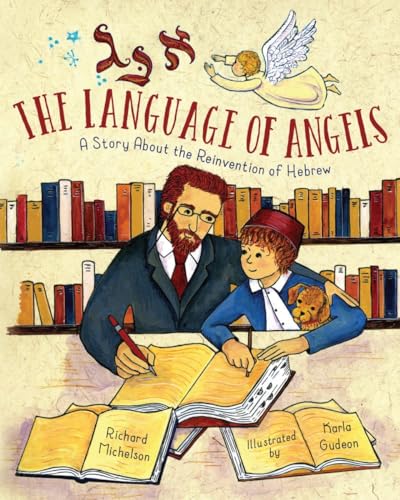
In 1885, few Jews in Israel used the holy language of their ancestors, and Hebrew was in danger of being lost—until Ben Zion and his father got involved. Through the help of his father and a community of children, Ben modernized the ancient language, creating a lexicon of new, modern words to bring Hebrew back into common usage. Historically influenced dialogue, engaging characters, and colorful art offer a linguistic journey about how language develops and how one person's perseverance can make a real difference.
Influenced by illuminated manuscripts, Karla Gudeon’s illustrations bring Ben Zion—and the rebirth of Hebrew—to life.
A compelling emotional journey — Publisher's Weekly
A lively introduction to the work of a Hebrew language scholar and lover—and his family — Kirkus Reviews
A perfect resource for religious school collections and public library language shelves — Booklist
Hebrew teachers and students in Jewish schools will welcome this gorgeous new picture book about how the language developed and the impact of one person's perseverance on an entire people — School Library Journal
Les informations fournies dans la section « Synopsis » peuvent faire référence à une autre édition de ce titre.
À propos de l'auteur
Richard Michelson's children's books have been listed among the 10 Best Books of the Year by The New York Times, Publishers Weekly, and the New Yorker. His many books include Too Young for Yiddish and Busing Brewster. He lives in Northampton, Massachusetts.
Karla Gudeon is a former teacher whose art is influenced by illuminated manuscripts and folk art. She is the illustrator of One Red Apple, Hanukkah Haiku, and Grandma's Wedding Album.
Extrait. © Reproduit sur autorisation. Tous droits réservés.
Once there was a child without a friend.
Two boys his age lived nearby, but they spoke Yiddish. In the morning they said “guten tog” to each other. Two girls down the road spoke Arabic. They said hello when they met. “Marhaba!”
Some children spoke Spanish. They said “hola” to their neighbors. Others spoke Ladino. They wished each other “buenas tardes” in the afternoon.
But Ben-Zion didn’t speak Yiddish or Arabic, Spanish or Ladino. He didn’t speak Turkish or Russian or English or any of the many languages spoken in Jerusalem in 1885. So he spent most of his time alone.
Les informations fournies dans la section « A propos du livre » peuvent faire référence à une autre édition de ce titre.
Résultats de recherche pour The Language of Angels: A Story About the Reinvention...

Image d'archives
The Language of Angels: A Story About the Reinvention of Hebrew
Edité par
Charlesbridge, 2017
ISBN 10 : 1580896367
ISBN 13 : 9781580896368
Ancien ou d'occasion
Couverture rigide
Vendeur : Half Price Books Inc., Dallas, TX, Etats-Unis
Évaluation du vendeur 5 sur 5 étoiles

hardcover. Etat : Very Good. Gudeon, Karla (illustrateur). Connecting readers with great books since 1972! Used books may not include companion materials, and may have some shelf wear or limited writing. We ship orders daily and Customer Service is our top priority! N° de réf. du vendeur S_481501118
Acheter D'occasion
EUR 2,72
Expédition à EUR 3,31
Expédition nationale : Etats-Unis
Expédition nationale : Etats-Unis
Quantité disponible : 1 disponible(s)
Image d'archives
The Language of Angels: A Story About the Reinvention of Hebrew
Edité par
Charlesbridge, 2017
ISBN 10 : 1580896367
ISBN 13 : 9781580896368
Ancien ou d'occasion
Couverture rigide
Vendeur : Gulf Coast Books, Cypress, TX, Etats-Unis
Évaluation du vendeur 5 sur 5 étoiles
hardcover. Etat : Fair. Gudeon, Karla (illustrateur). N° de réf. du vendeur 1580896367-4-37106989
Acheter D'occasion
EUR 6,12
Livraison gratuite
Expédition nationale : Etats-Unis
Expédition nationale : Etats-Unis
Quantité disponible : 1 disponible(s)
Image d'archives
The Language of Angels: A Story About the Reinvention of Hebrew
Edité par
Charlesbridge, 2017
ISBN 10 : 1580896367
ISBN 13 : 9781580896368
Ancien ou d'occasion
Couverture rigide
Vendeur : Orion Tech, Kingwood, TX, Etats-Unis
Évaluation du vendeur 5 sur 5 étoiles
Hardcover. Etat : Good. Gudeon, Karla (illustrateur). N° de réf. du vendeur 1580896367-3-24864569
Acheter D'occasion
EUR 6,12
Livraison gratuite
Expédition nationale : Etats-Unis
Expédition nationale : Etats-Unis
Quantité disponible : 1 disponible(s)
Image d'archives
The Language of Angels: A Story About the Reinvention of Hebrew
Edité par
Charlesbridge, 2017
ISBN 10 : 1580896367
ISBN 13 : 9781580896368
Ancien ou d'occasion
Couverture rigide
Vendeur : HPB-Diamond, Dallas, TX, Etats-Unis
Évaluation du vendeur 5 sur 5 étoiles
hardcover. Etat : Very Good. Gudeon, Karla (illustrateur). Connecting readers with great books since 1972! Used books may not include companion materials, and may have some shelf wear or limited writing. We ship orders daily and Customer Service is our top priority! N° de réf. du vendeur S_438190694
Acheter D'occasion
EUR 3,19
Expédition à EUR 3,31
Expédition nationale : Etats-Unis
Expédition nationale : Etats-Unis
Quantité disponible : 1 disponible(s)
Image d'archives
The Language of Angels: A Story About the Reinvention of Hebrew
Edité par
Charlesbridge, 2017
ISBN 10 : 1580896367
ISBN 13 : 9781580896368
Ancien ou d'occasion
Couverture rigide
Vendeur : HPB-Emerald, Dallas, TX, Etats-Unis
Évaluation du vendeur 5 sur 5 étoiles
hardcover. Etat : Very Good. Gudeon, Karla (illustrateur). Connecting readers with great books since 1972! Used books may not include companion materials, and may have some shelf wear or limited writing. We ship orders daily and Customer Service is our top priority! N° de réf. du vendeur S_470049304
Acheter D'occasion
EUR 3,19
Expédition à EUR 3,31
Expédition nationale : Etats-Unis
Expédition nationale : Etats-Unis
Quantité disponible : 1 disponible(s)
Image d'archives
The Language of Angels: A Story About the Reinvention of Hebrew
Edité par
Charlesbridge, 2017
ISBN 10 : 1580896367
ISBN 13 : 9781580896368
Ancien ou d'occasion
Couverture rigide
Vendeur : HPB-Ruby, Dallas, TX, Etats-Unis
Évaluation du vendeur 5 sur 5 étoiles
Hardcover. Etat : Very Good. Gudeon, Karla (illustrateur). Connecting readers with great books since 1972! Used books may not include companion materials, and may have some shelf wear or limited writing. We ship orders daily and Customer Service is our top priority! N° de réf. du vendeur S_464011155
Acheter D'occasion
EUR 3,19
Expédition à EUR 3,31
Expédition nationale : Etats-Unis
Expédition nationale : Etats-Unis
Quantité disponible : 1 disponible(s)
Image d'archives
The Language of Angels: A Story About the Reinvention of Hebrew
Edité par
Charlesbridge Publishing, 2017
ISBN 10 : 1580896367
ISBN 13 : 9781580896368
Neuf
Couverture rigide
Vendeur : BookOutlet, Jefferson City, TN, Etats-Unis
Évaluation du vendeur 5 sur 5 étoiles
Hardcover. Etat : New. Gudeon, Karla (illustrateur). Hardcover. Publisher overstock, may contain remainder mark on edge. N° de réf. du vendeur 9781580896368B
Acheter neuf
EUR 3,63
Expédition à EUR 2,87
Expédition nationale : Etats-Unis
Expédition nationale : Etats-Unis
Quantité disponible : Plus de 20 disponibles
Image fournie par le vendeur
The Language of Angels: A Story About the Reinvention of Hebrew
Edité par
Charlesbridge, 2017
ISBN 10 : 1580896367
ISBN 13 : 9781580896368
Ancien ou d'occasion
Couverture rigide
Vendeur : Blue Vase Books, Interlochen, MI, Etats-Unis
Évaluation du vendeur 5 sur 5 étoiles
Etat : good. Gudeon, Karla (illustrateur). The item shows wear from consistent use, but it remains in good condition and works perfectly. All pages and cover are intact including the dust cover, if applicable . Spine may show signs of wear. Pages may include limited notes and highlighting. May NOT include discs, access code or other supplemental materials. N° de réf. du vendeur BVV.1580896367.G
Acheter D'occasion
EUR 6,82
Livraison gratuite
Expédition nationale : Etats-Unis
Expédition nationale : Etats-Unis
Quantité disponible : 1 disponible(s)
Image d'archives
The Language of Angels: The Reinvention of Hebrew
Edité par
Charlesbridge Publishing, 2017
ISBN 10 : 1580896367
ISBN 13 : 9781580896368
Ancien ou d'occasion
Couverture rigide
Vendeur : ThriftBooks-Dallas, Dallas, TX, Etats-Unis
Évaluation du vendeur 5 sur 5 étoiles
Hardcover. Etat : Very Good. No Jacket. Gudeon, Karla (illustrateur). May have limited writing in cover pages. Pages are unmarked. ~ ThriftBooks: Read More, Spend Less. N° de réf. du vendeur G1580896367I4N00
Acheter D'occasion
EUR 6,83
Livraison gratuite
Expédition nationale : Etats-Unis
Expédition nationale : Etats-Unis
Quantité disponible : 1 disponible(s)
Image d'archives
The Language of Angels: A Story About the Reinvention of Hebrew
Edité par
Charlesbridge, 2017
ISBN 10 : 1580896367
ISBN 13 : 9781580896368
Ancien ou d'occasion
Couverture rigide
Vendeur : Wonder Book, Frederick, MD, Etats-Unis
Évaluation du vendeur 5 sur 5 étoiles
Etat : Good. Gudeon, Karla (illustrateur). Good condition. A copy that has been read but remains intact. May contain markings such as bookplates, stamps, limited notes and highlighting, or a few light stains. N° de réf. du vendeur J10Q-00138
Acheter D'occasion
EUR 7,07
Livraison gratuite
Expédition nationale : Etats-Unis
Expédition nationale : Etats-Unis
Quantité disponible : 1 disponible(s)