
Articles liés à Uncharitable: How Restraints on Nonprofits Undermine...
Synopsis
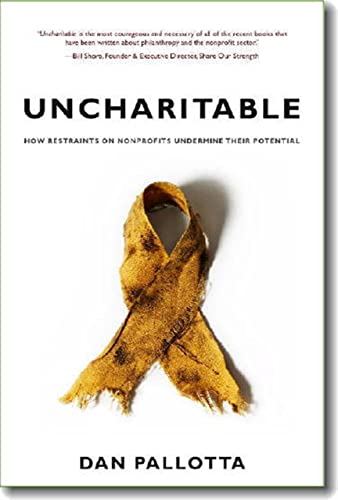
Uncharitable goes where no other book on the nonprofit sector has dared to tread. Where other texts suggest ways to optimize performance inside the existing paradigm, Uncharitable suggests that the paradigm itself is the problem and calls into question our fundamental canons about charity. Author Dan Pallotta argues that society's nonprofit ethic acts as a strict regulatory mechanism on the natural economic law. It creates an economic apartheid that denies the nonprofit sector critical tools and permissions that the for-profit sector is allowed to use without restraint (e.g., no risk-reward incentives, no profit, counterproductive limits on compensation, and moral objections to the use of donated dollars for anything other than program expenditures). These double-standards place the nonprofit sector at extreme disadvantage to the for profit sector on every level. While the for profit sector is permitted to use all the tools of capitalism to advance the sale of consumer goods, the nonprofit sector is prohibited from using any of them to fight hunger or disease. Capitalism is blamed for creating the inequities in our society, but charity is prohibited from using the tools of capitalism to rectify them. Ironically, this is all done in the name of charity, but it is a charity whose principal benefit flows to the for-profit sector and one that denies the nonprofit sector the tools and incentives that have built virtually everything of value in society. The very ethic we have cherished as the hallmark of our compassion is in fact what undermines it. This irrational system, Pallotta explains, has its roots in 400-year-old Puritan ethics that banished self-interest from the realm of charity. The ideology is policed today by watchdog agencies and the use of"efficiency" measures, which Pallotta argues are flawed, unjust, and should be abandoned. By declaring our independence from these obsolete ideas, Pallotta theorizes, we can dramatically accelerate progress on the most urgent social issues of our time. Pallotta has written an important, provocative, timely, and accessible book-a manifesto about equal economic rights for charity. Its greatest contribution may be to awaken society to the fact that they were so unequal in the first place.
Les informations fournies dans la section « Synopsis » peuvent faire référence à une autre édition de ce titre.
Présentation de l'éditeur
Uncharitable goes where no other book on the nonprofit sector has dared to tread. Where other texts suggest ways to optimize performance inside the existing paradigm, Uncharitable suggests that the paradigm itself is the problem and calls into question our fundamental canons about charity. Author Dan Pallotta argues that society's nonprofit ethic acts as a strict regulatory mechanism on the natural economic law. It creates an economic apartheid that denies the nonprofit sector critical tools and permissions that the for-profit sector is allowed to use without restraint (e.g., no risk-reward incentives, no profit, counterproductive limits on compensation, and moral objections to the use of donated dollars for anything other than program expenditures). These double-standards place the nonprofit sector at extreme disadvantage to the for profit sector on every level. While the for profit sector is permitted to use all the tools of capitalism to advance the sale of consumer goods, the nonprofit sector is prohibited from using any of them to fight hunger or disease. Capitalism is blamed for creating the inequities in our society, but charity is prohibited from using the tools of capitalism to rectify them. Ironically, this is all done in the name of charity, but it is a charity whose principal benefit flows to the for-profit sector and one that denies the nonprofit sector the tools and incentives that have built virtually everything of value in society. The very ethic we have cherished as the hallmark of our compassion is in fact what undermines it. This irrational system, Pallotta explains, has its roots in 400-year-old Puritan ethics that banished self-interest from the realm of charity. The ideology is policed today by watchdog agencies and the use of ""efficiency"" measures, which Pallotta argues are flawed, unjust, and should be abandoned. By declaring our independence from these obsolete ideas, Pallotta theorizes, we can dramatically accelerate progress on the most urgent social issues of our time. Pallotta has written an important, provocative, timely, and accessible book-a manifesto about equal economic rights for charity. Its greatest contribution may be to awaken society to the fact that they were so unequal in the first place.
Les informations fournies dans la section « A propos du livre » peuvent faire référence à une autre édition de ce titre.
Résultats de recherche pour Uncharitable: How Restraints on Nonprofits Undermine...

Image d'archives
Uncharitable: How Restraints on Nonprofits Undermine Their Potential (Civil Society: Historical and Contemporary Perspectives)
Vendeur : HPB Inc., Dallas, TX, Etats-Unis
Évaluation du vendeur 5 sur 5 étoiles

paperback. Etat : Very Good. Connecting readers with great books since 1972! Used books may not include companion materials, and may have some shelf wear or limited writing. We ship orders daily and Customer Service is our top priority! N° de réf. du vendeur S_472197000
Acheter D'occasion
EUR 2,48
Expédition à EUR 3,23
Expédition nationale : Etats-Unis
Expédition nationale : Etats-Unis
Quantité disponible : 1 disponible(s)
Image d'archives
Uncharitable: How Restraints on Nonprofits Undermine Their Potential (Civil Society: Historical and Contemporary Perspectives)
Vendeur : HPB-Diamond, Dallas, TX, Etats-Unis
Évaluation du vendeur 5 sur 5 étoiles
Paperback. Etat : Very Good. Connecting readers with great books since 1972! Used books may not include companion materials, and may have some shelf wear or limited writing. We ship orders daily and Customer Service is our top priority! N° de réf. du vendeur S_471779224
Acheter D'occasion
EUR 2,60
Expédition à EUR 3,23
Expédition nationale : Etats-Unis
Expédition nationale : Etats-Unis
Quantité disponible : 1 disponible(s)
Image d'archives
Uncharitable: How Restraints on Nonprofits Undermine Their Potential (Civil Society: Historical and Contemporary Perspectives)
Edité par
University Press of New England, 2010
ISBN 10 : 1584659556
ISBN 13 : 9781584659556
Ancien ou d'occasion
Paperback
Vendeur : HPB-Red, Dallas, TX, Etats-Unis
Évaluation du vendeur 5 sur 5 étoiles
Paperback. Etat : Very Good. Connecting readers with great books since 1972! Used textbooks may not include companion materials such as access codes, etc. May have some wear or limited writing/highlighting. We ship orders daily and Customer Service is our top priority! N° de réf. du vendeur S_460810810
Acheter D'occasion
EUR 2,67
Expédition à EUR 3,23
Expédition nationale : Etats-Unis
Expédition nationale : Etats-Unis
Quantité disponible : 1 disponible(s)
Image d'archives
Uncharitable: How Restraints on Nonprofits Undermine Their Potential
Edité par
University Press of New England, 2010
ISBN 10 : 1584659556
ISBN 13 : 9781584659556
Ancien ou d'occasion
Paperback
Vendeur : ThriftBooks-Phoenix, Phoenix, AZ, Etats-Unis
Évaluation du vendeur 5 sur 5 étoiles
Paperback. Etat : Very Good. No Jacket. May have limited writing in cover pages. Pages are unmarked. ~ ThriftBooks: Read More, Spend Less. N° de réf. du vendeur G1584659556I4N00
Acheter D'occasion
EUR 6
Livraison gratuite
Expédition nationale : Etats-Unis
Expédition nationale : Etats-Unis
Quantité disponible : 1 disponible(s)
Image d'archives
Uncharitable: How Restraints on Nonprofits Undermine Their Potential
Edité par
University Press of New England, 2010
ISBN 10 : 1584659556
ISBN 13 : 9781584659556
Ancien ou d'occasion
Paperback
Vendeur : ThriftBooks-Atlanta, AUSTELL, GA, Etats-Unis
Évaluation du vendeur 5 sur 5 étoiles
Paperback. Etat : Very Good. No Jacket. May have limited writing in cover pages. Pages are unmarked. ~ ThriftBooks: Read More, Spend Less. N° de réf. du vendeur G1584659556I4N00
Acheter D'occasion
EUR 6
Livraison gratuite
Expédition nationale : Etats-Unis
Expédition nationale : Etats-Unis
Quantité disponible : 1 disponible(s)
Image d'archives
Uncharitable: How Restraints on Nonprofits Undermine Their Potential (Civil Society: Historical and Contemporary Perspectives)
Edité par
University Press of New England, 2010
ISBN 10 : 1584659556
ISBN 13 : 9781584659556
Ancien ou d'occasion
Couverture souple
Vendeur : Wonder Book, Frederick, MD, Etats-Unis
Évaluation du vendeur 5 sur 5 étoiles
Etat : Very Good. Very Good condition. A copy that may have a few cosmetic defects. May also contain light spine creasing or a few markings such as an owner's name, short gifter's inscription or light stamp. N° de réf. du vendeur S11O-00885
Acheter D'occasion
EUR 6,21
Livraison gratuite
Expédition nationale : Etats-Unis
Expédition nationale : Etats-Unis
Quantité disponible : 1 disponible(s)
Image d'archives
Uncharitable : How Restraints on Nonprofits Undermine Their Potential
Edité par
Dartmouth College, 2010
ISBN 10 : 1584659556
ISBN 13 : 9781584659556
Ancien ou d'occasion
Couverture souple
Vendeur : Better World Books: West, Reno, NV, Etats-Unis
Évaluation du vendeur 5 sur 5 étoiles
Etat : Good. Pages intact with minimal writing/highlighting. The binding may be loose and creased. Dust jackets/supplements are not included. Stock photo provided. Product includes identifying sticker. Better World Books: Buy Books. Do Good. N° de réf. du vendeur 5619929-6
Acheter D'occasion
EUR 6,52
Livraison gratuite
Expédition nationale : Etats-Unis
Expédition nationale : Etats-Unis
Quantité disponible : 3 disponible(s)
Image d'archives
Uncharitable : How Restraints on Nonprofits Undermine Their Potential
Edité par
Dartmouth College, 2010
ISBN 10 : 1584659556
ISBN 13 : 9781584659556
Ancien ou d'occasion
Couverture souple
Vendeur : Better World Books, Mishawaka, IN, Etats-Unis
Évaluation du vendeur 5 sur 5 étoiles
Etat : Good. Pages intact with minimal writing/highlighting. The binding may be loose and creased. Dust jackets/supplements are not included. Stock photo provided. Product includes identifying sticker. Better World Books: Buy Books. Do Good. N° de réf. du vendeur 5619929-6
Acheter D'occasion
EUR 6,52
Livraison gratuite
Expédition nationale : Etats-Unis
Expédition nationale : Etats-Unis
Quantité disponible : 3 disponible(s)
Image d'archives
Uncharitable : How Restraints on Nonprofits Undermine Their Potential
Edité par
Dartmouth College, 2010
ISBN 10 : 1584659556
ISBN 13 : 9781584659556
Ancien ou d'occasion
Couverture souple
Vendeur : Better World Books, Mishawaka, IN, Etats-Unis
Évaluation du vendeur 5 sur 5 étoiles
Etat : Very Good. Pages intact with possible writing/highlighting. Binding strong with minor wear. Dust jackets/supplements may not be included. Stock photo provided. Product includes identifying sticker. Better World Books: Buy Books. Do Good. N° de réf. du vendeur 4633247-6
Acheter D'occasion
EUR 6,52
Livraison gratuite
Expédition nationale : Etats-Unis
Expédition nationale : Etats-Unis
Quantité disponible : 1 disponible(s)
Image d'archives
Uncharitable: How Restraints on Nonprofits Undermine Their Potential (Civil Society: Historical and Contemporary Perspectives)
Edité par
University Press of New England, 2010
ISBN 10 : 1584659556
ISBN 13 : 9781584659556
Ancien ou d'occasion
Paperback
Vendeur : HPB-Red, Dallas, TX, Etats-Unis
Évaluation du vendeur 5 sur 5 étoiles
Paperback. Etat : Good. Connecting readers with great books since 1972! Used textbooks may not include companion materials such as access codes, etc. May have some wear or writing/highlighting. We ship orders daily and Customer Service is our top priority! N° de réf. du vendeur S_426316310
Acheter D'occasion
EUR 4,44
Expédition à EUR 3,23
Expédition nationale : Etats-Unis
Expédition nationale : Etats-Unis
Quantité disponible : 1 disponible(s)