
Synopsis
Ce livre vous apprendra tout ce que vous devez savoir pour commencer à utiliser SOLIDWORKS 2016 avec des tutoriels étape par étape faciles à comprendre. Ce livre présente un design de robot simple utilisé comme projet tout au long du livre. Vous apprendrez à modéliser des pièces, à créer des assemblages, à exécuter des simulations et même à créer des animations de la conception de votre robot.
Aucune expérience préalable avec la conception assistée par ordinateur (CAO) n'est nécessaire puisque ce livre commence au niveau d'introduction. L'auteur commence par vous familiariser immédiatement avec l'interface SOLIDWORKS et ses outils de base. Vous commencerez par apprendre à modéliser des pièces de robot simples et bientôt vous serez diplômé pour créer des pièces plus complexes et des dessins multi-vues.
En cours de route, vous apprendrez les principes fondamentaux de la modélisation paramétrique grâce à l'utilisation de contraintes géométriques et de relations. Vous vous familiariserez également avec de nombreux outils et commandes puissants de SOLIDWORKS qui vous permettent de construire facilement des fonctionnalités complexes dans vos modèles. La couverture des engrenages, des trains d'engrenages et de la création d'engrenages droits à l'aide de SOLIDWORKS.
Ce livre continue en examinant les différents mécanismes couramment utilisés dans les robots marcheurs. Vous apprendrez les types de base de liaisons planaires à quatre barres couramment utilisées dans les conceptions mécaniques et comment utiliser le logiciel GeoGebra Dynamic Geometry pour simuler et yser les liaisons 2D. En utilisant les connaissances que vous avez acquises sur les liens et les mécanismes, vous apprendrez à modifier votre robot et à modifier son comportement en modifiant ou en créant de nouvelles pièces.
Dans le dernier chapitre de ce livre, vous apprendrez à combiner toutes les pièces du robot en assemblages, puis à exécuter une yse de mouvement.
Les informations fournies dans la section « Synopsis » peuvent faire référence à une autre édition de ce titre.
Présentation de l'éditeur
This book will teach you everything you need to know to start using SOLIDWORKS 2016 with easy to understand, step-by-step tutorials. This book features a simple robot design used as a project throughout the book. You will learn to model parts, create assemblies, run simulations and even create animations of your robot design.
No previous experience with Computer Aided Design (CAD) is needed since this book starts at an introductory level. The author begins by getting you familiar with the SOLIDWORKS interface and its basic tools right away. You will start by learning to model simple robot parts and before long you will graduate to creating more complex parts and multi-view drawings.
Along the way you will learn the fundamentals of parametric modeling through the use of geometric constraints and relationships. You will also become familiar with many of the powerful tools and commands that enable you to easily construct complex features in your models. Also included is coverage of gears, gear trains and spur gear creation using SolidWorks.
This book continues by examining the different mechanisms commonly used in walking robots. You will learn the basic types of planar four-bar linkages commonly used in mechanical designs and how to use the GeoGebra Dynamic Geometry software to simulate and analyze 2D linkages. Using the knowledge you gained about linkages and mechanism, you will learn how to modify your robot and change its behavior by modifying or creating new parts.
In the final chapter of this book you learn how to combine all the robot parts into assemblies and then run motion analysis. You will finish off your project by creating 3D animations of your robot in action.
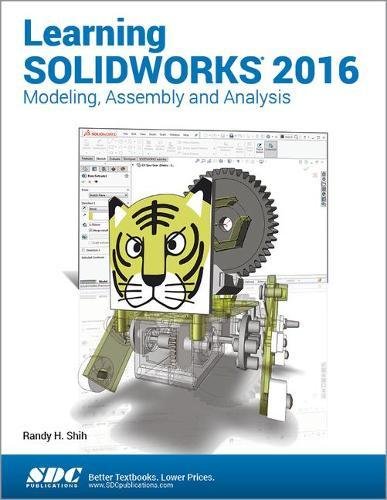
There are many books that show you how to perform individual tasks with SOLIDWORKS, but this book takes you through an entire project and shows you the complete engineering process. By the end of this book you will have modeled and assembled nearly all the parts that make up the TAMIYA Mechanical Tiger and can start building your own robot.
Table of Contents
1. Introduction - Getting Started2. Parametric Modeling Fundamentals
3. CSG Concepts and Model History Tree
4. Parametric Constraints Fundamentals
5. Pictorials and Sketching
6. Symmetrical Features and Part Drawings
7. Datum Features in Designs
8. Gears and SolidWorks Design Library
9. Advanced 3D Construction Tools
10. Planar Linkage Analysis using GeoGebra
11. Design Makes the Difference
12. Assembly Modeling and Motion Analysis
Index
Les informations fournies dans la section « A propos du livre » peuvent faire référence à une autre édition de ce titre.