
Articles liés à Seven Names for the Bellbird: Conservation Geography...
Synopsis
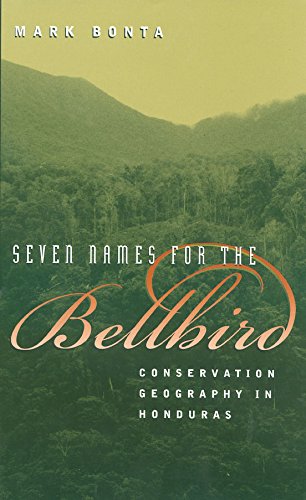
Offering intimate and unforgettable descriptions of the birds and people that inhabit Honduran landscapes, Seven Names for the Bellbird showcases the deep-rooted local traditions of bird appreciation and holds them up as a model for sound management of the environment. Through his appreciative recounting of local lore, author Mark Bonta makes the interaction between culture and avifauna in Latin America a key to better understanding the practice of biodiversity protection. He makes a significant contribution to the scarce anthropological and geographical literature on human-environment relationships in Central America and also provides wonderful stories of native birds and their human observers.
After a decade in the field in Honduras, Mark Bonta came to realize that, contrary to outsiders' general beliefs, the society he observed was predisposed "to like birds, to observe birds, to weave them into folklore, and to protect them on private property." Bonta argues that if North Americans and Europeans paid real attention to local knowledge and practice--instead of condemning them out-of-hand and imposing new beliefs and techniques--they would learn that rural cultures offer alternative ways of accommodating habitats and wildlife. Bonta uses the concept of "conservation geography"--the study of human beings and their landscapes, with natural resource conservation in the forefront--to advance his argument. He describes many cases where local individuals and their traditional knowledge of birds contribute to a de facto variety of bird conservation that precedes or parallels "official" bird protection efforts. This book is not offered as "proof" that all birds have happy futures in the Neotropics. Bonta recognizes the ravages of both human pressures and natural disasters on the birds and forests. But he shows that in many instances, birds are safe and even thrive in the presence of local people, who "celebrate them just as often as they persecute them."Les informations fournies dans la section « Synopsis » peuvent faire référence à une autre édition de ce titre.
À propos de l'auteur
Mark Bonta is an assistant professor of geography at Delta State University in Cleveland, Mississippi. In the early 1990s, he was a Peace Corps volunteer in Honduras, and he has returned many times since, living and working in the province of Olancho. He continues to participate in a wide variety of local environmental projects in Olancho, including protection of the Sierra de Agalta National Park and monitoring of the endemic tree cycad Dioon mejlae. This book was inspired by the sublimity and pathos of his adopted country.
Les informations fournies dans la section « A propos du livre » peuvent faire référence à une autre édition de ce titre.
Résultats de recherche pour Seven Names for the Bellbird: Conservation Geography...

Image d'archives
Seven Names for the Bellbird : Conservation Geography in Honduras
Edité par
Texas A&M University Press, 2003
ISBN 10 : 1585442496
ISBN 13 : 9781585442492
Ancien ou d'occasion
Couverture rigide
Vendeur : Better World Books, Mishawaka, IN, Etats-Unis
Évaluation du vendeur 5 sur 5 étoiles

Etat : Very Good. Former library copy. Pages intact with possible writing/highlighting. Binding strong with minor wear. Dust jackets/supplements may not be included. Includes library markings. Stock photo provided. Product includes identifying sticker. Better World Books: Buy Books. Do Good. N° de réf. du vendeur 14840614-6
Acheter D'occasion
EUR 30,74
Livraison gratuite
Expédition nationale : Etats-Unis
Expédition nationale : Etats-Unis
Quantité disponible : 1 disponible(s)
Image fournie par le vendeur
Seven names for the Bellbird: conservation geography in Honduras.
Edité par
College Station: Texas A & M Uinversity Press, 2003., 2003
ISBN 10 : 1585442496
ISBN 13 : 9781585442492
Ancien ou d'occasion
Couverture rigide
Vendeur : Andrew Isles Natural History Books, Prahran, VIC, Australie
Évaluation du vendeur 5 sur 5 étoiles
Octavo,231 pp.,photographs, maps, fine copy in dustwrapper. Through his recounting of local lore, Bonta makes the interaction between culture and avifauna in Latin America a key to better understanding the practice of biodiversity protection. He offers a significant contribution to the scarce anthropological and geographical literature on human-environmental relationships in Central America and also provides stories of native birds and their human observers. N° de réf. du vendeur 19299
Acheter D'occasion
EUR 38,11
Expédition à EUR 27,21
Expédition depuis Australie vers Etats-Unis
Expédition depuis Australie vers Etats-Unis
Quantité disponible : 1 disponible(s)
Image d'archives
Seven Names for the Bellbird: Conservation Geography in Honduras
Edité par
Texas A&M University Press, 2003
ISBN 10 : 1585442496
ISBN 13 : 9781585442492
Neuf
Couverture rigide
Vendeur : The Book Spot, Sioux Falls, MN, Etats-Unis
Évaluation du vendeur 4 sur 5 étoiles

Hardcover. Etat : New. N° de réf. du vendeur Abebooks371088
Acheter neuf
EUR 126,59
Livraison gratuite
Expédition nationale : Etats-Unis
Expédition nationale : Etats-Unis
Quantité disponible : 1 disponible(s)