
Articles liés à When the Birds Stopped Singing: Life in Ramallah Under...
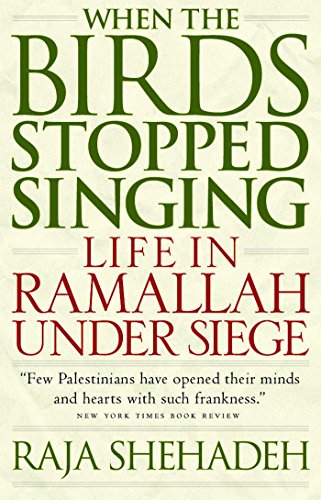
Synopsis
The Israeli army invaded Ramallah in March 2002. A tank stood at the end of Raja Shehadeh's road; Israeli soldiers patrolled from the roof toops. Four soldiers took over his brother's apartment and then used him as a human shield as they went through the building, while his wife tried to keep her composure for the sake of their frightened childred, ages four and six.
This is an account of what it is like to be under seige: the terror, the frustrations, the humiliations, and the rage. How do you pass your time when you are imprisoned in your own home? What do you do when you cannot cross the neighborhood to help your sick mother?
Shehadeh's recent memoir, Strangers in the House: Coming of Age in Occupied Palestine, was the first book by a Palestinian writer to chronicle a life of displacement on the West Bank from 1967 to the present. It received international acclaim and was a finalist for the 2002 Lionel Gelber Prize. When the Birds Stopped Singing is a book of the moment, a chronicle of life today as lived by ordinary Palestinians throughout the West Bank and Gaza in the grip of the most stringent Israeli security measures in years. And yet it is also an enduring document, at once literary and of great political import, that should serve as a cautionary tale for today's and future generations.
Les informations fournies dans la section « Synopsis » peuvent faire référence à une autre édition de ce titre.
À propos de l'auteur
Raja Shehadeh is a Palestinian lawyer and writer who lives in Ramallah. He is a founder of Al-Haq, a pioneering, nonpartisan human rights organization, and the author of several books about international law, human rights, and the Middle East.
Extrait. © Reproduit sur autorisation. Tous droits réservés.
28 MARCH
I felt the tension the moment I entered my law office. I asked about the two assistants from Jerusalem and was told they were unable to cross the checkpoint at Kalandia. They had phoned, alarmed at reports that all foreigners were being evacuated from Ramallah in anticipation of an Israeli invasion. The presence of foreigners in the town had always seemed a protection for the Palestinian community from Israeli excesses. The news that they were being evacuated made us feel that some atrocity was being planned for which the Israeli army wanted no witnesses. For a long time Palestinians had been demanding an international protection force. I would have felt immensely more secure if one had been dispatched.
It was only two weeks ago that the army had withdrawn from Ramallah after an occupation of three days. They were now stationed on the outskirts of the town, which was under siege. There were two points of view at the office. The first was that the attack was imminent; the second that Arafat has signed the document that General Anthony Zinni, the U.S. envoy, wanted him to sign, therefore there was not going to be an attack. My own sense was that something was going to happen. I felt overwhelmed by a strong sense of foreboding.
One of our secretaries asked to leave early to do some shopping. I too decided to take the precaution of shopping, stocking up on things and getting prepared for a long curfew. I didn’t want to be caught off-guard. I left the office and went out to the street. Our law office is in the center of town on its main commercial artery, Main Street. I didn’t drive. I walked. The town was in its usually chaotic state, with posters plastered on many walls with pictures
of the latest Palestinian bombers. But something was different today. It was as though the place had been struck by a storm. There was a rush on the market. Everyone was moving quickly, and people were emerging from shops with heavy bags. Prices had risen appreciably. A sense of an impending catastrophe loomed in the air. At the vegetable shop a frantic middle-aged woman with ruffled hair was loading vegetables into her shopping bag. I saw that she was taking a large number of golden onions. When she bent down to pick them from the lower rack, I noticed that their yellowish translucent skin was the color of her hair. She looked up at me, “Onions go a long way. They’re good to have,” she said, and helped herself to more. Vegetables from her overfilled bags were falling on the narrow paths between the stalls. She stooped down to collect them. She was creating panic in the crowded shop. I carried my vegetables and left, passing by the Manara, the recently renovated roundabout at the center of downtown. I looked at the plastic lions, an addition from the Oslo years, and remembered the picture I saw in the daily paper a few weeks ago of the Palestinian fighters crouching behind one of them, shooting at the Israeli soldiers. One cub had lost its tail in the fusillade.
Dominating the square was a large banner the width of the street with a picture of Arafat, his kuffieh piled up like a small pyramid over his head, raising his finger like a teacher, his eyes open wide. The words he was preaching were sprawled in large script:
All it takes is to will it. You are the knight of this hour.
Farther up the street, by the florist where a gun battle had blown away the cornerstones of the old building, I noticed fresh plastering between the restored stones. The glass of the travel agency across the street had also been replaced. The son had recently renovated his father’s office and, rather than install full metal shutters like the rest of his neighbors, he wanted to distinguish his agency by using
the daintier metal grille. It cost him the entire glass front. Nearby was the blackened butcher’s shop that had been firebombed and its proprietor killed in a criminal feud involving armed groups from a nearby refugee camp. Disputes of this sort used to be settled by the court. Now, with the predominance of arms, people were taking the law into their own hands.
These shops around the center of town are not far from Arafat’s headquarters. During the last Israeli incursion into Ramallah the army had stayed away from this area. It became a refuge for the Palestinian fighters resisting the occupation of Ramallah. All other parts of the city were occupied, with Israeli tanks crowding the narrow streets. We could not move out of our house for three days as gun battles raged. This episode had ended with an Israeli withdrawal and the feeling that our side had won and had driven back the mighty Israeli army.
No wonder the large contingent of armed men in uniform and civilian clothes seemed to carry their arms with pride. They finally had the opportunity to use them to defend the town. A columnist in the local daily newspaper called this second Intifada the Palestinian War of Independence.
• • •
Les informations fournies dans la section « A propos du livre » peuvent faire référence à une autre édition de ce titre.
Résultats de recherche pour When the Birds Stopped Singing: Life in Ramallah Under...

Image d'archives
When the Birds Stopped Singing: Life in Ramallah Under Siege
Edité par
Steerforth (edition Us), 2003
ISBN 10 : 1586420690
ISBN 13 : 9781586420697
Ancien ou d'occasion
Paperback
Vendeur : BooksRun, Philadelphia, PA, Etats-Unis
Évaluation du vendeur 5 sur 5 étoiles

Paperback. Etat : Very Good. Us. It's a well-cared-for item that has seen limited use. The item may show minor signs of wear. All the text is legible, with all pages included. It may have slight markings and/or highlighting. N° de réf. du vendeur 1586420690-11-1
Acheter D'occasion
EUR 6,63
Livraison gratuite
Expédition nationale : Etats-Unis
Expédition nationale : Etats-Unis
Quantité disponible : 1 disponible(s)
Image d'archives
When the Birds Stopped Singing : Life in Ramallah under Siege
Edité par
Steerforth Press, 2003
ISBN 10 : 1586420690
ISBN 13 : 9781586420697
Ancien ou d'occasion
Couverture souple
Vendeur : Better World Books, Mishawaka, IN, Etats-Unis
Évaluation du vendeur 5 sur 5 étoiles
Etat : Good. Pages intact with minimal writing/highlighting. The binding may be loose and creased. Dust jackets/supplements are not included. Stock photo provided. Product includes identifying sticker. Better World Books: Buy Books. Do Good. N° de réf. du vendeur 8671555-20
Acheter D'occasion
EUR 8,32
Livraison gratuite
Expédition nationale : Etats-Unis
Expédition nationale : Etats-Unis
Quantité disponible : 4 disponible(s)
Image d'archives
When the Birds Stopped Singing : Life in Ramallah under Siege
Edité par
Steerforth Press, 2003
ISBN 10 : 1586420690
ISBN 13 : 9781586420697
Ancien ou d'occasion
Couverture souple
Vendeur : Better World Books: West, Reno, NV, Etats-Unis
Évaluation du vendeur 5 sur 5 étoiles
Etat : Good. Former library copy. Pages intact with minimal writing/highlighting. The binding may be loose and creased. Dust jackets/supplements are not included. Includes library markings. Stock photo provided. Product includes identifying sticker. Better World Books: Buy Books. Do Good. N° de réf. du vendeur 1486195-6
Acheter D'occasion
EUR 8,32
Livraison gratuite
Expédition nationale : Etats-Unis
Expédition nationale : Etats-Unis
Quantité disponible : 1 disponible(s)
Image d'archives
When the Birds Stopped Singing: Life in Ramallah Under Siege
Edité par
Steerforth Press, 2003
ISBN 10 : 1586420690
ISBN 13 : 9781586420697
Ancien ou d'occasion
Paperback
Vendeur : ThriftBooks-Dallas, Dallas, TX, Etats-Unis
Évaluation du vendeur 5 sur 5 étoiles
Paperback. Etat : Good. No Jacket. Pages can have notes/highlighting. Spine may show signs of wear. ~ ThriftBooks: Read More, Spend Less. N° de réf. du vendeur G1586420690I3N00
Acheter D'occasion
EUR 8,65
Livraison gratuite
Expédition nationale : Etats-Unis
Expédition nationale : Etats-Unis
Quantité disponible : 1 disponible(s)
Image d'archives
When the Birds Stopped Singing: Life in Ramallah Under Siege
Edité par
Steerforth Press, 2003
ISBN 10 : 1586420690
ISBN 13 : 9781586420697
Ancien ou d'occasion
Paperback
Vendeur : ThriftBooks-Dallas, Dallas, TX, Etats-Unis
Évaluation du vendeur 5 sur 5 étoiles
Paperback. Etat : Fair. No Jacket. Readable copy. Pages may have considerable notes/highlighting. ~ ThriftBooks: Read More, Spend Less. N° de réf. du vendeur G1586420690I5N00
Acheter D'occasion
EUR 8,65
Livraison gratuite
Expédition nationale : Etats-Unis
Expédition nationale : Etats-Unis
Quantité disponible : 1 disponible(s)
Image d'archives
When the Birds Stopped Singing: Life in Ramallah Under Siege
Edité par
Steerforth Press, 2003
ISBN 10 : 1586420690
ISBN 13 : 9781586420697
Ancien ou d'occasion
Paperback
Vendeur : ThriftBooks-Reno, Reno, NV, Etats-Unis
Évaluation du vendeur 5 sur 5 étoiles
Paperback. Etat : Good. No Jacket. Pages can have notes/highlighting. Spine may show signs of wear. ~ ThriftBooks: Read More, Spend Less. N° de réf. du vendeur G1586420690I3N00
Acheter D'occasion
EUR 8,65
Livraison gratuite
Expédition nationale : Etats-Unis
Expédition nationale : Etats-Unis
Quantité disponible : 1 disponible(s)
Image d'archives
When the Birds Stopped Singing: Life in Ramallah Under Siege
Edité par
Steerforth Press, 2003
ISBN 10 : 1586420690
ISBN 13 : 9781586420697
Ancien ou d'occasion
Paperback
Vendeur : ThriftBooks-Atlanta, AUSTELL, GA, Etats-Unis
Évaluation du vendeur 5 sur 5 étoiles
Paperback. Etat : Good. No Jacket. Pages can have notes/highlighting. Spine may show signs of wear. ~ ThriftBooks: Read More, Spend Less. N° de réf. du vendeur G1586420690I3N00
Acheter D'occasion
EUR 8,65
Livraison gratuite
Expédition nationale : Etats-Unis
Expédition nationale : Etats-Unis
Quantité disponible : 1 disponible(s)
Image d'archives
When the Birds Stopped Singing: Life in Ramallah Under Siege
Edité par
Steerforth Press, 2003
ISBN 10 : 1586420690
ISBN 13 : 9781586420697
Ancien ou d'occasion
Paperback
Vendeur : ThriftBooks-Atlanta, AUSTELL, GA, Etats-Unis
Évaluation du vendeur 5 sur 5 étoiles
Paperback. Etat : Fair. No Jacket. Readable copy. Pages may have considerable notes/highlighting. ~ ThriftBooks: Read More, Spend Less. N° de réf. du vendeur G1586420690I5N00
Acheter D'occasion
EUR 8,65
Livraison gratuite
Expédition nationale : Etats-Unis
Expédition nationale : Etats-Unis
Quantité disponible : 1 disponible(s)
Image d'archives
When the Birds Stopped Singing: Life in Ramallah Under Siege
Edité par
Steerforth Press, 2003
ISBN 10 : 1586420690
ISBN 13 : 9781586420697
Ancien ou d'occasion
Paperback
Vendeur : ThriftBooks-Reno, Reno, NV, Etats-Unis
Évaluation du vendeur 5 sur 5 étoiles
Paperback. Etat : Fair. No Jacket. Readable copy. Pages may have considerable notes/highlighting. ~ ThriftBooks: Read More, Spend Less. N° de réf. du vendeur G1586420690I5N00
Acheter D'occasion
EUR 8,65
Livraison gratuite
Expédition nationale : Etats-Unis
Expédition nationale : Etats-Unis
Quantité disponible : 1 disponible(s)
Image d'archives
When the Birds Stopped Singing: Life in Ramallah Under Siege
Vendeur : GoldBooks, Denver, CO, Etats-Unis
Évaluation du vendeur 5 sur 5 étoiles
Paperback. Etat : new. New Copy. Customer Service Guaranteed. N° de réf. du vendeur 58Q47_98_1586420690
Acheter neuf
EUR 70,73
Expédition à EUR 4,89
Expédition nationale : Etats-Unis
Expédition nationale : Etats-Unis
Quantité disponible : 1 disponible(s)