
Articles liés à Hard Times
Synopsis
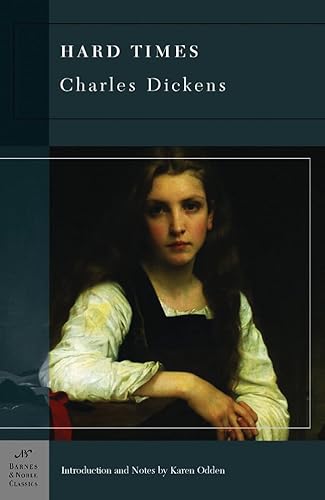
The Barnes & Noble Classics series offers quality editions of important works of literature at affordable prices to the student and the general reader, each featuring new scholarship and pages of carefully crafted extras. All editions are beautifully designed and are printed to superior specifications; some include illustrations of historical interest. The series pulls together a constellation of influences; biographical, historical and literary, to enrich each reader's understanding of these enduring works.
Les informations fournies dans la section « Synopsis » peuvent faire référence à une autre édition de ce titre.
Extrait
CHAPTER I
The One Thing Needful
“Now, what I want is, Facts. Teach these boys and girls nothing but Facts. Facts alone are wanted in life. Plant nothing else, and root out everything else. You can only form the minds of reasoning animals upon Facts: nothing else will ever be of any service to them. This is the principle on which I bring up my own children, and this is the principle on which I bring up these children. Stick to Facts, Sir!”
The scene was a plain, bare, monotonous vault of a schoolroom, and the speaker’s square forefinger emphasized his observations by underscoring every sentence with a line on the schoolmaster’s sleeve. The emphasis was helped by the speaker’s square wall of a forehead, which had his eyebrows for its base, while his eyes found commodious cellerage in two dark caves, overshadowed by the wall. The emphasis was helped by the speaker’s mouth, which was wide, thin, and hard set. The emphasis was helped by the speaker’s voice, which was inflexible, dry, and dictatorial. The emphasis was helped by the speaker’s hair, which bristled on the skirts of his bald head, a plantation of firs to keep the wind from its shining surface, all covered with knobs, like the crust of a plum pie, as if the head had scarcely warehouse-room for the hard facts stored inside. The speaker’s obstinate carriage, square coat, square legs, square shoulders,—nay, his very neckcloth, trained to take him by the throat with an unaccommodating grasp, like a stubborn fact, as it was,—all helped the emphasis.
“In this life, we want nothing but Facts, Sir; nothing but Facts!”
The speaker, and the schoolmaster, and the third grown person present, all backed a little, and swept with their eyes the inclined plane of little vessels then and there arranged in order, ready to have imperial gallons of facts poured into them until they were full to the brim.
CHAPTER II
Murdering the Innocents
Thomas Gradgrind, Sir. A man of realities. A man of facts and calculations. A man who proceeds upon the principle that two and two are four, and nothing over, and who is not to be talked into allowing for anything over. Thomas Gradgrind, Sir—peremptorily Thomas—Thomas Gradgrind. With a rule and a pair of scales, and the multiplication table always in his pocket, Sir, ready to weigh and measure any parcel of human nature, and tell you exactly what it comes to. It is a mere question of figures, a case of simple arithmetic. You might hope to get some other nonsensical belief into the head of George Gradgrind, or Augustus Gradgrind, or John Gradgrind, or Joseph Gradgrind (all supposititious, non-existent persons), but into the head of Thomas Gradgrind—no, Sir!
In such terms Mr. Gradgrind always mentally introduced himself, whether to his private circle of acquaintance, or to the public in general. In such terms, no doubt, substituting the words “boys and girls,” for “Sir,” Thomas Gradgrind now presented Thomas Gradgrind to the little pitchers before him, who were to be filled so full of facts.
Indeed, as he eagerly sparkled at them from the cellarage before mentioned, he seemed a kind of cannon loaded to the muzzle with facts, and prepared to blow them clean out of the regions of childhood at one discharge. He seemed a galvanizing apparatus, too, charged with a grim mechanical substitute for the tender young imaginations that were to be stormed away.
“Girl number twenty,” said Mr. Gradgrind, squarely pointing with his square forefinger, “I don’t know that girl. Who is that girl?”
“Sissy Jupe, sir,” explained number twenty, blushing, standing up, and curtseying.
“Sissy is not a name,” said Mr. Gradgrind. “Don’t call yourself Sissy. Call yourself Cecilia.”
“It’s father as calls me Sissy, sir,” returned the young girl in a trembling voice, and with another curtsey.
“Then he has no business to do it,” said Mr. Gradgrind. “Tell him he mustn’t. Cecilia Jupe. Let me see. What is your father?”
“He belongs to the horse-riding, if you please, sir.”
Mr. Gradgrind frowned, and waved off the objectionable calling with his hand.
“We don’t want to know anything about that, here. You mustn’t tell us about that, here. Your father breaks horses, don’t he?”
“If you please, sir, when they can get any to break, they do break horses in the ring, sir.”
“You mustn’t tell us about the ring, here. Very well, then. Describe your father as a horsebreaker. He doctors sick horses, I dare say?”
“Oh yes, sir.”
“Very well, then. He is a veterinary surgeon, a farrier and horsebreaker. Give me your definition of a horse.”
(Sissy Jupe thrown into the greatest alarm by this demand.)
“Girl number twenty unable to define a horse!” said Mr. Gradgrind, for the general behoof of all the little pitchers. “Girl number twenty possessed of no facts, in reference to one of the commonest of animals! Some boy’s definition of a horse. Bitzer, yours.”
The square finger, moving here and there, lighted suddenly on Bitzer, perhaps because he chanced to sit in the same ray of sunlight which, darting in at one of the bare windows of the intensely whitewashed room, irradiated Sissy. For, the boys and girls sat on the face of the inclined plane in two compact bodies, divided up the centre by a narrow interval; and Sissy, being at the corner of a row on the sunny side, came in for the beginning of a sunbeam, of which Bitzer, being at the corner of a row on the other side, a few rows in advance, caught the end. But, whereas the girl was so dark-eyed and dark-haired, that she seemed to receive a deeper and more lustrous colour from the sun, when it shone upon her, the boy was so light-eyed and light-haired that the self-same rays appeared to draw out of him what little colour he ever possessed. His cold eyes would hardly have been eyes, but for the short ends of lashes which, by bringing them into immediate contrast with something paler than themselves, expressed their form. His short-cropped hair might have been a mere continuation of the sandy freckles on his forehead and face. His skin was so unwholesomely deficient in the natural tinge, that he looked as though, if he were cut, he would bleed white.
“Bitzer,” said Thomas Gradgrind. “Your definition of a horse.”
“Quadruped. Graminivorous. Forty teeth, namely twenty-four grinders, four eye-teeth, and twelve incisive. Sheds coat in the spring; in marshy countries, sheds hoofs, too. Hoofs hard, but requiring to be shod with iron. Age known by marks in mouth.” Thus (and much more) Bitzer.
“Now girl number twenty,” said Mr. Gradgrind. “You know what a horse is.”
She curtseyed again, and would have blushed deeper, if she could have blushed deeper than she had blushed all this time. Bitzer, after rapidly blinking at Thomas Gradgrind with both eyes at once, and so catching the light upon his quivering ends of lashes that they looked like the antennæ of busy insects, put his knuckles to his freckled forehead, and sat down again.
The third gentleman now stepped forth. A mighty man at cutting and drying, he was; a government officer; in his way (and in most other people’s too), a professed pugilist; always in training, always with a system to force down the general throat like a bolus, always to be heard of at the bar of his little Public-office, ready to fight all England. To continue in fistic phraseology, he had a genius for coming up to the scratch,2 wherever and whatever it was, and proving himself an ugly customer. He would go in and damage any subject whatever with his right, follow up with his left, stop, exchange, counter, bore his opponent (he always fought All England)3 to the ropes, and fall upon him neatly. He was certain to knock the wind out of common sense, and render that unlucky adversary deaf to the call of time. And he had it in charge from high authority to bring about the great public- office Millennium, when Commissioners should reign upon earth.
“Very well,” said this gentleman, briskly smiling, and folding his arms. “That’s a horse. Now, let me ask you girls and boys, Would you paper a room with representations of horses?”
After a pause, one half of the children cried in chorus, “Yes, Sir!” Upon which the other half, seeing in the gentleman’s face that Yes was wrong, cried out in chorus, “No, Sir!”—as the custom is, in these examinations.
“Of course, No. Why wouldn’t you?”
A pause. One corpulent slow boy, with a wheezy manner of breathing, ventured the answer, Because he wouldn’t paper a room at all, but would paint it.
“You must paper it,” said the gentleman, rather warmly.
“You must paper it,” said Thomas Gradgrind, “whether you like it or not. Don’t tell us you wouldn’t paper it. What do you mean, boy?”
Biographie de l'auteur
One of the grand masters of Victorian literature, Charles Dickens was born on February 7, 1812, in Landport, Portsea, England. He died in Kent on June 9, 1870. The second of eight children of a family continually plagued by debt, the young Dickens came to know not only hunger and privation,but also the horror of the infamous debtors’ prison and the evils of child labor. A turn of fortune in the shape of a legacy brought release from the nightmare of prison and "slave" factories and afforded Dickens the opportunity of two years’ formal schooling at Wellington House Academy. He worked as an attorney’s clerk and newspaper reporter until his Sketches by Boz (1836) and The Pickwick Papers (1837) brought him the amazing and instant success that was to be his for the remainder of his life. In later years, the pressure of serial writing, editorial duties, lectures, and social commitments led to his separation from Catherine Hogarth after twenty-three years of marriage. It also hastened his death at the age of fifty-eight, when he was characteristically engaged in a multitude of work.
Les informations fournies dans la section « A propos du livre » peuvent faire référence à une autre édition de ce titre.
Résultats de recherche pour Hard Times

Image d'archives
Hard Times
Edité par
Fine Communications,US, 2004
ISBN 10 : 1593081561
ISBN 13 : 9781593081560
Ancien ou d'occasion
Paperback
Vendeur : World of Books (was SecondSale), Montgomery, IL, Etats-Unis
Évaluation du vendeur 5 sur 5 étoiles

Paperback. Etat : Good. &&LDIV&&R&&LDIV&&R&&LI&&RHard Times&&L/I&&R, by &&LB&&RCharles Dickens&&L/B&&R, is part of the &&LI&&RBarnes & Noble Classics&&L/I&&R&&LI&&R &&L/I&&Rseries, which offers quality editions at affordable prices to the student and the general reader, including new scholarship, thoughtful design, and pages of carefully crafted extras. Here are some of the remarkable features of &&LI&&RBarnes & Noble Classics&&L/I&&R: &&LDIV&&RNew introductions commissioned from today's top writers and scholars Biographies of the authors Chronologies of contemporary historical, biographical, and cultural events Footnotes and endnotes Selective discussions of imitations, parodies, poems, books, plays, paintings, operas, statuary, and films inspired by the work Comments by other famous authors Study questions to challenge the reader's viewpoints and expectations Bibliographies for further reading Indices & Glossaries, when appropriateAll editions are beautifully designed and are printed to superior specifications; some include illustrations of historical interest. &&LI&&RBarnes & Noble Classics &&L/I&&Rpulls together a constellation of influences--biographical, historical, and literary--to enrich each reader's understanding of these enduring works.&&L/DIV&&R&&L/DIV&&R&&LP style=MARGIN: 0in 0in 0pt&&R &&L/P&&R&&LP style=MARGIN: 0in 0in 0pt&&RSet amid smokestacks and factories, &&LB&&RCharles Dickens&&L/B&&R's &&LI&&RHard Times&&L/I&&R is a blistering portrait of Victorian England as it struggles with the massive economic turmoil brought on by the Industrial Revolution. &&L/P&&R&&LP&&RChampioning the mind-numbing materialism of the period is Thomas Gradgrind, one of Dickens's most vivid characters. He opens the novel by arguing that boys and girls should be taught nothing but Facts. Facts alone are wanted in life. Forbidding the development of imagination, Gradgrind is ultimately forced to confront the results of his philosophy--his own daughter's terrible unhappiness. &&LP&&RFull of suspense, humor, and tenderness, &&LI&&RHard Times &&L/I&&Ris a brilliant defense of art in an age of mechanism.&&L/P&&R&&LP&&R&&LB&&RKaren Odden&&L/B&&R received her Ph.D. from New York University, where she did her dissertation on Victorian literature. Most recently a lecturer at University of Wisconsin-Milwaukee, she is now a freelance writer and lives in Arizona.&&L/P&&R&&L/DIV&&R. N° de réf. du vendeur 00109327561
Acheter D'occasion
EUR 3,71
Livraison gratuite
Expédition nationale : Etats-Unis
Expédition nationale : Etats-Unis
Quantité disponible : 2 disponible(s)
Image d'archives
Hard Times (Barnes & Noble Classics)
Edité par
Barnes & Noble Classics, 2004
ISBN 10 : 1593081561
ISBN 13 : 9781593081560
Ancien ou d'occasion
Couverture souple
Vendeur : World of Books (was SecondSale), Montgomery, IL, Etats-Unis
Évaluation du vendeur 5 sur 5 étoiles
Etat : Acceptable. Item in acceptable condition! Textbooks may not include supplemental items i.e. CDs, access codes etc. N° de réf. du vendeur 00086046797
Acheter D'occasion
EUR 3,71
Livraison gratuite
Expédition nationale : Etats-Unis
Expédition nationale : Etats-Unis
Quantité disponible : 3 disponible(s)
Image d'archives
Hard Times (Barnes & Noble Classics)
Edité par
Barnes & Noble Classics, 2004
ISBN 10 : 1593081561
ISBN 13 : 9781593081560
Ancien ou d'occasion
Paperback
Vendeur : Gulf Coast Books, Cypress, TX, Etats-Unis
Évaluation du vendeur 5 sur 5 étoiles
Paperback. Etat : Fair. N° de réf. du vendeur 1593081561-4-23946305
Acheter D'occasion
EUR 3,71
Livraison gratuite
Expédition nationale : Etats-Unis
Expédition nationale : Etats-Unis
Quantité disponible : 1 disponible(s)
Image fournie par le vendeur
Hard Times (Barnes & Noble Classics)
Edité par
Barnes & Noble Classics, 2004
ISBN 10 : 1593081561
ISBN 13 : 9781593081560
Ancien ou d'occasion
Couverture souple
Vendeur : Used Book Company, Egg Harbor Township, NJ, Etats-Unis
Évaluation du vendeur 5 sur 5 étoiles
Etat : Good. Shows moderate signs of wear and previous use. Can include notes/highlighting. A portion of your purchase benefits nonprofits! - Note: Edition & format may differ from what is shown in stock photo & item details. May not include supplementary material such as toys, access code, dvds, etc. N° de réf. du vendeur UBCV.1593081561.G
Acheter D'occasion
EUR 4,04
Livraison gratuite
Expédition nationale : Etats-Unis
Expédition nationale : Etats-Unis
Quantité disponible : 1 disponible(s)
Image fournie par le vendeur
Hard Times (Barnes & Noble Classics)
Edité par
Barnes & Noble Classics, 2004
ISBN 10 : 1593081561
ISBN 13 : 9781593081560
Ancien ou d'occasion
Couverture souple
Vendeur : ZBK Books, Carlstadt, NJ, Etats-Unis
Évaluation du vendeur 5 sur 5 étoiles
Etat : good. Fast & Free Shipping â" Good condition. It may show normal signs of use, such as light writing, highlighting, or library markings, but all pages are intact and the book is fully readable. A solid, complete copy that's ready to enjoy. N° de réf. du vendeur ZWV.1593081561.G
Acheter D'occasion
EUR 4,62
Livraison gratuite
Expédition nationale : Etats-Unis
Expédition nationale : Etats-Unis
Quantité disponible : 1 disponible(s)
Image d'archives
Hard Times (Barnes & Noble Classics)
Edité par
Barnes & Noble Classics (edition First Edition), 2004
ISBN 10 : 1593081561
ISBN 13 : 9781593081560
Ancien ou d'occasion
Paperback
Edition originale
Vendeur : BooksRun, Philadelphia, PA, Etats-Unis
Évaluation du vendeur 5 sur 5 étoiles
Paperback. Etat : Fair. First Edition. The item might be beaten up but readable. May contain markings or highlighting, as well as stains, bent corners, or any other major defect, but the text is not obscured in any way. N° de réf. du vendeur 1593081561-7-1-13
Acheter D'occasion
EUR 4,68
Livraison gratuite
Expédition nationale : Etats-Unis
Expédition nationale : Etats-Unis
Quantité disponible : 1 disponible(s)
Image d'archives
Hard Times (Barnes & Noble Classics)
Edité par
Barnes & Noble Classics (edition First Edition), 2004
ISBN 10 : 1593081561
ISBN 13 : 9781593081560
Ancien ou d'occasion
Paperback
Edition originale
Vendeur : BooksRun, Philadelphia, PA, Etats-Unis
Évaluation du vendeur 5 sur 5 étoiles
Paperback. Etat : Very Good. First Edition. It's a well-cared-for item that has seen limited use. The item may show minor signs of wear. All the text is legible, with all pages included. It may have slight markings and/or highlighting. N° de réf. du vendeur 1593081561-11-1
Acheter D'occasion
EUR 4,72
Livraison gratuite
Expédition nationale : Etats-Unis
Expédition nationale : Etats-Unis
Quantité disponible : 1 disponible(s)
Image d'archives
Hard Times
Edité par
Fine Communications,US, 2004
ISBN 10 : 1593081561
ISBN 13 : 9781593081560
Ancien ou d'occasion
Paperback
Vendeur : World of Books Inc, Montgomery, IL, Etats-Unis
Évaluation du vendeur 4 sur 5 étoiles

Paperback. Etat : Fair. &&LDIV&&R&&LDIV&&R&&LI&&RHard Times&&L/I&&R, by &&LB&&RCharles Dickens&&L/B&&R, is part of the &&LI&&RBarnes & Noble Classics&&L/I&&R&&LI&&R &&L/I&&Rseries, which offers quality editions at affordable prices to the student and the general reader, including new scholarship, thoughtful design, and pages of carefully crafted extras. Here are some of the remarkable features of &&LI&&RBarnes & Noble Classics&&L/I&&R: &&LDIV&&RNew introductions commissioned from today's top writers and scholars Biographies of the authors Chronologies of contemporary historical, biographical, and cultural events Footnotes and endnotes Selective discussions of imitations, parodies, poems, books, plays, paintings, operas, statuary, and films inspired by the work Comments by other famous authors Study questions to challenge the reader's viewpoints and expectations Bibliographies for further reading Indices & Glossaries, when appropriateAll editions are beautifully designed and are printed to superior specifications; some include illustrations of historical interest. &&LI&&RBarnes & Noble Classics &&L/I&&Rpulls together a constellation of influences--biographical, historical, and literary--to enrich each reader's understanding of these enduring works.&&L/DIV&&R&&L/DIV&&R&&LP style=MARGIN: 0in 0in 0pt&&R &&L/P&&R&&LP style=MARGIN: 0in 0in 0pt&&RSet amid smokestacks and factories, &&LB&&RCharles Dickens&&L/B&&R's &&LI&&RHard Times&&L/I&&R is a blistering portrait of Victorian England as it struggles with the massive economic turmoil brought on by the Industrial Revolution. &&L/P&&R&&LP&&RChampioning the mind-numbing materialism of the period is Thomas Gradgrind, one of Dickens's most vivid characters. He opens the novel by arguing that boys and girls should be taught nothing but Facts. Facts alone are wanted in life. Forbidding the development of imagination, Gradgrind is ultimately forced to confront the results of his philosophy--his own daughter's terrible unhappiness. &&LP&&RFull of suspense, humor, and tenderness, &&LI&&RHard Times &&L/I&&Ris a brilliant defense of art in an age of mechanism.&&L/P&&R&&LP&&R&&LB&&RKaren Odden&&L/B&&R received her Ph.D. from New York University, where she did her dissertation on Victorian literature. Most recently a lecturer at University of Wisconsin-Milwaukee, she is now a freelance writer and lives in Arizona.&&L/P&&R&&L/DIV&&R. N° de réf. du vendeur CIN1593081561A
Acheter D'occasion
EUR 5,54
Livraison gratuite
Expédition nationale : Etats-Unis
Expédition nationale : Etats-Unis
Quantité disponible : 3 disponible(s)
Image d'archives
Hard Times
Edité par
Fine Communications,US, 2004
ISBN 10 : 1593081561
ISBN 13 : 9781593081560
Ancien ou d'occasion
Paperback
Vendeur : World of Books Inc, Montgomery, IL, Etats-Unis
Évaluation du vendeur 4 sur 5 étoiles
Paperback. Etat : Good. &&LDIV&&R&&LDIV&&R&&LI&&RHard Times&&L/I&&R, by &&LB&&RCharles Dickens&&L/B&&R, is part of the &&LI&&RBarnes & Noble Classics&&L/I&&R&&LI&&R &&L/I&&Rseries, which offers quality editions at affordable prices to the student and the general reader, including new scholarship, thoughtful design, and pages of carefully crafted extras. Here are some of the remarkable features of &&LI&&RBarnes & Noble Classics&&L/I&&R: &&LDIV&&RNew introductions commissioned from today's top writers and scholars Biographies of the authors Chronologies of contemporary historical, biographical, and cultural events Footnotes and endnotes Selective discussions of imitations, parodies, poems, books, plays, paintings, operas, statuary, and films inspired by the work Comments by other famous authors Study questions to challenge the reader's viewpoints and expectations Bibliographies for further reading Indices & Glossaries, when appropriateAll editions are beautifully designed and are printed to superior specifications; some include illustrations of historical interest. &&LI&&RBarnes & Noble Classics &&L/I&&Rpulls together a constellation of influences--biographical, historical, and literary--to enrich each reader's understanding of these enduring works.&&L/DIV&&R&&L/DIV&&R&&LP style=MARGIN: 0in 0in 0pt&&R &&L/P&&R&&LP style=MARGIN: 0in 0in 0pt&&RSet amid smokestacks and factories, &&LB&&RCharles Dickens&&L/B&&R's &&LI&&RHard Times&&L/I&&R is a blistering portrait of Victorian England as it struggles with the massive economic turmoil brought on by the Industrial Revolution. &&L/P&&R&&LP&&RChampioning the mind-numbing materialism of the period is Thomas Gradgrind, one of Dickens's most vivid characters. He opens the novel by arguing that boys and girls should be taught nothing but Facts. Facts alone are wanted in life. Forbidding the development of imagination, Gradgrind is ultimately forced to confront the results of his philosophy--his own daughter's terrible unhappiness. &&LP&&RFull of suspense, humor, and tenderness, &&LI&&RHard Times &&L/I&&Ris a brilliant defense of art in an age of mechanism.&&L/P&&R&&LP&&R&&LB&&RKaren Odden&&L/B&&R received her Ph.D. from New York University, where she did her dissertation on Victorian literature. Most recently a lecturer at University of Wisconsin-Milwaukee, she is now a freelance writer and lives in Arizona.&&L/P&&R&&L/DIV&&R. N° de réf. du vendeur CIN1593081561G
Acheter D'occasion
EUR 5,54
Livraison gratuite
Expédition nationale : Etats-Unis
Expédition nationale : Etats-Unis
Quantité disponible : 2 disponible(s)
Image d'archives
Hard Times (Barnes & Noble Classics)
Edité par
Barnes & Noble Classics, 2004
ISBN 10 : 1593081561
ISBN 13 : 9781593081560
Ancien ou d'occasion
Paperback
Vendeur : Half Price Books Inc., Dallas, TX, Etats-Unis
Évaluation du vendeur 5 sur 5 étoiles
Paperback. Etat : Very Good. Connecting readers with great books since 1972! Used books may not include companion materials, and may have some shelf wear or limited writing. We ship orders daily and Customer Service is our top priority! N° de réf. du vendeur S_480509861
Acheter D'occasion
EUR 2,37
Expédition à EUR 3,33
Expédition nationale : Etats-Unis
Expédition nationale : Etats-Unis
Quantité disponible : 1 disponible(s)