
Articles liés à DMT and the Soul of Prophecy: A New Science of Spiritual...
DMT and the Soul of Prophecy: A New Science of Spiritual Revelation in the Hebrew Bible - Couverture souple
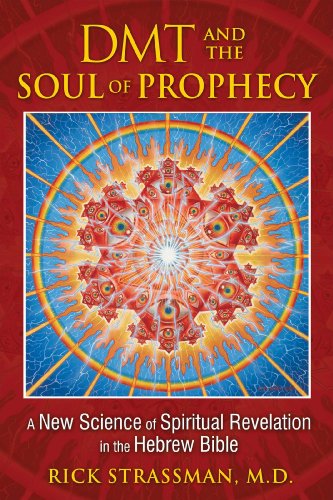
Synopsis
Naturally occurring DMT may produce prophecy-like states of consciousness and thus represent a bridge between biology and religious experience
• Reveals the striking similarities between the visions of the Hebrew prophets and the DMT state described by Strassman’s research volunteers
• Explains how prophetic and psychedelic states may share biological mechanisms
• Presents a new top-down “theoneurological” model of spiritual experience
After completing his groundbreaking research chronicled in DMT: The Spirit Molecule, Rick Strassman was left with one fundamental question: What does it mean that DMT, a simple chemical naturally found in all of our bodies, instantaneously opens us to an interactive spirit world that feels more real than our own world?
When his decades of clinical psychiatric research and Buddhist practice were unable to provide answers to this question, Strassman began searching for a more resonant spiritual model. He found that the visions of the Hebrew prophets--such as Ezekiel, Moses, Adam, and Daniel--were strikingly similar to those of the volunteers in his DMT studies. Carefully examining the concept of prophecy in the Hebrew Bible, he characterizes a “prophetic state of consciousness” and explains how it may share biological and metaphysical mechanisms with the DMT effect.
Examining medieval commentaries on the Hebrew Bible, Strassman reveals how Jewish metaphysics provides a top-down model for both the prophetic and DMT states, a model he calls “theoneurology.” Theoneurology bridges biology and spirituality by proposing that the Divine communicates with us using the brain, and DMT--whether naturally produced or ingested--is a critical factor in such visionary experience. This model provides a counterpoint to “neurotheology,” which proposes that altered brain function simply generates the impression of a Divine-human encounter.
Theoneurology addresses issues critical to the full flowering of the psychedelic drug experience. Perhaps even more important, it points the way to a renewal of classical prophetic consciousness, the soul of Hebrew Bible prophecy, as well as unexpected directions for the evolution of contemporary spiritual practice.
Les informations fournies dans la section « Synopsis » peuvent faire référence à une autre édition de ce titre.
À propos de l'auteur
Rick Strassman, M.D., author of DMT : The Spirit Molecule, and co-author of Inner Paths to Outer Space, lives in Albuquerque, New Mexico, and is Clinical Associate Professor of Psychiatry at the University of New Mexico School of Medicine.
Extrait. © Reproduit sur autorisation. Tous droits réservés.
Chapter 12 Perception
The preceding two chapters addressed physical and emotional aspects of the DMT and prophetic states. They have begun accommodating us to the notion that the two sets of experiences resemble each other to an impressive degree. Now I will consider perceptual properties: taste, touch, sight, sound, and smell. This chapter brings nearly overwhelmingly convincing evidence that the two experiences share profound phenomenological similarities.
Vision
The DMT effect and prophecy are extraordinarily visual. These features are the most numerous and detailed of any perceptual category, and for that matter, of any category of the syndromes’ phenomenologies. I will begin with darkness and proceed to colors and their characteristics.
Darkness
- DMT
Rex: It looked like it was in a field of black space (DMT 208).
- Prophecy
At the onset of Abraham’s vision: A great darkness fell upon him (Gen. 15:12). In the vision itself, the text qualifies the nature of the darkness: . . . and it was dense darkness . . . (Gen. 15:17).
View from High above Earth
Those in either the prophetic or DMT state refer to viewing things from great height.
- DMT
Philip: Then I was above a strange landscape, like Earth, but very unearthly (DMT 182).
- Prophecy
Ezekiel finds himself high above earth, but not in deep space: . . . a wind lifted me up between the earth and the heavens . . . (Ezra 8:3).
Clouds or a Cloud
We find accounts of a cloud or clouds--sometimes smoke or clouds of smoke--in both sets of altered states. In the Hebrew Bible, such images often occur in the context of God’s glory. Prophetic clouds frequently are fiery and occupy relatively well-demarcated space. They fill parts or all of the Tabernacle or Temple, and pillars of smoke and/or fire travel with the Hebrews in the wilderness. Clouds also are relevant to the notion of “emerging,” a process by which an identifiable image appears or takes shape out of a relatively amorphous visual matrix.
- DMT
Sean: There were bright yellow clouds I was floating through. As an example of emerging, Philip described a humanoid figure: . . .coming out of the clouds . . . .
- Prophecy
In the beginning of Ezekiel’s vision in Babylonia, by the Kevar River, he sees: . . . a great cloud with flashing fire and a brilliance surrounding it . . . (Ezra 1:4).
After dividing certain sacrificial items in half, Abraham’s vision begins with: . . . a smoky furnace and a torch of fire which passed between the pieces . . . (Gen. 15:17).
Moses receives the Ten Commandments on the top of Mt. Sinai where: . . . the mountain was burning with the fire up to the heart of the heavens, darkness, cloud, and thick cloud (Deut. 4:11).
Daniel witnesses the emerging phenomenon: I was watching in night visions and behold, with the clouds of heaven one like a man came (Dan. 7:13).
Flashes, Sparks, Fire: Equivalence of Imagery
The Hebrew Bible constantly refers to fire and fiery images, either by themselves or with clouds or smoke. While DMT volunteers rarely used the word “fire” to describe what they saw, images in the DMT state do flash, shoot off sparks, and are “fiery.” Many of the colors they described are common to fire--red, yellow, and orange.
It seems that the DMT volunteers and those experiencing Biblical prophecy may be calling by different names visual imagery that appears to be quite similar. This finding led me to the idea of “equivalence of imagery.” The same image receives a label consistent with that person’s psychological and cultural repertoire. This repertoire comprises the raw materials with which one constructs a notion of--and labels--what she or he sees. The research subjects and someone in a prophetic state both see red, yellow, and orange light that glows, shoots off sparks, and vibrates. Whereas DMT volunteers see much less fire in their lives than did nomadic and agricultural tribes from the ancient Near East, our Biblical figures never saw neon lights and Day-Glo paint. Thus the prophet sees “fire” while the research volunteers described more modern- day facsimiles.
- DMT
Mike was a married 30 year-old psychology graduate student, who during a session glimpsed: . . . a large orange-ish sphere, flaming, flashing, sparkling, but not on fire.
Seth described an example of the “emerging” phenomenon from a fiery background: Out of the raging colossal waterfall of flaming color expanding into my visual field . . . they stepped, or rather, emerged (DMT 344).
- Prophecy
David describes his vision: From out of the brilliance that is before [God] burned fiery coals (2 Sam. 22:13).
Similarly, Ezekiel notes: There was a brilliance to the fire, and from the fire went forth lightning (Ezra 1:13).
Daniel sees: [God’s] throne’s fiery flames, its wheels blazing fire (Dan. 7:9).
Beings themselves may be fiery. Ezekiel describes the Chayot he sees in his initial vision: Their appearance was like fiery coals, burning like the appearance of torches (Ezra 1:13).
A being emerges from fire at the onset of Moses’ initial theophany at the burning bush: An angel of YHVH appeared to him in a flame of fire from within the thorn bush (Exod. 3:2).
Ezekiel also reports something emerges: . . . a great cloud with flashing fire and a brilliance surrounding it, and from its midst came a semblance of Chashmal from the midst of the fire (Ezra 1:4).
Les informations fournies dans la section « A propos du livre » peuvent faire référence à une autre édition de ce titre.
Résultats de recherche pour DMT and the Soul of Prophecy: A New Science of Spiritual...

Image fournie par le vendeur
DMT and the Soul of Prophecy: A New Science of Spiritual Revelation in the Hebrew Bible
Edité par
Park Street Press, 2014
ISBN 10 : 1594773424
ISBN 13 : 9781594773426
Ancien ou d'occasion
Couverture souple
Vendeur : -OnTimeBooks-, Phoenix, AZ, Etats-Unis
Évaluation du vendeur 5 sur 5 étoiles

Etat : good. A copy that has been read, remains in good condition. All pages are intact, and the cover is intact. The spine and cover show signs of wear. Pages can include notes and highlighting and show signs of wear, and the copy can include "From the library of" labels or previous owner inscriptions. 100% GUARANTEE! Shipped with delivery confirmation, if you're not satisfied with purchase please return item! Ships via media mail. N° de réf. du vendeur OTV.1594773424.G
Acheter D'occasion
EUR 11,22
Livraison gratuite
Expédition nationale : Etats-Unis
Expédition nationale : Etats-Unis
Quantité disponible : 1 disponible(s)
Image d'archives
DMT and the Soul of Prophecy: A New Science of Spiritual Revelation in the Hebrew Bible
Edité par
Park Street Press, 2014
ISBN 10 : 1594773424
ISBN 13 : 9781594773426
Ancien ou d'occasion
Paperback
Vendeur : HPB-Diamond, Dallas, TX, Etats-Unis
Évaluation du vendeur 5 sur 5 étoiles
Paperback. Etat : Very Good. Connecting readers with great books since 1972! Used books may not include companion materials, and may have some shelf wear or limited writing. We ship orders daily and Customer Service is our top priority! N° de réf. du vendeur S_483890287
Acheter D'occasion
EUR 8,87
Expédition à EUR 3,23
Expédition nationale : Etats-Unis
Expédition nationale : Etats-Unis
Quantité disponible : 1 disponible(s)
Image fournie par le vendeur
DMT and the Soul of Prophecy: A New Science of Spiritual Revelation in the Hebrew Bible
Edité par
Park Street Press, 2014
ISBN 10 : 1594773424
ISBN 13 : 9781594773426
Ancien ou d'occasion
Couverture souple
Vendeur : Fables Books, Goshen, IN, Etats-Unis
Évaluation du vendeur 5 sur 5 étoiles
Etat : acceptable. Significant shelf, storage or usage wear present that does not affect the readability of the book. A former library book with all the expected stamps, stickers and markings. Cover reinforced in protective plastic, though most has peeled away from the rear cover. The pages appear unmarked. Hinges are partially separated. The binding is loose, but all pages are present. Pictures available upon request. Individually inspected by Shay. Thanks for supporting an independent bookseller! N° de réf. du vendeur FBV.1594773424.A
Acheter D'occasion
EUR 9,67
Expédition à EUR 2,59
Expédition nationale : Etats-Unis
Expédition nationale : Etats-Unis
Quantité disponible : 1 disponible(s)
Image d'archives
DMT and the Soul of Prophecy: A New Science of Spiritual Revelation in the Hebrew Bible
Edité par
Park Street Press, 2014
ISBN 10 : 1594773424
ISBN 13 : 9781594773426
Ancien ou d'occasion
Paperback
Vendeur : Books From California, Simi Valley, CA, Etats-Unis
Évaluation du vendeur 4 sur 5 étoiles

Paperback. Etat : Very Good. N° de réf. du vendeur mon0003818612
Acheter D'occasion
EUR 8,85
Expédition à EUR 4,30
Expédition nationale : Etats-Unis
Expédition nationale : Etats-Unis
Quantité disponible : 3 disponible(s)
Image d'archives
DMT and the Soul of Prophecy: A New Science of Spiritual Revelation in the Hebrew Bible
Edité par
Park Street Press, 2014
ISBN 10 : 1594773424
ISBN 13 : 9781594773426
Ancien ou d'occasion
paperback
Vendeur : Calliopebooks, Potomac, MD, Etats-Unis
Évaluation du vendeur 5 sur 5 étoiles
paperback. Etat : Very Good. Park Street Press. 2014. First Printing. Fine condition appears unread. Spine is smooth and not creased. N° de réf. du vendeur SKU1022138
Acheter D'occasion
EUR 11,10
Expédition à EUR 4,27
Expédition nationale : Etats-Unis
Expédition nationale : Etats-Unis
Quantité disponible : 1 disponible(s)
Image d'archives
DMT and the Soul of Prophecy : A New Science of Spiritual Revelation in the Hebrew Bible
Edité par
Inner Traditions International, Limited, 2014
ISBN 10 : 1594773424
ISBN 13 : 9781594773426
Ancien ou d'occasion
Couverture souple
Vendeur : Better World Books, Mishawaka, IN, Etats-Unis
Évaluation du vendeur 5 sur 5 étoiles
Etat : Good. Former library copy. Pages intact with minimal writing/highlighting. The binding may be loose and creased. Dust jackets/supplements are not included. Includes library markings. Stock photo provided. Product includes identifying sticker. Better World Books: Buy Books. Do Good. N° de réf. du vendeur 8081258-6
Acheter D'occasion
EUR 15,92
Livraison gratuite
Expédition nationale : Etats-Unis
Expédition nationale : Etats-Unis
Quantité disponible : 1 disponible(s)
Image d'archives
DMT and the Soul of Prophecy: A New Science of Spiritual Revelation in the Hebrew Bible
Edité par
Park Street Press, 2014
ISBN 10 : 1594773424
ISBN 13 : 9781594773426
Neuf
Couverture souple
Vendeur : Lakeside Books, Benton Harbor, MI, Etats-Unis
Évaluation du vendeur 5 sur 5 étoiles
Etat : New. Brand New! Not Overstocks or Low Quality Book Club Editions! Direct From the Publisher! We're not a giant, faceless warehouse organization! We're a small town bookstore that loves books and loves it's customers! Buy from Lakeside Books! N° de réf. du vendeur OTF-S-9781594773426
Acheter neuf
EUR 13,46
Expédition à EUR 3,44
Expédition nationale : Etats-Unis
Expédition nationale : Etats-Unis
Quantité disponible : 1 disponible(s)
Image d'archives
DMT and the Soul of Prophecy: A New Science of Spiritual Revelation in the Hebrew Bible
Edité par
Park Street Press, 2014
ISBN 10 : 1594773424
ISBN 13 : 9781594773426
Ancien ou d'occasion
Paperback
Vendeur : Books From California, Simi Valley, CA, Etats-Unis
Évaluation du vendeur 4 sur 5 étoiles
Paperback. Etat : Fine. N° de réf. du vendeur mon0003818966
Acheter D'occasion
EUR 13,33
Expédition à EUR 4,30
Expédition nationale : Etats-Unis
Expédition nationale : Etats-Unis
Quantité disponible : 1 disponible(s)
Image d'archives
DMT and the Soul of Prophecy Format: Paperback
Edité par
Simon and Schuster, 2014
ISBN 10 : 1594773424
ISBN 13 : 9781594773426
Ancien ou d'occasion
Couverture souple
Vendeur : INDOO, Avenel, NJ, Etats-Unis
Évaluation du vendeur 5 sur 5 étoiles
Etat : As New. Unread copy in mint condition. N° de réf. du vendeur SS9781594773426
Acheter D'occasion
EUR 18,16
Livraison gratuite
Expédition nationale : Etats-Unis
Expédition nationale : Etats-Unis
Quantité disponible : Plus de 20 disponibles
Image d'archives
DMT and the Soul of Prophecy Format: Paperback
Edité par
Simon and Schuster, 2014
ISBN 10 : 1594773424
ISBN 13 : 9781594773426
Neuf
Couverture souple
Vendeur : INDOO, Avenel, NJ, Etats-Unis
Évaluation du vendeur 5 sur 5 étoiles
Etat : New. Brand New. N° de réf. du vendeur 9781594773426
Acheter neuf
EUR 18,26
Livraison gratuite
Expédition nationale : Etats-Unis
Expédition nationale : Etats-Unis
Quantité disponible : Plus de 20 disponibles